
Middle-schoolers reinvent the farm for Future City life
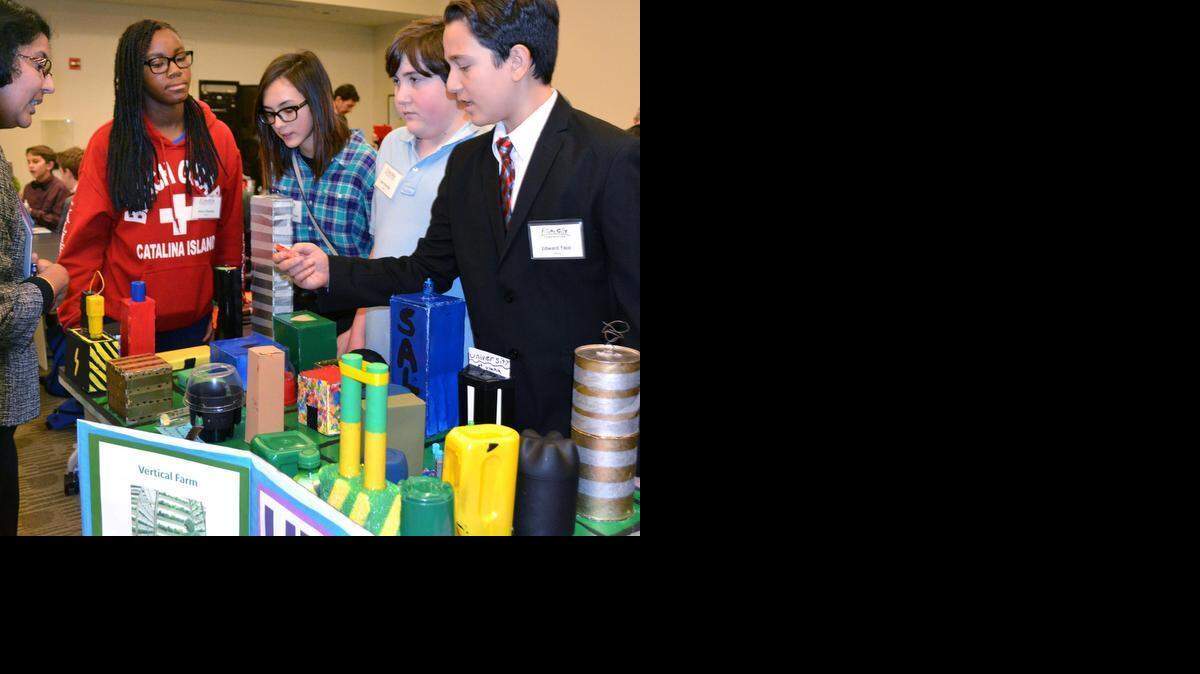
The future looks bright for urban farming, full of skyscrapers laden with veggies and smog-free renewable energy. Cows graze in a giant greenhouse, fertilizing at will, every whiff of methane captured to produce electricity. Hunger is history. Recycling is second nature, and stadiums get top billing.
Such options sit just a tantalizing moment away for sixth-, seventh- and eighth-grade Future City planners competing at the Northern California championship Saturday at California State University, Stanislaus.
“The imagination and the creativity – there are a few things I could learn from them, ideas on pollution and recycling,” said judge Viji Gururajan, an IT systems project manager from Sacramento. The middle schoolers’ work is unencumbered by worries about financing, liability insurance or political roadblocks, she mused.
“For them, it’s just the idea, and they want to bring it out to the world,” Gururajan said.
Those ideas come from creating a virtual city using SimCity software, researching for an essay about solving a problem, creating an oral presentation, and building a model city using recycled or very cheap materials.
Eighth-graders on the La Loma Junior High team from Modesto used a tennis-ball can, cut up shoe boxes and green pipe cleaners. Painted Styrofoam peeled back created a rocky beach, and black duct tape made roads. A long forgotten Lego set re-created the famed Ferry Building as a farmers market.
Team member Isaac Walters launched into the virtues of a nutritious cross of kidney beans and spinach called the Spidney Bean and a Golden Gate Lock system for the San Francisco Bay. After catastrophic earthquakes, the team’s vision for a reinvented city by the bay includes energy generated by wind, waves, solar panels and buoyancy turbines – a budding technology that Isaac improved for the project.
The tough part for him, Isaac said, “was memorizing our lines. It’s hours and hours of going over the same thing. It’s so menial.”
For teammate Carter Neumann, the challenge came in laying out the existing San Francisco street grid as a basis. New, however, is a bay-side stadium – the 49ers are back. “It was really cool to listen to all the future technology that we could incorporate now, in 2015,” Carter said.
For example, in the future San Francisco, coe salmon are farmed under docks in the bay that recycle fish waste to fertilize intensive plantings above. The financial district has sprouted greenery grown at every story without soil, the roots nurtured by nutrient rich sprays – “aeroponics,” explained teammate Lars Paulsen.
Turlock Junior High’s city of Utopia team focused on sparkling skies. “I’m most proud of what we did for pollution, making clear air to breathe – not like right now,” said Starr Charles.
Buildings that create wind energy using man-made tornadoes were the best idea, said teammate Joey Perrella. Edward Yaco liked building the model, especially the dual sports stadium for simultaneous soccer and football games.
“Cooperative skills, patience, sharing ideas, friendship” – Edward’s mom Ramona Yaco, watching from the sidelines, ticked off benefits of the program she saw. “He has so many ideas. Look at how comfortable he feels presenting in class,” Yaco said, adding the program may have changed his life. “I feel like he’s going to be up there – a senator, in the House of Representatives, an engineer making things better for everybody.”
Several Turlock Junior High teams, one from Denair Middle School and a sixth-grade team from Virginia Parks Elementary in Ceres were among the 38 teams competing Saturday. San Jose was well-represented. Students from Santa Rosa came up with the domed pasture idea, capturing cattle’s (ahem) emissions to power generators and create fertilizer.
All had their eyes on making the national competition in Washington, D.C., and a shot at a trip to U.S. Space Camp in Huntsville, Ala. The winning team also takes home $7,500 for their school or organization’s science, tech, engineering and math programs. Runners-up take back $5,000 for second place, or $2,000 for third.
Some 25 other prizes also capitalize on the chance to aim bright young minds to the tasks of engineering a better world. Among them, the American Society of Agricultural and Biological Engineers sponsors the Most Sustainable Food Production System award. Electrical engineers prize the Best Communications System, and nanotechnologists applaud innovations for the teeniest tech. Paralyzed Veterans of America give the Accessible City Award.
The competition leads up to National Engineers Week, Feb. 22-28, and has heavy participation from local engineers.
Civil engineer Tom Esch of San Jose, a Saturday volunteer whose son was competing, said he likes the way the contest gets the kids away from video games. “Really, the thing about it is there’s a lot of creativity,” Esch said.
Three Stanislaus teams advanced to the final round in Saturday’s competition. First place was captured by Gratton School seventh-graders, with student presenters Stephanie Temnyk, Kendall La Rosa and Matthew Reis coached by Rexann Jenson and mentored by Troy Gravatt.
Modesto’s La Loma team came in second, and in fourth place was HiMAP STEM Academy, an extracurricular program through California State University, Stanislaus.
Bee education reporter Nan Austin can be reached at naustin@modbee.com or (209) 578-2339. Follow her on Twitter @NanAustin.
This story was originally published January 24, 2015 at 9:03 PM with the headline "Middle-schoolers reinvent the farm for Future City life."