
Ceres families seek success on Stanislaus State tour
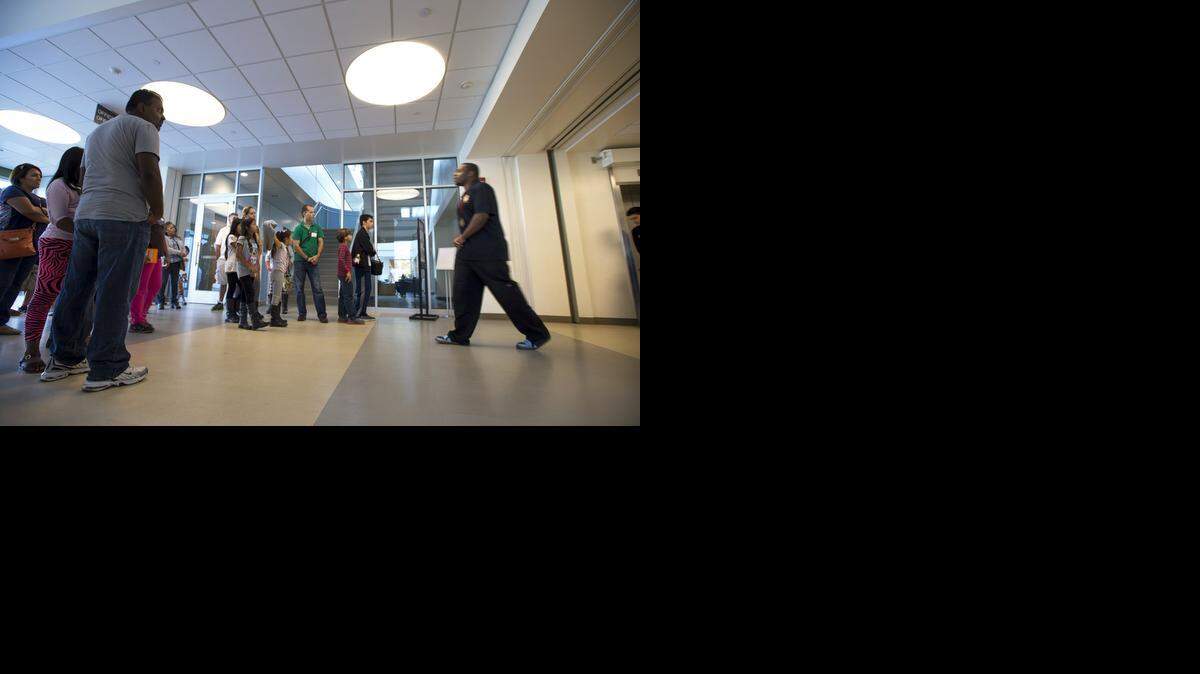
Three busloads of Ceres families toured California State University, Stanislaus, walking the tree-lined paths and seeing opportunity around every corner.
“We’re here because the school is open and he can get the experience, get the sense of being at a university,” said Eva Martinez, who came Saturday with her 8-year-old son Yangel. Yangel, a fourth-grader at Walter White Elementary, already has a piggy bank dedicated to saving for college, but Martinez knows it takes more than pennies to get there.
“He needs a 3.0 (grade-point average) for the university (of California). I wish I had known what to do,” she said. Martinez went back to school and is one class away from her bachelor’s degree at Brandman University.
Ceres Unified provided the buses, bringing participants in Parent Institute for Quality Education classes at Lucas, Sam Vaughn, Caswell and Walter White elementary schools, and Blaker-Kinser Junior High to the Turlock campus.
PIQE (pronounced “pea-kay”) trains parents to help their children succeed, said Visalni Prasad. “We weren’t told by our parents and grandparents how to get to college,” she said. “There are these steppingstones to get you there. They simplify everything.”
“PIQE gives you an introduction to the ins and outs of school systems and what it takes to make the decision to go to college,” said Susanna Loza. Loza brought her 6-year-old, Isabella Toledo, a first-grader at Lucas Elementary who hopes to be a veterinarian.
“I’m second-generation in this country. My parents never had the opportunity to go to school at all. I’m the only one in my family to have gone to college, and I want her to have that, to go to college,” Loza said.
Lead tour guide Jerrelle Wilson said the PIQE visits aim to give an overview of higher education, not just Stanislaus State. “We’re trying to get the parents to understand we want their kids to go to college – maybe not this college, but college in general,” he said.
That starts with knowing what classes to take in high school, why grades matter and which pre-college tests to take. Parent support counts after students get into the university, too, Wilson said. “I see a lot of kids going to college alone. This is a way to get their families involved,” he said.
Student guides, most of whom are fluent Spanish speakers, led groups around the campus, ending with a discussion of smart moves for high school years and how to get financial aid, with parents and children seated in a typical college lecture hall.
The guides work with the Stanislaus State Admissions and Outreach office. They make presentations at schools, man information tables, travel to health fairs and step up for career fairs, said bilingual guide Johnathan Jiminez.
That Spanish-friendly outreach is one facet of the Turlock university’s appeal to Latino students. In a study released last month, BestColleges.com ranked Stanislaus State 25th in the nation for serving Hispanic students, who make up 41 percent of its enrollment.
“Many Hispanic students are the first in their families to attend college, so it is important for them to choose the right school – one with a support system that will help them navigate degrees, financial aid, and their school and social obligations,” BestColleges.com said in notifying the university of its ranking.
Saturday’s tours included stops outside the Mary Stuart Rogers administrative building and student bookstore, the Vasche Library with its tutoring center and computer labs and the eco-friendly Naraghi Hall of Science.
Guide Terrance Sims pointed out staircases on classroom building exteriors, a Stan State hallmark. “The fall of every year you see people inside turning around in circles trying to find (the stairs),” Sims said with a laugh.
Other tour notes: The university has a 21-to-1 student-teacher ratio, the campus has seven ponds and separate gyms for athletic teams and general fitness.
But parents were most interested in the dorms. “Do you allow alcohol?” “Is there a curfew?” “Girls live in a separate building, right?”
Sims had answers: Only residents over 21 can have alcohol and only in their bedroom, not any common areas. There is quiet time starting at 11 p.m., but no curfew. Dorm suites have just women or just men, but next door can be a different gender.
“The Hispanic culture is very traditional. Dads don’t want their daughters going to wild places,” said Amanda Rodriguez, a Walter White teacher who graduated from the Stan State credential program in 2012. Rodriguez laughed, but Sims took pains to explain dorm rooming arrangements, pricing and social activities.
“We try to talk about everything,” Wilson said.
Bee education reporter Nan Austin can be reached at naustin@modbee.com or (209) 578-2339. Follow her on Twitter @NanAustin.
This story was originally published November 8, 2014 at 7:36 PM with the headline "Ceres families seek success on Stanislaus State tour."