
Modesto City Schools part of state panel on budgeting
California’s makeover for school funding has had its rough patches, including a tortuous reporting form and a lot less money than most people think. But Modesto City Schools and Calaveras Unified School District have signed on to be part of the solution.
The two are among 17 selected from California’s nearly 1,000 districts and county offices for a statewide panel to find ideas that worked and suggest improvements to the Local Control Funding Formula and its community input piece, the Local Control Accountability Plan.
The LCFF Collaborative Working Group, created by the California School Boards Association and nonprofit California Forward, had its inaugural meeting last month. The group spans massive districts from Southern California and the Bay Area to rural districts from the north state. Modesto City, with just under 30,000 students, ranks as midsize. Calaveras Unified, with 3,082 kids, added a voice for smaller districts.
“It’s basically to work together to find out what are our success stories and what were the challenges in doing our LCAPs this first year,” said Modesto City Schools Board President Cindy Marks. Marks attended the meeting with Associate Superintendent Ginger Johnson.
“It was a long day, but a great day,” Marks said. “We broke up into smaller groups and got to hear the challenges that we all faced, and how do you overcome those,” she said. The new funding formula, new community budgeting model and instructional shifts all went into effect this year, she noted.
“It went beyond anybody’s expectation of what this would take this first year,” she said. “It’s all new. No one has done this before, and figuring it out takes a lot of energy and time.”
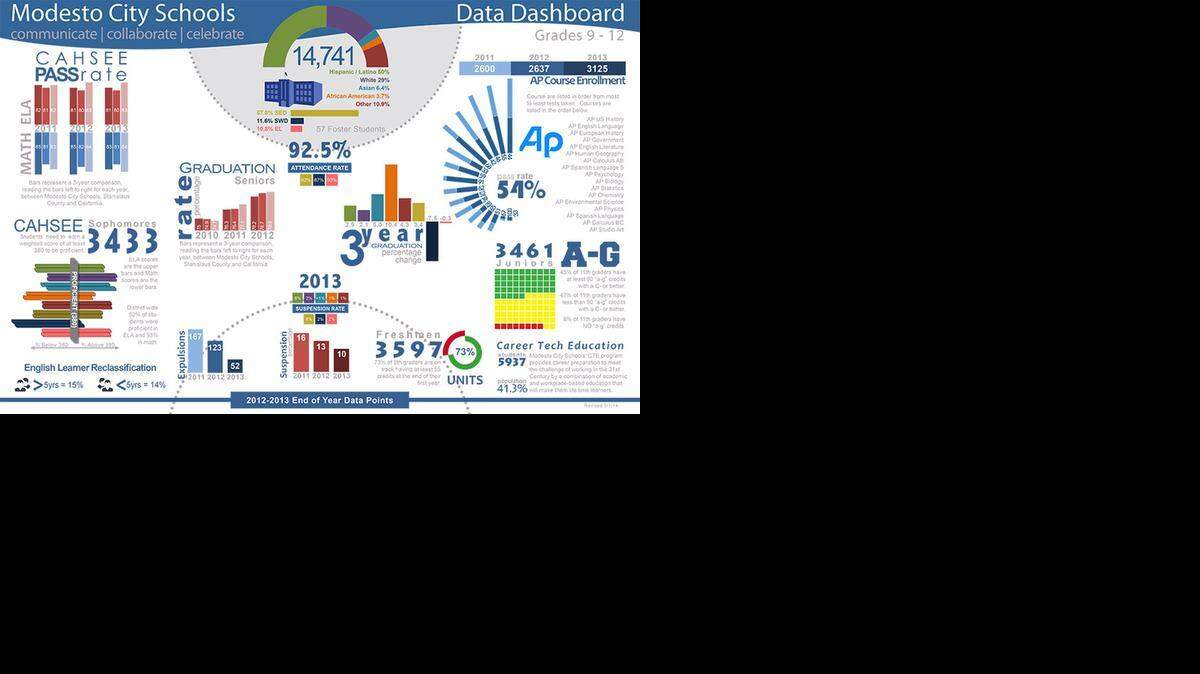
Modesto’s contributions included its online graphic showing student test scores, high school exit exam pass rates and other key achievement measures. “Our Data Dashboard is a model for other areas to use, to be able to inform the public about the needs and the successes,” Marks said.
Johnson developed the Data Dashboards, in part to help manage expectations, she said. “Transparency was a huge part for every district,” Johnson said, with a collective headache from trying to explain costs tied to state and federal programs and mandates. “Even if you get more money, if it’s eaten up in a hundred different ways, you really don’t have very much,” she said.
Modesto, with its high numbers of poor and English-learning students, will get a great deal more money under the new formula, but not immediately. The funding level rises over several years.
“There’s a mistaken perception that districts have lots more money,” Johnson said, “and why couldn’t we be doing it all? … LCAP is not only about identifying your needs, it’s prioritizing your needs. We can’t have everything that everyone wants.”
Ideas she took back from the session included one from Riverside Unified, which had great success with an outside firm, she said. “People weren’t talking to the school district. It established an air of trust and professionalism because you took the school district out of it.”
Another district had students lead every public input session. “Because students led it, more people attended, they felt, and also it changed the conversation. People were less apt to get angry, and it kept the conversation focused on the students,” Johnson said.
One thing every district agreed on was a need to revise the LCAP reporting form. Even with recent revisions, the table-formatted lists are cumbersome to write and difficult to read, said Calaveras Superintendent Mark Campbell, who attended with a school board member.
“I’d like to see the LCAP template encompass the (federally required) Single Plan for Student Achievement, the (state-required) Technology Plan – any plan the state requires – be all in one,” Campbell said. “The LCAP template, the way it is now, feels like a checklist for compliance.”
Calaveras Unified will get more money under the new funding formula, but not enough to cover an ongoing deficit that will force the district to find $2 million in cuts for the coming year, Campbell said. On the table are either salary cuts or layoffs of teachers, and the possibility of closing three very small schools, he said.
With a declining student base and lower funding through the recession, the added funds do not mean extra programs for kids in his district. “We’re just playing catch-up,” he said.
But even with those tough community discussions, Campbell likes the LCAP’s focus on student achievement. “We’ve established a good foundation to grow upon,” he said.
The working group will meet for three years, offering support and ideas through the transition, Johnson said. “It’s very, very obvious to everyone in that room that we can’t educate the way we did. Kids in second grade now will graduate in 2025 and the world is going to be very different, and we need to get them ready for that,” she said.
Every district is scrambling, she said. “No change ever happens without chaos and conflict. We’re trying to manage that to move forward, but I do feel we’re in it.”
Bee education reporter Nan Austin can be reached at naustin@modbee.com or (209) 578-2339. Follow her on Twitter @NanAustin.
This story was originally published November 7, 2014 at 8:07 PM with the headline "Modesto City Schools part of state panel on budgeting."