
Modesto world religions course recognized in new book, state resolution
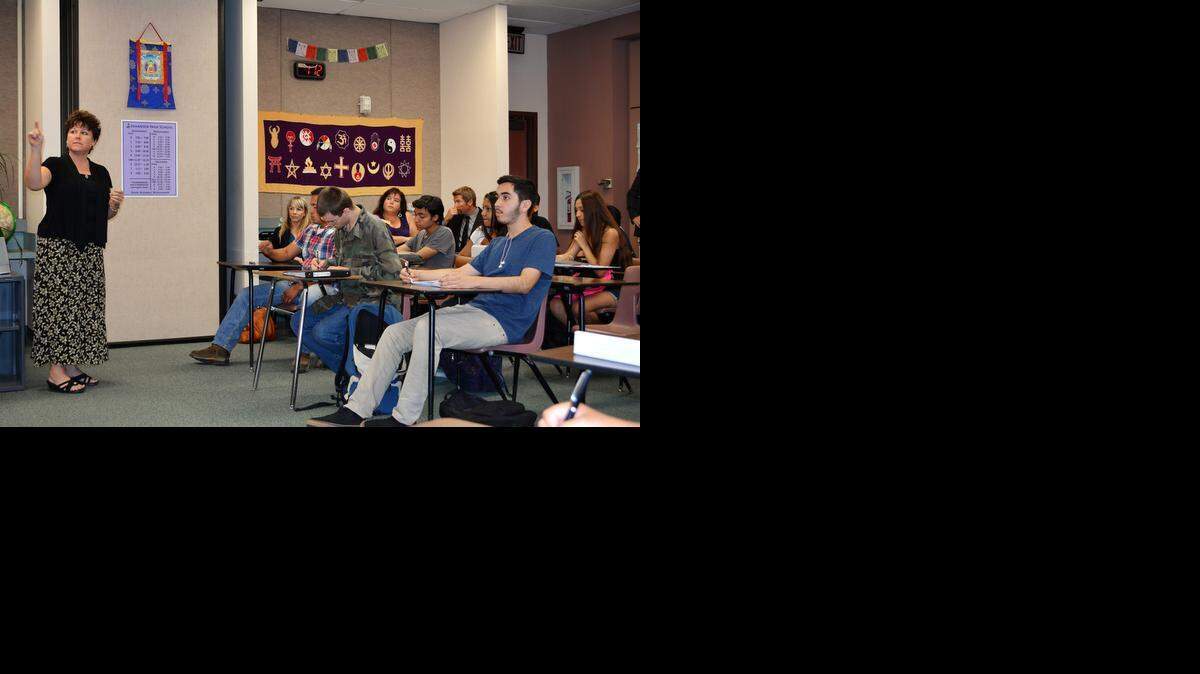
As religious violence flares, Modesto City Schools’ course in world geography and religions finds itself in the spotlight once again, included in an upcoming book and the subject of a freshly passed Capitol resolution.
The district is believed to be the only public school district in the nation to require a class on religions. The respect-focused course, developed with community input, was thrust into the spotlight following the Sept. 11, 2001, attacks, one year after its September 2000 implementation.
It will be included in “Faith Ed: Teaching Religion in an Age of Intolerance,” due out in 2015 from Beacon Press. Author Linda K. Wertheimer visited Johansen High earlier this year for her research.
California Assembly Concurrent Resolution 154 applauds the course for its effectiveness against bullying of Sikh children and other faith groups, and recommends it be considered by school districts statewide.
The measure will be presented to the Modesto City Schools board on Sept. 29. Authored by Assembly members Adam Gray, D-Merced, and Kristin Olsen, R-Riverbank, and state Sens. Anthony Canella, R-Ceres, and Cathleen Galgiani, D-Stockton, the resolution passed both chambers in August.
Beyond the accolades stands a growing citizenry that is more informed and respectful, board President Cindy Marks said. “I believe our students have a much better grasp of world events.”
Pointing to past research, Marks said, “When they finish, they had more understanding of their own faith and became much more tolerant of other faiths. They had a better understanding of cultural issues, even than adults. That, to me, was one of the greatest points.”
Board member Steve Grenbeaux said his daughter took the course. “She was raised in a Christian home, so divergent religious thought was new to her. It made for some interesting dinner conservations,” Grenbeaux said.
Johansen High junior Arianna Sibaja said the course helped her get past stereotypes of other religions and have a more informed view of events unfolding in the Middle East. “It helps us understand why it’s going on and what their motives are,” Sibaja said.
“Some students base their views on religion off things they might have heard, or seen on the news, but that class really took the gray area out of assumed beliefs,” said Downey grad Aaron Zwahlen, son of board member Sue Zwahlen.
At Johansen High, Sherry McIntyre teaches only that course. Classes at every high school in Modesto will switch over the next few weeks from geography lessons to learning about Judaism, Christianity, Islam, Hinduism, Sikhism, Buddhism and Confucianism.
In an introductory lecture, McIntyre stressed the importance of respecting all views, even those that reject religion. “We’re not talking about agreement. We’re talking about honoring the right,” she said. Gesturing around the class, she said, “We are not a cookie-cutter-looking room in here, neither is the state, neither is the world.”
McIntyre dissected the First Amendment, going over each clause. “You have the right to complain. There are some countries in the world where this is not OK,” she told the class.
She touched on Roger Williams, a Puritan preacher who formed Rhode Island, the first colony to allow free practice of any religion. “That was shocking,” she said. People of all faiths flocked there “because it was safe,” she said.
“This is a very special class. We’re very careful in teaching it. We’ve never had a complaint or a lawsuit,” she said after class. The course textbook is the Usborne Encyclopedia of World Religions, which combs methodically through each religion, listing how its practitioners worship, its symbols, a synopsis of key beliefs and a thumbnail sketch of its history.
‘Knowledge is the key’
The course came from a convergence of three issues, those instrumental in creating it said: egregious bullying, Sikh students carrying religious daggers and history teachers discussing students’ lack of geography skills and understanding of other religions.
In 1996, longtime Superintendent James C. Enochs was shaken by the story of a gay youth’s harassment. “You’d have to have a heart of stone not to be moved by reports of their son’s daily treatment,” he later said. His outrage led to a district policy adopted in 1997 entitled “Principles of Tolerance, Respect and Dignity to Ensure a Safe School Environment.”
Critics of the policy, who saw it as promoting gay lifestyles, brought to light student concerns about respect for their conservative religious beliefs.
Another controversy of the day swirled around devout Sikhs who wear small ceremonial daggers called kirpans, a practice that conflicted with school rules on knives. Modesto schools worked out a compromise, allowing kirpans sewn into an inner lining of the students’ clothes and kept private, Marks said.
But pressure to teach creationism did not figure in creating the course, said Jennie Sweeney, who developed the curriculum with colleague Yvonne Taylor. “Urban legend,” Sweeney said last week with a definitive shake of her head.
“We were revising the course outlines for various courses,” said Sweeney, who now teaches advanced placement classes at Johansen. “There were two problems kids always seemed to have, geography and religion,” she said. The group proposed a one-semester geography and world religions course to pair with the one-semester health class required of freshmen.
They invited religious leaders from the community to weigh in. “That was instrumental,” she said. The First Amendment Center and Anti-Defamation League gave assistance in teaching sensitive subjects without controversy.
Teachers visited the Islamic Center of Modesto, Congregation Beth Shalom Synagogue, the Greek Orthodox Church and other religious centers. But teacher training was done by professors of California State University, Stanislaus – purposely removed from faith practitioners, she said.
“We’re not learning how to do it,” Sweeney said; they were learning how to teach it.
There is an opt-out form, she said, but only a handful out of roughly 45,000 students who have gone through Modesto high schools since 2000 have used it.
“We have support of the religious community. They take back to their congregations that we want safe schools, we want all our students to be respected and protected. Knowledge is the key to that,” Sweeney said.
Knowledge was the crux of the matter for Enochs, the retired administrator said via email: “As a former history teacher, I was convinced that a knowledge of the world’s great religions was an essential part of every person’s education, which was the charge to the committee that developed the course.”
A model for the nation
Marks and her panel colleagues voted unanimously to adopt the course May 8, 2000. “The room was packed that night, of course. But everyone that spoke that night, that I remember, was very positive,” Marks said.
After the Sept. 11 attacks, ABC News featured the course and Modesto’s character education program in a segment that aired in January 2002, including interviews of students and teachers at Johansen High.
Freedom Forum scholar Charles Haynes wrote at the time: “If we’re going to move forward as one nation of many faiths, we’ll need more districts like Modesto. We’ll need schools that teach us about one another – and instill the civic virtues that sustain our democracy.”
A First Amendment Center-funded study released in May 2006, titled “Learning About World Religions in Public Schools,” recommended the Modesto course as a model. Its authors were Emile Lester, a government professor at The College of William and Mary in Williamsburg, Va., and Patrick Roberts of Stanford University.
Stephen Prothero, chairman of the religion department at Boston University, included the Modesto class in his 2008 book “Religious Literacy: What Every American Needs to Know – And Doesn’t.”
This story was originally published September 14, 2014 at 11:37 PM with the headline "Modesto world religions course recognized in new book, state resolution."