Modesto refugee student finally allowed to play football. What was the holdup?
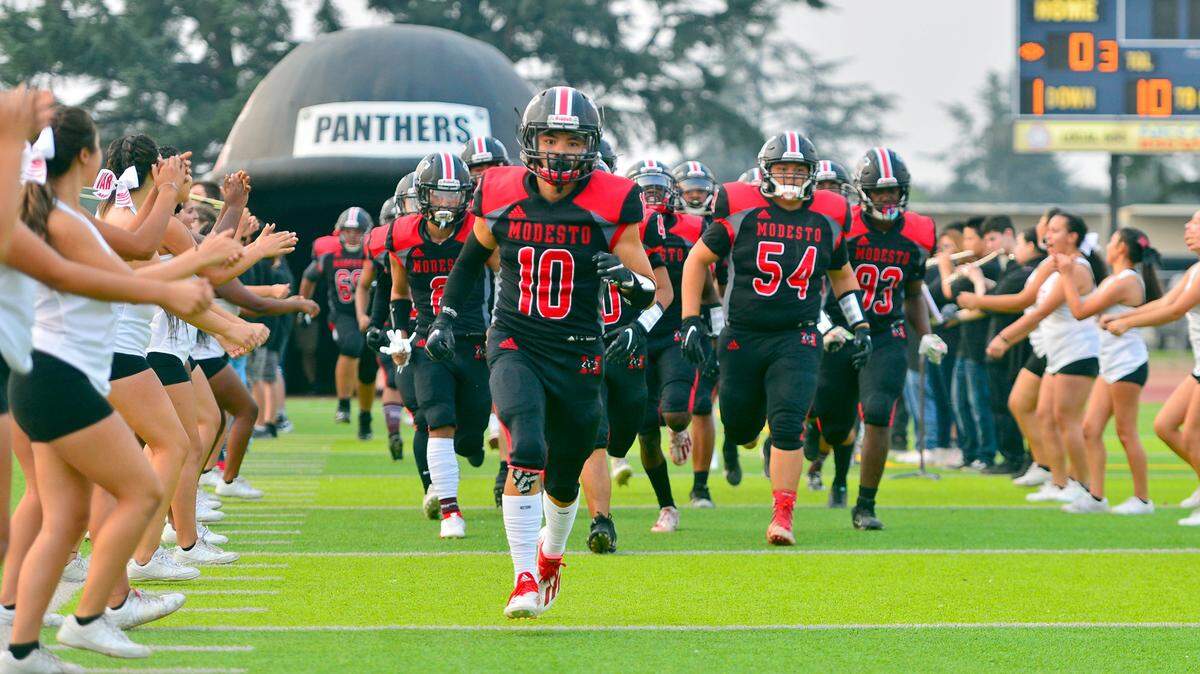
The California Department of Education is investigating a California Interscholastic Federation policy after a Modesto High School refugee student from Colombia was initially deemed ineligible to play football after refusing to provide immigration documentation.
CIF, the governing body for high school sports in the state, requires an international transfer student to provide a visa, translated copy of his or her transcripts and an affidavit from the school and family verifying other details regarding the student’s eligibility.
This is to verify a student’s age to ensure that over-age professional international student athletes are not being recruited. Students cannot participate in sports if their 19th birthday is prior to June 15 of the following school year.
As of Tuesday, the student has been cleared to participate after a number of meetings and a letter to the CIF written by the Modesto City Schools superintendent. But the case has raised questions about the CIF’s rules and their accordance with state law, specifically with AB 699 and AB 1327, which bar requiring students to disclose immigration status or related documents.
A letter was drafted by Lindsey Bird, an education leadership coach for Teach Plus California, and addressed to Attorney General Rob Bonta and State Superintendent Tony Thurmond. It is signed by over 60 individuals, including Modesto City Schools Superintendent Vanessa Buitrago and City Councilmember Chris Ricci.
The letter urges the offices to act immediately to ensure the CIF fully complies with state law by issuing formal guidance that CIF rules follow AB 699 and AB 1327. It also calls for investigations of noncompliance to protect immigrant and refugee students’ rights and for collaboration with CIF leadership to implement training and oversight that prevent discrimination and remove financial barriers to participation.
“Athletics are not a privilege reserved for a few — they are a critical part of student development, belonging, and wellness,” the letter reads. “For immigrant and refugee students, access to sports can be one of the most important ways to build community, improve mental health, and succeed academically. To deny these students equitable access is to deny them an essential part of their education.”
The Attorney General’s Office said it cannot comment on, or even confirm or deny, any potential or ongoing investigations, in order to protect their integrity.
What is CIF’s policy?
According to CIF bylaws, students transferring from other countries who are not part of an approved foreign exchange program are generally processed under the same eligibility rules as any student transferring between schools within California.
A school’s athletic director collects information about the student and submits it to CIF, which determines eligibility. Hardship waivers may be granted in certain circumstances, such as students coming from war-torn areas or experiencing family hardship like divorce or a forced relocation.
“We do what we can for kids to get eligible,” said Will DeBoard, assistant commissioner of the CIF Sac-Joaquin Section.
Students coming from other countries require more documentation because the education system in which they may be transferring from may be different to the ones in the U.S. and so there needs to be a way to determine a student’s grade and age.
DeBoard said if a student is unable to present everything on the list, a letter can be submitted explaining why. A majority of international students who provide their documents get cleared, DeBoard said.
“It has nothing to do with how they got here,” he said.
Of the 168 requests for waiver of CIF rules for foreign students in the Sac-Joaquin section, only five were denied in the past year.
Brian Seymour, associate executive director of the CIF state office, said each student is handled differently. He said the CIF recognizes that some students don’t have all their documents, so the sections work with the schools to determine the students’ eligibility.
All the CIF really needs is any kind of transcript or documentation indicating the age of a student to make sure the requirements are met, he said. The school and the section therefore then have to work together to determine the student’s age to the best of their ability.
“It’s not about citizenship or immigration enforcement constraints,” Seymour said. “It’s procedural requirements to ensure fair athletic participation.”
Modesto City Schools said the athletic director contacted the CIF Sac-Joaquin Section for guidance, was given instructions, and followed them. The district added that it has remained in communication with the section regarding the process for determining a student’s athletic eligibility.
“We have confirmed on multiple occasions that we followed the correct process prescribed by the CIF-SJS. Additionally, the school provided letters of support to the CIF for the student,” said district spokesperson Sharokina Shams.
Buitrago, in a statement to The Bee, said the district does not ask students for their immigration status, and if district staff become aware of their status, they don’t share that information with outside agencies.
“We can affirm that students belong in school and in activities that meaningfully engage them — including sports. We do not agree with policies or practices that prevent this,” Buitrago stated.
She said the district is compelled to adhere to CIF rules so that the eligibility of its students is not in jeopardy.
“However, we do not agree with CIF’s ‘international student’ classification for students who are immigrants, refugees or asylum seekers, and we recognize that this particular CIF practice and policy do not align with state law. This is an exclusionary rule, and that is disappointing,” Buitrago added.
Potential violation of law
AB 699, passed in 2017, protects students from discrimination based on immigration status and bars schools’ collection of immigration information. The law also strengthened protections by prohibiting discrimination, harassment, intimidation or bullying based on immigration status and by adding immigration status to the definition of a hate crime.
Xilonin Cruz-Gonzalez, deputy director of Californians Together, which provides resources and guidance to help schools implement the policy and support immigrant students, said school districts should keep staff informed and provide training on their legal responsibilities.
“For students, often extracurriculars [and] other activities are really what bring them and pull them into school,” Cruz-Gonzalez said. “I would hope that our systems are being developed to really encourage students to participate in programs like athletics.”
AB 1327 requires the CIF to report on its accountability and evaluation activities to the Legislature and make itself available for hearings. It mandates the state and participating schools to track, report and post incidents of racial discrimination, harassment or hazing at high school sporting events.
Seymour said that law doesn’t really apply to immigrant students as it’s more related to racial discrimination and harassment at sporting events.
A new hurdle?
DeBoard said this is not a new policy with CIF. However, teachers and former newcomer students at MCS said this was never an issue when trying to enroll into sports in the past.
Evet Youkhana moved to Modesto from Iraq when she was 15 years old, graduating in 2017.
Youkhana said in order to play tennis at Davis High School, all she had to do was fill out an application, do the physical exam and maintain a good GPA. She said she didn’t have any issues with verifying her age because her dad had all the documents necessary. Everything was able to get done in one day.
“I was never asked for anything else,” Youkhana said.
Valantina Rashoo, another former newcomer student who graduated from the district in 2017, played tennis during her junior and senior years. She said she doesn’t recall being asked for any immigration paperwork or transcripts from her previous school.
“We were able to sign up just like any student and we’re eligible to play and compete with other schools,” Rashoo said.
Amelia Herrera, a language institute classroom teacher at Davis High School who also signed the letter, said this is the first time she’s heard of students being required to provide visas, at least at her school.
“That’s like a new beast,” Herrera said.
She noted that newcomer students face additional challenges in joining sports, including language barriers, lack of medical insurance, transportation issues and navigating paperwork.
Coaches often don’t proactively reach out, so if sports opportunities are announced, students with limited English may not understand that they can participate. She said it’s often up to the teachers to connect students who seem interested in sports with coaches.