Stanislaus State facing $8.1 million in permanent cuts in wake of proposed California budget
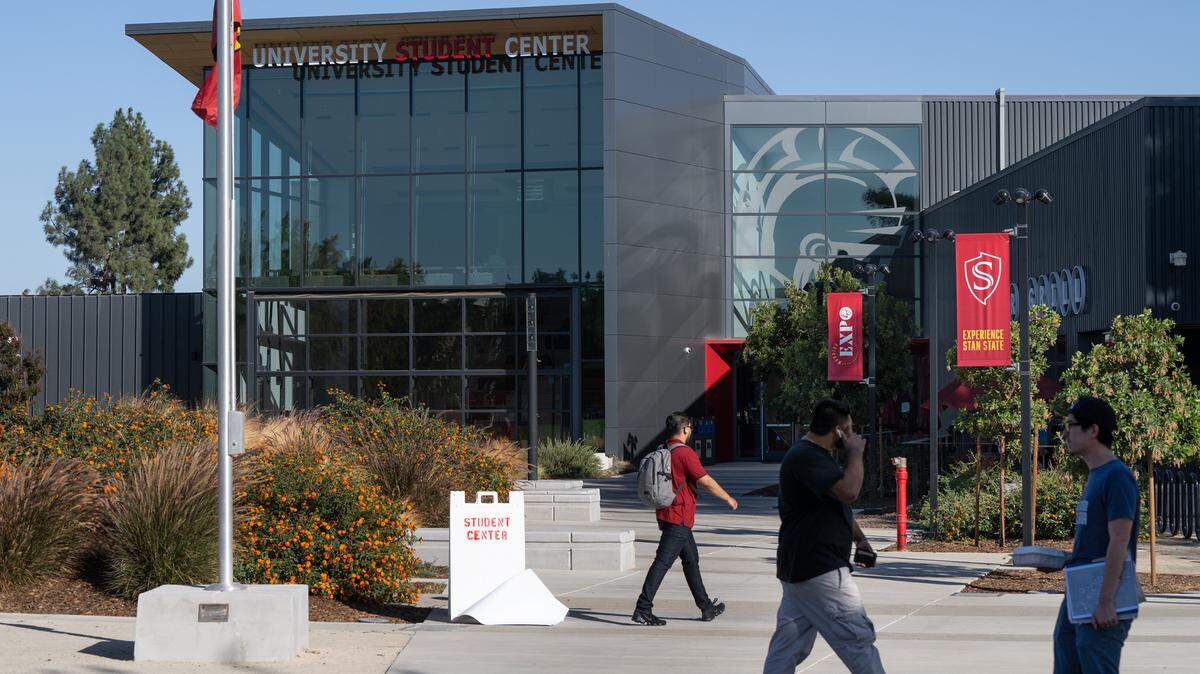
Faced with having to cut its 2025-26 budget by $8.1 million, Stanislaus State has taken steps including early-retirement incentives for staff, adjusting course schedules and reducing energy and supply costs. A faculty spokesman warned that the deep cuts could have “catastrophic consequences” for students.
Rosalee Rush, the senior associate vice president of strategic communications and marketing, said the school is aware how the budget cuts will have significant real-world consequences and impact classroom experiences.
“While we are taking thoughtful measures to mitigate the impact of these cuts—such as limiting spending to essential needs and identifying efficiencies across the entire institution—we remain focused on protecting our core mission: providing a high-quality education and critical support services for our students and ensuring that our stellar graduates fulfill the regional workforce and professional needs of the Central Valley.”
These cuts will affect all 23 campuses in the California State University system as there is a proposed $375 million, or 8% reduction in state funding.
Rush said the university has been proactive in its approach to addressing potential budget savings.
The university so far has added a voluntary separation incentive program where staff can retire early. It also has reduced energy and supply costs, implemented course schedule adjustments, and restricted nonessential travel.
In addition, Stanislaus State required each division to engage in proportionate reductions to its operating budget.
Even when the state contribution to the CSU budget was increased by 5% for the current academic year, Stanislaus State already was cutting classes and faculty, said Dave Colnic, chapter president of the California Faculty Association.
He hopes Gov. Gavin Newsom will recognize the disastrous impacts of these cuts.
“A nearly 8% cut to the base budget — if not reimbursed from reserves — carries catastrophic consequences for student success,” said Colnic, who chairs the department of political science and public administration. “Our students would have fewer scheduling options, reduced access to specialized courses, and less opportunity for high-impact practices such as research, field work and service learning.”
Colnic said in addition, faculty workload would increase, constraining the capacity to for instructors to provide one-on-one mentoring for students.
“Put simply, students will take longer to graduate, have less expertise and experience in their fields, and fewer relationships with faculty that are valuable for professional success. Additionally, given the return on investment, a reduction of this magnitude will have ripple impacts throughout our communities.”
University President Britt Rios-Ellis said Stan State is shaping the Central Valley’s future by ensuring students have the tools to thrive in a rapidly changing world.
“We encourage friends and supporters of Stan State and the CSU to join us in advocating for the resources necessary to ensure Stan State continues to transform lives, elevate communities, and power the economic and social vitality of our region,” she said.
This story was originally published January 21, 2025 at 4:30 PM.