Modesto program teaches English, life skills to refugees. How Trump ruling affects it
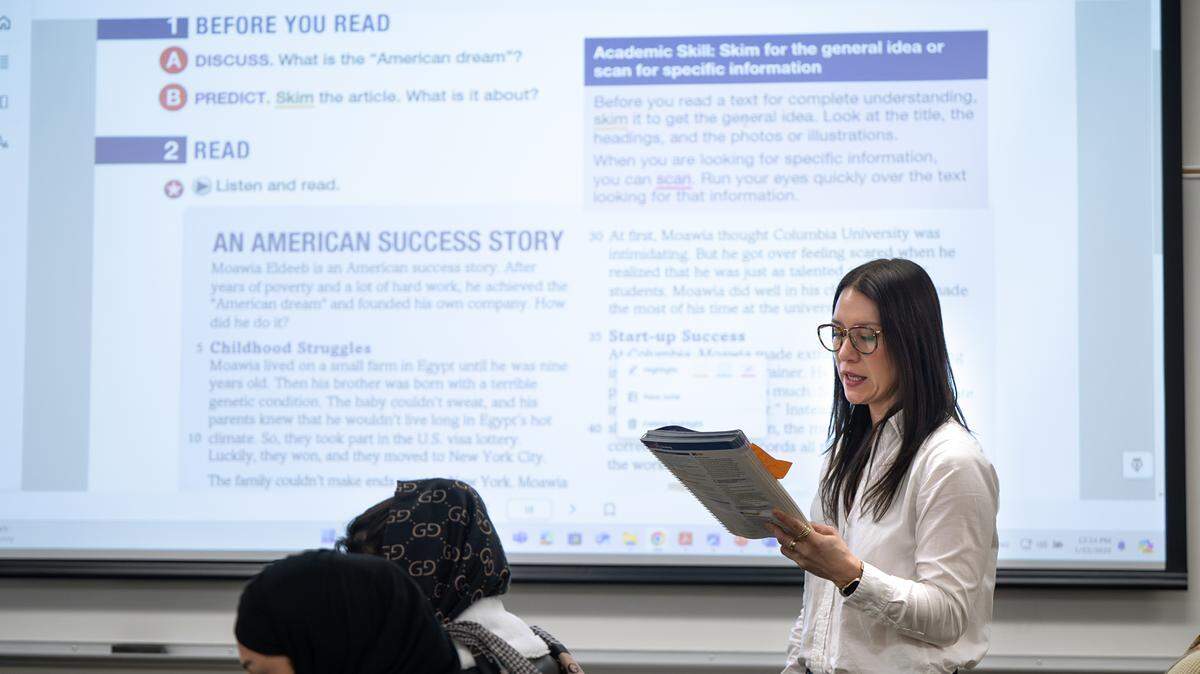
On a Wednesday morning at Modesto Junior College, students — many of them refugees and asylees — worked together to answer questions in English about global holidays. Meanwhile, the federal government is suspending programs that benefit people like them.
Martha Pimentel-Franco, a part-time English instructor at MJC who teaches the fourth-level course, pairs classmates to discuss how holidays are celebrated in their cultures. The students use English as a bridge between disparate first languages to discuss their favorites.
One student’s favorite holiday is “Nowruz,” which celebrates the coming of spring and is celebrated largely in Iran and Afghanistan. Another student loves “Aztec New Year,” which marks the new year according to the ancient Aztec calendar on March 12 and is celebrated in Mexico. Yet another student shares “Eid al-Fitr,” the end of Ramadan, which marks for one student a time of year when her family gets new dresses.
These courses may be disrupted by an executive order President Donald Trump issued Jan. 20. It suspends the Refugee Resettlement Program, halting new refugees from entering the country even if the State Department previously accepted them.
Ruth Luman, an English professor at MJC, said about 30% of students in the English language learner program are refugees. She expects the classes to continue to be full in the short term because the demand is high, but thinks the number of students will peter out in the long term if the suspension on resettlement continues.
“The executive order does indicate [Jan.] 27th, but we received word yesterday from [the Bureau of Population, Refugees and Migration] that refugee admissions were suspended immediately, so all flights have been canceled as of yesterday,” Tara Winter, the International Rescue Committee’s executive director for Northern California, said Wednesday. “There are no more refugees in the pipeline as of now.”
According to the executive order, the decision will be reviewed in three months.
Winter said her group has been a longstanding partner with MJC, partnering newly arrived refugees with English language courses required by the State Department’s resettlement program.
“Without incoming referrals, participation in the classes will decline, which may affect the program’s sustainability and definitely reduce opportunities for language acquisition and integration support for newcomers in the area,” she said.
‘A lot of hand gestures ... at the beginning’
Students in MJC’s English for Life and Work (ELW) courses come from a mix of countries that change from class to class.
Sara Berger teaches the fifth-level ELW course and said students in her classes usually have five or six different first languages. When she taught the lower-level classes many years ago, there were “a lot of hand gestures and photos at the beginning” as students tried to communicate with one another.
In general, Berger said most of her students have come to the United States in the past couple of years, or even the past couple of months.
Pimentel-Franco said her class, which began Jan. 13, is full. She often has a long waitlist for her courses. “My heart breaks to not be able to get all the students in the class,” she said.
Alma Aguilar, a student in an ELW class, said she’s been in the United States for three years since immigrating from Jalisco, Mexico.
“Thanks to the teachers that I have met in this new stage of my life as a student, I have been able to move forward,” she said. “However, I would like to express that in a classroom where adults have little time and are in a hurry to learn, in order to achieve this, we make a double effort.”
Luman taught ELW for many years and said a lot of the students come with trauma. “Sometimes, for a lot of students, we find their goal is to survive,” she said. “As newcomers, everything is really overwhelming.”
Before becoming a teacher, Pimentel-Franco was an immigrant from Mexico studying at MJC with hopes of someday teaching there. She had trouble learning English as a child because her family moved with the crops, and it was hard to put down roots.
“I can tell you I totally understand their plight because I’ve been there,” she said. “I always tell my classes this so they know if they really want to reach a goal, they can.”
Along with MJC’s English courses, there is a multilingual English Language Learner Welcome Center, which helps students sign up for courses and navigate the college system. Luman said Spanish, Farsi and Dari speakers help at the center, but it needs people who speak Arabic.
Aguilar, who was a lawyer and merchant in Mexico, said it’s been a challenge to balance her children and schoolwork. “A second language is for many more than a pleasure; we consider it a great need,” she said.
Luman coordinates with nonprofits including the International Rescue Committee and World Relief, both of which released statements on the executive order and its impact on the programs they provide.
As part of the now-suspended resettlement process, the International Rescue Committee administers support for people who enter the country through asylum, which includes setting them up with English courses, finding housing and providing job training.
Winter said that the refugee settlement is a tradition that dates back to the founding of the nation and has traditionally been bipartisan.
“We’re really urging an evidence-based reassessment of the decision,” she said. “Now is a time when [there are] record numbers of refugees around the world, and multiple challenges around the world. There’s currently no justification for ending the most established, secure and effective program to offer a route to safety here in the United States.”
The assignment students were given for homework in Berger’s class was a story about an immigrant who achieved the “American dream,” the idea that people who work hard can succeed in the United States. For many of the students, this is their plan too.
“I hear a lot of people say, ‘they are lucky to be here,’” Luman said. “I actually think we’re lucky to have them here, they’re lucky that they came.”
This story was originally published January 27, 2025 at 6:00 AM.