Modesto students ask if school phone restrictions are worth losing quick access to family
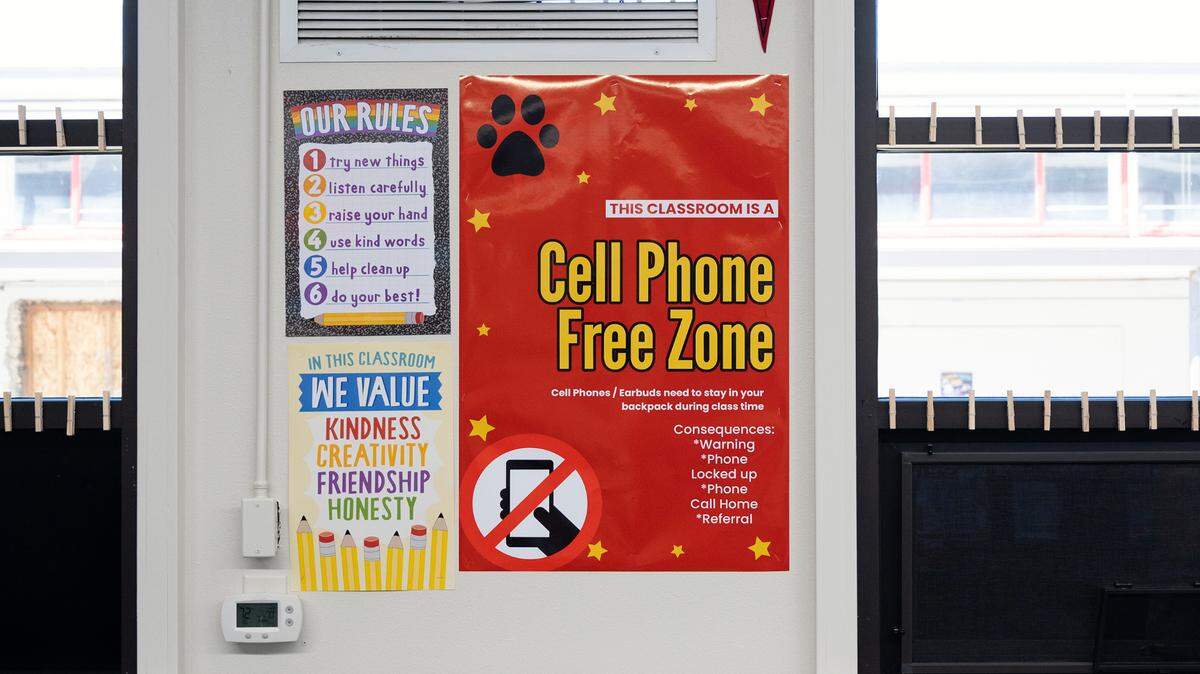
In a world where school violence is increasingly becoming a reality, in Modesto, students have mixed feelings about how a statewide cellphone restriction will be implemented.
In September, Gov. Gavin Newsom signed a bill to limit the use of cellphones at public schools throughout the state. The restrictions will go into effect in July 2026.
Ahmad Dagher, a student at Modesto High School, said the possible phone ban isn’t a black-or-white issue and there are pros and cons. He also thinks there will be backlash from other students.
On the one hand, he said phone usage in the classroom can be a distraction and deterrent to both learning and engaging socially with peers.
However, he said, there is also a need to be able to contact parents or guardians at any moment. Dagher believes that communication is vital to reduce anxiety and reassure worried parents in emergencies.
“When it comes to education, at least, eliminating phone usage in the classroom will certainly help promote effective learning. But the real question is whether it’s worth the inability for rapid communication that would come along with it,” he said.
Dagher is a part of the International Baccalaureate program and said he doesn’t see people distracted by phones in his class, but recognizes it could prove significant in other kinds of environments.
“I think that the most important step to be taken will be local implementation; allowing districts and schools to make decisions tailored to their local environments will be crucial, because different environments require different policies,” he said.
Assembly Bill 3216, known as the Phone-Free School Act, will require every school district, charter school and county office of education to adopt within two years a policy limiting or prohibiting the use of smartphones. In 2019, Newsom signed Assembly Bill 272 into law, which specified how school districts have the authority to regulate the use of smartphones during school hours.
“We know that excessive smartphone use increases anxiety, depression, and other mental health issues – but we have the power to intervene,” Newsom said when he signed the bill in September. “This new law will help students focus on academics, social development, and the world in front of them, not their screens, when they’re in school.”
In October 2023, the Modesto City Schools Board of Education said students may use cellphones, smart watches, pagers and other devices on campus during noninstructional times.
The policy urges phones to be turned off; however, it does not have any requirement that devices be taken away or stored at the beginning of class. The phone policy does state that students found using a phone inappropriately may be disciplined and an employee has the right to confiscate the device.
Jude Tecson, also a student at Modesto High School, said he doesn’t think a phone ban is good or will stop distractions in school.
Tecson said his phone is essential to getting rides home. During a bomb threat at his high school, he had to call his friend to get him home because his parents could not pick him up at the time.
In September, when Newsom signed the bill, Stanislaus County students faced a series of threats of school violence, resulting in the arrests of eight juveniles.
Threatening times make phones essential ‘at all times’
“In our modern society, phones are necessary to communicate with parents and friends,” Tecson said. “Especially when there have been countless threats of school shootings and bombs, as well as actual cases of these types of events, phones are essential to have on one’s person at all times.”
Tecson also feels the reasoning behind the ban is flawed.
Last month, Newsom sent letters to various school district leaders saying excessive smartphone use increases anxiety, depression and other mental health issues in children.
“There’s a lot of positivity that can come from being on different applications depending on what those apps look like and what they’re about. However, being too much right on your phone and social media can have a negative effect on students like on their self-esteem because there’s a lot of comparison that goes on,” Aletha Harven, associate professor of psychology at Stanislaus State, said.
Tecson feels banning phones in schools will not curb this issue as students will have access to the devices at home.
“Of course, there’s also the entire debate behind social media for children and whether it’s healthy in the first place, but even in the worst-case scenario where social media is 100% unhealthy for students, only banning phones during school won’t help solve the problem,” Tecson said.
In addition, he does not think it helps students pay better attention in class since teacher’s already have various policies in place.
He urges that the school district to look at what is happening across the nation.
“Just a week ago, my school had to tell students to go back home because of a bomb threat, and similar situations have occurred across the United States,” Tecson said. “Of course, school faculty and the police are doing their best to secure our schools; however, there’s always the chance of something happening, and it’s imperative that students should be able to contact their parents or guardians in even the slightest emergencies or dangers.”
Dagher hopes whatever is implemented at Modesto City Schools caters more locally and can balance both concerns and praises surrounding the bill.
“The more locally attuned a policy can get, the better,” he said.
This story was originally published October 22, 2024 at 2:29 PM.