We sat down with MJC’s ‘out of the box’ interim president. Can he be ‘Felix the Fixer’?
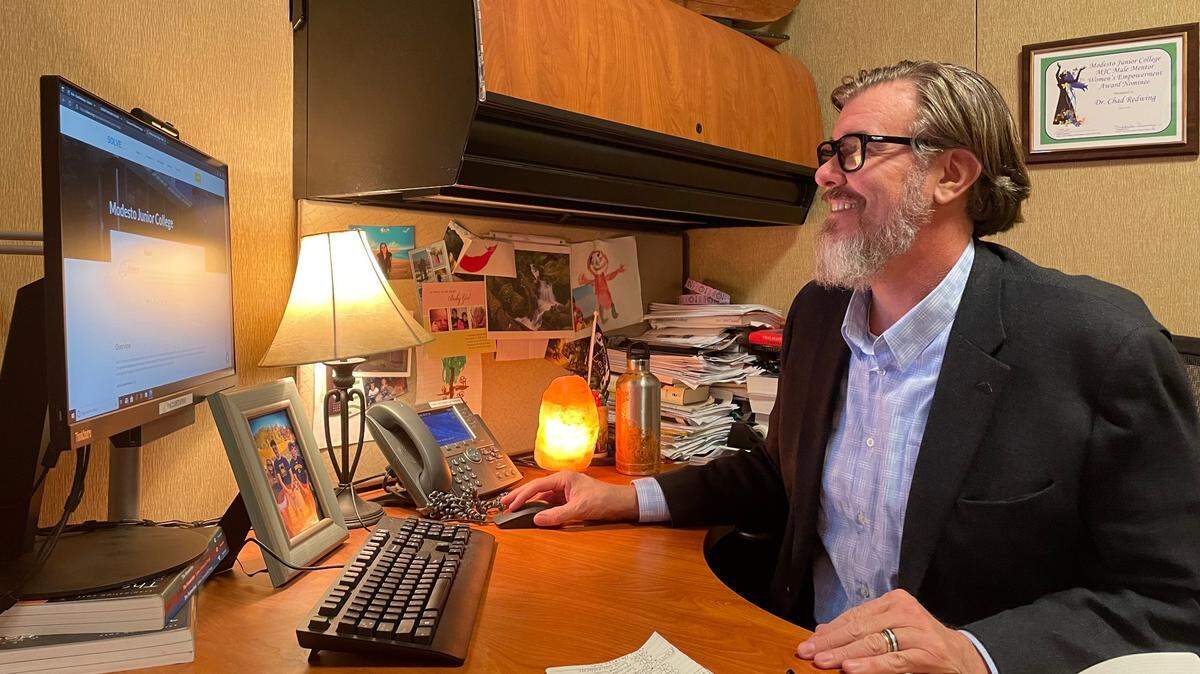
At 6-foot-5, and with a gray beard, Chad Redwing appears more god than man — even with his long hair, typically worn in a ponytail, cut off. For Halloween, he dressed up as Thor, though he is adamant he looks nothing like Chris Hemsworth. No “catfishing,” he says with a laugh: “I’m fat Thor.”
As Modesto Junior College’s new interim president, effective Feb. 6, Redwing inherits numerous entrenched challenges that could use some divine intervention. The six-year graduation rate at California community colleges for students seeking a two-year associate’s degree hovers around 49%, and MJC’s is at around 45%, according to the most recent data. The school has the highest presidential turnover rate of any community college in the state. And its accreditation next year is no guarantee.
Redwing knows the problems well. With nearly two decades of experience at MJC, he has worked as a professor, a faculty representative and a co-chair on the college’s accreditation committee.
He talks quickly and passionately, eager to go on tangents about his classes on interdisciplinary humanities and the students he teaches. Unlike every other past interim president since 2000, Redwing never has held a full-time college administration position.
“I’m a scholar,” he says. “I’m going into this going, OK, what’s the problem? If this is ‘Wreck-it Ralph,’ my job is to be Felix the Fixer.”
Redwing sat down with The Bee within days of being announced as interim president. The interview has been edited and condensed for clarity.
The Bee: Tell me about your family and the person you are
My wife and I came to the Central Valley in 2005 for the first time. My wife is Chilean. I met her in the Peace Corps, so we have a very unique home. We fight in Spanish, and we celebrate Chilean Independence Day. We’ve got three kids, all of them have dual citizenship. The eldest is at Cal studying neuroscience. The middle one is off to college this year somewhere, and then we’ve got a daughter going into high school. This is perfect timing because none of them want to talk to me anymore.
We decided to come here precisely because it is the community it is, not in spite of it. I’ll just say that Modesto has had one of the lowest educational attainment rates in the nation for the last 100 years. This is where you can do good work.
Do you live in Modesto?
We did for many years. We moved up outside of Oakdale in the foothills. We have a little goat ranch. We still live in our service area. I just live out a little bit further.
What was your position when you arrived in 2005?
I started right away with a tenure-track, full-time position. I’d finished my master’s and as soon as I got here, I finished my doctorate at the University of Chicago.
What kind of teacher are you?
I’m squirrelly as a teacher.
What does that mean?
Well, what’s the largest country on earth? And by a country, I mean an imagined community where they have rules and they agree and they communicate. I bet none of you know. China? India? No, it’s Facebook. Facebook has 4 billion followers. It’s the largest imagined community in the history of the world. That’s a squirrelly question, right? Because you’re setting them up to answer it wrong.
When did you get involved in leadership at MJC?
It took a while. They usually tell you, get your tenure, understand your teaching, that comes first. I mean, the most transformative thing we do is in the classroom.
Around 40% of our students get a two-year degree in six years, so I was always curious why. Why isn’t it 91% like at Cal? That’s what brought me into faculty leadership.
What were some of your biggest accomplishments as president of the faculty senate?
For one, we redesigned the shared governance system collaboratively amongst all constituency groups, so we had classified professionals, the leadership team, faculty, even student input, and our union to look at this and say: Can we find a way to reduce our meetings? Can we find a way to be more strategic when we meet so the meetings relate to each other and we can accomplish things?
Why did you apply to be MJC’s interim president?
It’s in my skill set. I’m used to short-term appointments in extreme situations. I did it in the Peace Corps. I’ve done it in my career. I was a senate president once. I said the same thing in the senate: I’ll do one term, one two-year term.
Do you have a 100-day plan?
This is what I talked about in the process of acquiring this position: internships. The reality is that most people at four-year colleges and universities succeed in their careers, produce more wealth, have longer happier lives and better relationships because 60% of undergraduates at four-year universities have internships. The question for anyone starting their educational journey is: What’s the relevance of this to my life?
… 85 percent of our students already have a job. We don’t really need to find them internships. We just need to find them jobs where they can leverage the things they know from the classroom.
We know people are more successful, that we can improve retention, improve our long-term vision – it all fixes itself when we have experiential learning alongside their book learning.
How do you feel like your interim presidency can ensure MJC gets its accreditation?
My other leadership experience outside the senate is being faculty co-chair on the accreditation. So by taking this position, I can no longer do that for a semester. That’s why it’s important to me that this is an interim position, because I need to go back to that accreditation work before it’s due in December.
Can you, as interim president, help advance some of the accreditation work?
As I step away from writing the (accreditation) report this semester, I’m going to actually go on an accreditation visit at Monterey Peninsula College to understand what they’re looking for, as an accreditor.
Has MJC ever lost its accreditation?
No, but we’ve had issues that we’ve had to work on and been put on shorter cycles. I’m confident we’re not going to lose our accreditation, but yes, we may find things in our peer review that we need to work on.
The relationship between the president and the Yosemite Community College District board historically has been contentious, and that’s one you’ll have to navigate. How do you plan to strike a new tone with the board and help ensure there is retention in the future?
I don’t intend to strike a new tone. The board already knows me. Intellectually, I’m a little squirrelly, but not in dealing with people. You don’t surprise people. I’m a known quantity. My next board report is going to be a lot like the last 22 they got (on behalf of the faculty senate).
You start Feb. 6. Is there an end date?
My job is to help stabilize the culture, make sure everyone feels that we are ready to welcome this process and retain a leader, and then get out of the way. My hope is that can be done in a matter of months.
You have said publicly that you do not want the position of president. Why not?
I’ve broken the meritocracy a bit. When you jump straight from the classroom to a position like this, you’re telling all the deans in between the classroom and the president, and all the vice presidents, that you’re going to go out of the box for a little bit. How would you feel?
I’d feel pretty bad.
I’d be angry. I’d be angry at me, so it’s crucial to me that this is interim. I’ve got a lot of things to learn.
What I hear from you is that it wouldn’t be fair for you to be president. What I didn’t hear from you is that you don’t want to be president.
Well, I don’t know. I’ve been a senate president. I’ve been a superintendent and a director of a charter school district. I’ve done it a few times, but I don’t know what this one is going to be like.
After this interim presidency, is it possible that you might want to be a president in the long-term?
Only if it’s in our service area, because I’m not killing my goats.
This story was originally published February 3, 2023 at 1:07 PM.