‘They really surprised me’: Stanislaus educators on distance learning effect on K-1 students
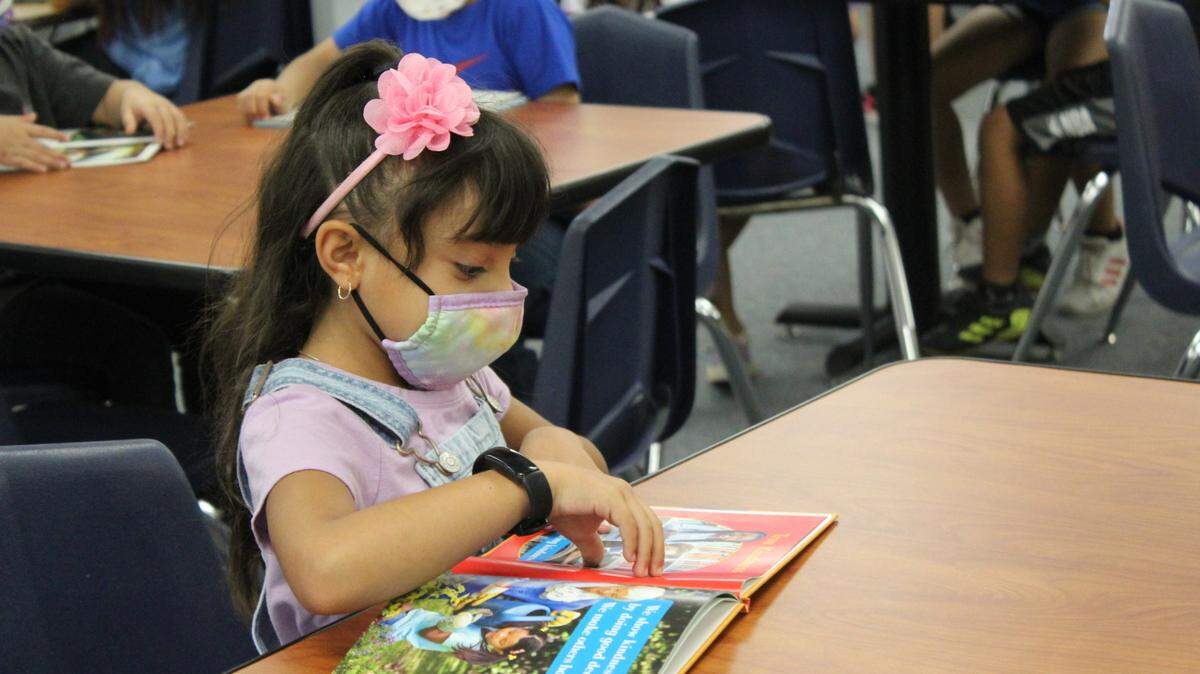
When school began in August, teacher Debra Thompson at Northmead Elementary School in Patterson said her kindergarten students couldn’t recognize their names or hold a pencil. Most of them could identify only one or two letters.
“I usually have about a quarter of my class that’s ready — that’s really ready — for kindergarten,” Thompson said in mid-September. “This year, I’m not seeing that at all.”
As students missed school days due to the ongoing pandemic — quarantines caused one boy to join class on the 20th day — Thompson questioned whether she could get her students where they needed to be. But once students could attend school every day, they learned school routines, expanded their attention spans and connected with the lessons Thompson reviewed.
Six weeks later, she said, about half of her class meets or exceeds standards. Everyone can hold a pencil.
“They really surprised me,” Thompson said.
After a year and a half of distance learning, many of the youngest learners entered classrooms in August having never attended traditional school. Though some children thrived during online learning, likely owing to parental support and access to technology, other children struggled to grasp basic concepts or didn’t enroll in school at all.
This created a potentially wider divide in kindergarten and first-grade readiness than usual, said Jamie Garner, math director at the Stanislaus County Office of Education.
Educators braced for a struggle
Garner said she and her colleagues expected children would struggle this year. During distance learning, younger students couldn’t engage with the small groups and the physical teaching tools their teachers normally rely on.
Sometimes, though, the data “looks surprisingly good.”
“They blow us away with the things that they know and are able to do,” Garner said.
At Northmead, first-grade teacher Diana Gregory said she’s teaching “very similarly” to prepandemic years. “We expected more dips than we’re seeing,” she said.
The isolation of learning from home affected children socially, as well. Some students treat their peers more akin to siblings, Gregory said. They’re less thoughtful before they act.
First-grade teacher Nancy Mendoza said she’s spending time teaching Ceres Sinclear Elementary students how to behave in a school environment.
The pandemic meant that many children who would have learned “school etiquette” in preschool or kindergarten didn’t get that chance. Enrollment in those grades declined across the country, and Stanislaus County was no different.
Head Start enrollment fluctuates
SCOE Child and Family Services Director Tony Jordan said enrollment in Head Start, a federally funded early learning program for low-income families, dropped from its standard 100% capacity to 54% in September 2020. By September of this year, enrollment increased to 75%.
In the Modesto City Schools district, about 140 more first-graders enrolled in 2021 than enrolled in kindergarten in 2020, according to September enrollment counts. (By comparison, first-grade to second-grade enrollment from 2020 to 2021 dropped by 18.) Kindergarten enrollment from 2019 to 2020 dropped by 5.6%.
Modesto City Schools teachers asked for comment in this article declined to be interviewed.
In addition to lower enrollments, school closures and hybrid learning models meant children didn’t reap the full benefits of their early education. In Head Start, 86% of 4-year-olds assessed in the spring scored ready for kindergarten, compared to 91% in the 2018-19 school year.
Out of 13 areas of assessment, Jordan said letter recognition was “significantly lower than what we’ve seen in the past.” Children scored next lowest in self-regulation and attention to task and impulse control, and strongest in name recognition, colors and shapes, he said.
“Our kindergarten, first-, second- and third-grade teachers will have their work cut out for them,” Jordan said.
Teacher Kristina Hart at Hidahl Elementary in Ceres said her first-grade students began the year needing additional practice with letter names and sounds, which is something they usually enter first grade knowing.
“We have quite a few needs this year that are different than a typical year,” Hart said in September.
Reading and math findings
At the beginning of October, Hidahl first-grade teachers split students into three groups depending on their reading level. Hart’s group includes students who know their sounds but can’t blend them into words. Another teacher focuses solely on sounds, and a third teacher pushes students who can read.
After just three weeks, Hart said she moved three of her students into the higher-level group, and the other teacher moved three students up, too. “That was really nice to see,” she said.
In math, Hart said she’s moving a lot more slowly than usual and focusing on foundations.
“I feel like it’s better worth my while with these kids to make sure they really have that strong foundation in addition and subtraction before I try to do those more difficult concepts,” Hart said.
Garner and Stanislaus County Office of Education literacy director Lori Dougherty said they’re advising teachers across the county to take a similar approach. Teachers might not cover as much ground as usual, but the most important foundations will prepare children for the learning they’ll experience to come.
Thompson, the Northmead teacher, said she feels hopeful when looking to the rest of the school year. “They’ve really bounced back,” she said.