How teen scientists at one Stanislaus County school are receiving national acclaim
Earth science students at Pitman High in Turlock are semifinalists in a nationwide competition by Samsung that challenges sixth- through 12th-graders to apply STEM (science, technology, engineering and math) education to help improve their communities.
There are 75 semifinalist groups across the country in the Solve for Tomorrow contest, and the Turlock students and their teacher, Eric Hauck, are working toward being selected in April as one of 10 national finalists.
The issue they’ve tackled is one they’ve been studying all school year and one that’s familiar to many Valley residents: selenium concentration in water at toxic levels. It’s a problem made infamous nearly in their own backyard — less than 30 miles south at the Kesterson wildlife refuge in Merced County.
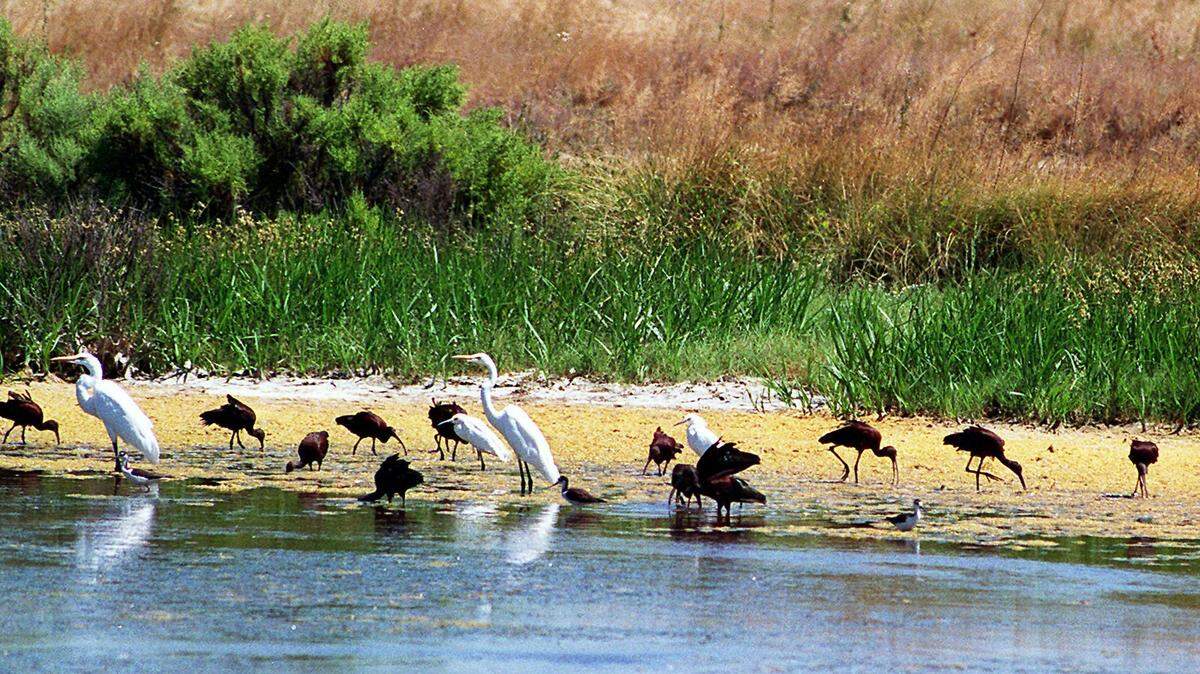
Kesterson, part of the San Luis National Wildlife Refuge, was established in 1969 using irrigation water. But as Sacramento Bee reporter Dale Kasler wrote in an article earlier this month, “In the early 1980s, hundreds of waterfowl turned up dead and deformed” at Kesterson. “The birds were poisoned by irrigation water runoff that was tainted with salt and selenium, the result of improper soil drainage. The ensuing litigation spawned a settlement in the early 2000s that resulted in 85,000 acres of contaminated Westlands (Water District) land taken out of commission.”
Mitigation efforts “were successful in drawing back a lot of the selenium toxicity in that area,” Hauck said in a phone interview along with some of his students this week. And in consultation with Turlock Unified School District science instructional coach Ryan Hollister, a full study unit for Pitman earth science students was built around the problem.
The Samsung competition, which was created more than a decade ago, has been on his “radar,” Hauck said, and he decided his students’ selenium studies were a good fit. All 90 of his students across a few classes have contributed to the work that got Pitman into the semifinals, he said. They’re working in several teams, such as video development (being selected a finalist requires a three-minute project video to be submitted by March 21), genetic engineering, and development of a real-time, water-quality app for the Central Valley.
Help from across the nation
The students’ efforts, including consulting with scientists from the U.S. Geological Survey and universities in Texas, Pennsylvania and Colorado, aim to identify selenium “hot spots” in the Central Valley and remediate the problem, their teacher said.
Pitman’s contest application says irrigation waters probably still contain high levels of selenium because the ancient clay layer serves as a bowl, trapping those trace elements. But testing is limited, it says, and biological treatment methods “can be ineffective in the presence of nitrates, which is exceptionally prevalent in the Central Valley due to fertilizer. To this day, selenium is still a problem to the community.”
The student project proposes “a remediation strategy that can be broadly applied using data tracking, phytoremediation (using living plants to decontaminate) and chemical filtration” including reverse osmosis.
The initial phase, phytoremediation, would use bioengineered plants at the alluvial fans on the coast. Students would conduct experiments using known selenium accumulator plants to see if phytoremediation is a viable solution.
According to Samsung, each semifinalist school will receive $15,000, to be redeemed on DonorsChoose.org, and a Samsung Galaxy Note20 to execute their project this school year, whether they are engaging in a virtual, in-person or hybrid teaching environment.
Striving for real solutions
Pitman students interviewed along with Hauck said they’re excited about the work they’re doing. “I really believe that we could create a solution for selenium” contamination, said Julius Camacho. “At first, I thought it was just another school assignment ... but this has a lot of potential. If we could move forward, then I think that would be really great. This is something that I’m now starting to see how important this is.”
Spending a lot of time learning about the contamination made clear what a problem it was and still may be, classmate Josephine Swanson said. Those problems, added fellow student John Sylvester, include leaf curl and incomplete development of plants, and illness and deformities in birds and fish. Students have seen images of fish with scoliosis and waterfowl with boils and missing feathers, he said.
“Continuing with the project and working with Samsung during the competition,” Swanson said, “is really making me want to keep going and actually put in place solutions.”
Classmate Loveinya Khoshabeh added that if the students can come up with a way to improve water quality, “I think we’re doing our environment a big favor. Because not only will that improve the plants and the animals, it can also improve our own lives. ... It makes me happy to know that us being at the age we are, we’re able to have such a large impact on the environment.”
According to the Solve for Tomorrow competition site, the 10 national finalists will participate in a “Community Choice video voting contest on social media from April 6–26.”
Samsung also says the chosen finalists will make a “virtual pitch” of their projects to a panel of judges. Seven of the finalist schools will be awarded $65,000 in technology and classroom materials, while the remaining three will be named national winners.
Each winning school will receive the grand prize of $130,000 in classroom technology and supplies. Follow the contest at www.facebook.com/SamsungSolveForTomorrow.
This story was originally published January 29, 2021 at 4:00 AM.