School leaders weigh in on how return to campuses will look for Modesto-area students
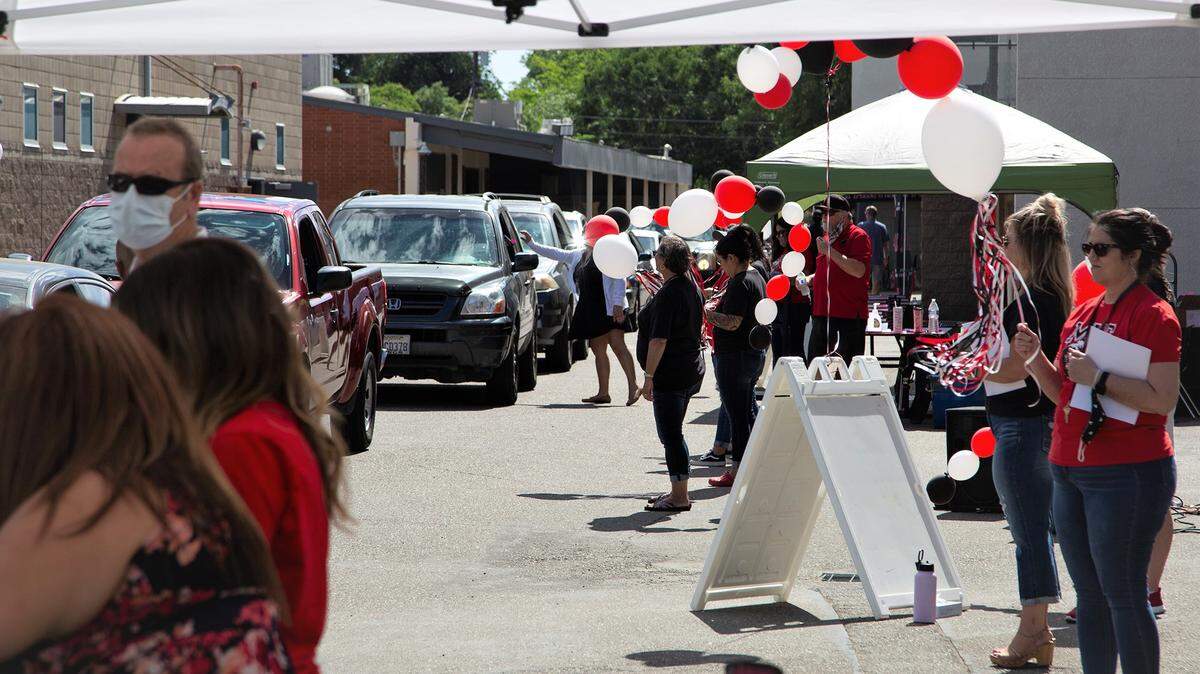
Friday was the last day of Modesto City Schools’ 2019-20 academic calendar, which has ended with something never before seen in the district’s nearly 150-year history: Campuses closed, academic competitions canceled, sports seasons cut short before some even began. Students studying from home — online if they’ve had sufficient Internet connectivity, with printed materials if not. No proms, no grad nights, no in-person commencement ceremonies.
And now, as district and school-site educators work toward the next year, perhaps just one thing is absolutely certain, MCS Superintendent Sara Noguchi has said, and repeated last week: School will begin Monday, Aug. 10.
How it will begin is another matter.
In a recent Facebook Live update by Stanislaus County officials on the coronavirus pandemic, county schools Superintendent Scott Kuykendall said “the plan that we all want to have happen” is that schools are given the green light that it’s safe to bring kids back to classrooms. But school districts also are planning for a situation in which students can’t return at all and full distance learning has to continue at least well into the school year, he said.
Stanislaus educators don’t anticipate that worst-case scenario coming to pass, Kuykendall said, but “our best thinking really is if we know we have a solid plan to reopen full scale, traditionally, and we know we also have a solid plan for distance learning, we can make anything in between work.”
So that’s how Noguchi and her team are proceeding: studying what needs to happen for both in-person and distance learning, and how to get there.
A survey sent to MCS families, asking that it be completed by June 5, wants to know the method of schooling they prefer “given the current COVID-19 environment” and how the district can improve distance learning. It summarizes and seeks feedback on three methods of schooling currently being considered:
- Distance Learning: The model students have used since the school closures in mid-March. “Students check in with their teachers on a daily basis and engage in new learning. Changes will be made to this model given the feedback and input from parents and students.”
- Modesto Virtual Academy: This would be a self-paced, computer-based online program. Students would check in with their teachers weekly.
- Hybrid Model: Students would go to school for a half day to be taught math, English language arts and Science. They would return home for distance learning the other half of the day.
Returning to traditional learning
The biggest challenges to resuming in-person education at schools are obvious. They’re the same measures society has adopted since the governor put California on lockdown more than two months ago because of the COVID-19 outbreak: social distancing, cleaning/disinfecting and using personal protective equipment.
Kuykendall gave a clear picture of how social distancing may have to look in the classroom, saying that to safely keep children apart in a typical 850-square-foot space, only 6 to 10 could be taught at a time. “I don’t know that that’s feasible,” he said.
There are only so many teachers, so many classrooms and so many hours in the day. Noguchi said staffing would be a huge challenge, because if a classroom can be at just a third of its capacity, kids would have to be on a schedule that rotates between them learning at home and at school. That in turn is a problem for parents who need their children in school so they can go to their jobs, she added.
At the high school level, rotating students through classes could resemble the block scheduling that was used at Beyer High School in its early years, the superintendent said. Back then, a teacher offered a class at least twice a day, and students went to the session of their choice based on perhaps whether they needed to finish homework or study more for a quiz. Now, its point would simply be to reduce the number of students in class.
Classrooms are but part of the social-distancing puzzle. Children’s safety has to be ensured in lunchrooms and hallways and on buses, said Mike Rich, the school district’s senior director in the curriculum instruction and professional development division. “We don’t realize how often we have kids clustered,” he said.
A school bus that previously carried close to 70 kids would be able to safely accommodate only 14, Noguchi added. A survey item on busing says, “This will be impossible to do given the number of students we transport each day, so we need to assess how many students are planning on using our busing services.” It asks parents if they will be able to find alternate transportation.
Modesto City Schools officials — and, safe to say, those in school districts across the country — are looking, too, at all the other ways they need to protect the health and welfare of students and employees. Those include conducting health checks like taking temperatures, having masks and other PPE available, and regularly cleaning and disinfecting, Noguchi said.
“It’s not going to be the deep disinfection because of time and space. We can see that being a challenge,” she said. “The reality is that if we are back in school, social distancing or not, there’s no way we can guarantee kids won’t have exposure to the virus.” What the district can do is have employees monitor themselves and children, and work with parents to ensure they, too, pay close attention to their kids’ health.
What Stanislaus educators have realized as they’ve opened this “can of worms,” Kuykendall said, is that there are many authorities involved: Cal/OSHA on safety practices and PPE for staff, the California Highway Patrol on home-to-school transportation, among others. “So a lot of these agencies need to chime in on what’s needed and what’s even possible,” he said.
Continuing with distance learning, or a mix
Distance learning is no one’s choice as the best way to teach children, Kuykendall and Noguchi said. But in terms of keeping children and district employees safe, it’s the easier plan to manage, the Modesto superintendent said.
The past couple of months have been a “test drive” for remote learning, Noguchi said, and she finds it “amazing how the teachers have leaned into it and put in countless hours” of training and work. She said 95 percent of the district’s students now have Internet access and have gotten online to do schoolwork, and teachers and district staff are “working individually with the last 5 percent.”
Certainly, offering quality instruction is a challenge, she said, noting that not until the pandemic did MCS’s elementary school teachers and students gain any familiarity with distance learning. And this summer, district and school staffs will be working hard to “fill in the gaps,” like ensuring that students are logging in and doing their work and that teachers are accountable for grading and providing new instruction.
These are things that need to be shored up for next year, and we’re working with MTA (the Modesto Teachers Association) on that,” Noguchi said.
She said everyone recognizes that students have lost out on learning during the shelter-at-home period, which is why rather than collecting children’s learning devices at the close of the school year, they’ve been left in homes. The district is creating online enrichment opportunities for students from kindergarten through 12th grade, which will be available by June 8, Noguchi said. Those will include things like virtual field trips and scavenger hunts.
K-6 students also have the opportunity to get onto Freckle, which structures assessments like games and addresses standards-based skills and concepts in core subject areas.
A major challenge no matter what shape education takes in the months ahead, Noguchi said, is the emotional health of students. She’s concerned about how students are doing with the isolation of distance learning, she said, and wants to ensure the unique needs of special-education and English-learning students are being met.
She and Kuykendall also said that even if by good fortune schools are able to begin in a largely traditional fashion in August, schools must continue working to prepare students and families that another outbreak forces a return to full remote learning.
They also realize that even if children are allowed to return to schools, some families will not want them to. In his Facebook Live comments, Kuykendall said there undoubtedly will be parents who have the resources to accommodate distance learning, to help their kids with studies and homework, and will want to. He assured parents there will continue to be a distance-learning option in any case.
This story was originally published June 1, 2020 at 5:00 AM.