What matters most as Modesto City Schools teachers begin new remote instruction
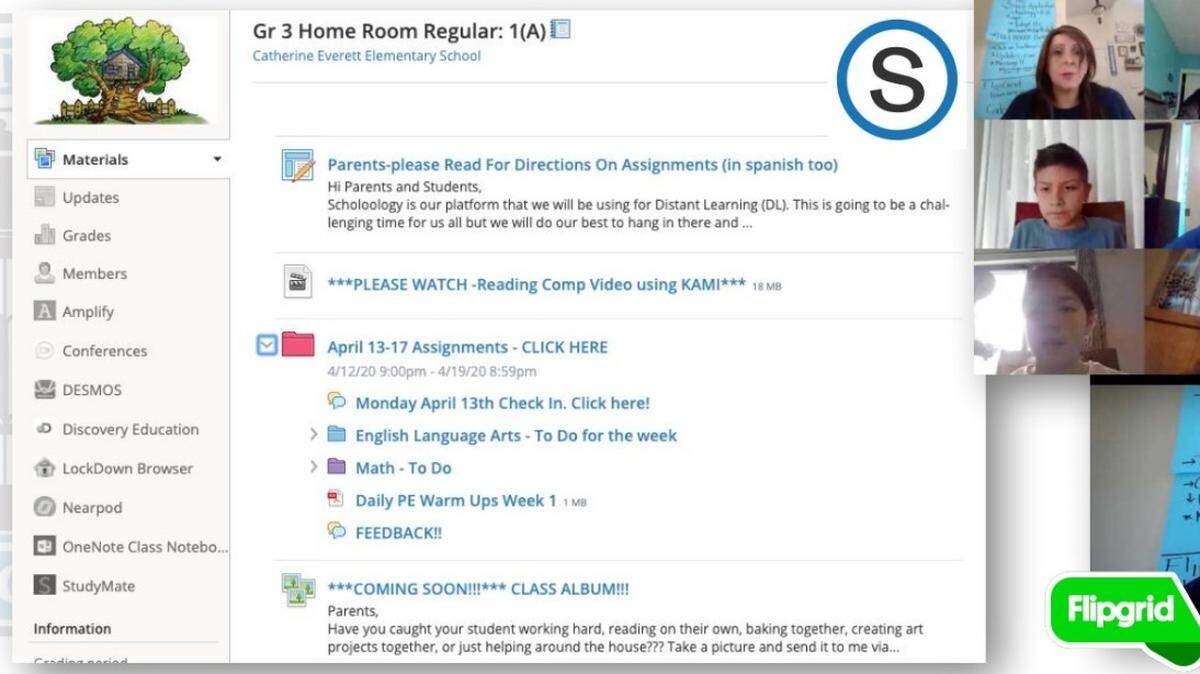
When third-grade teacher Christina Elizondo got online with her Everett Elementary School students last Monday, she quickly saw there was something they had been missing more than instruction during this period of coronavirus pandemic distance learning.
It was connection with one another.
Using the learning management system Schoology, she videoconferences with kids who are logged in. To respect home privacy, the students can only hear, not see, one another. But just to do that, “they were so excited, and I could see their faces light up,” Elizondo said.
It made her realize the importance of not just posting lessons and instructional videos, but “going live with them more often, and giving them the opportunity just to talk and chitchat with each other.”
As Modesto City Schools begins its second week of new instruction to kids learning at home, teachers and administrators are working to locate all students (some may be staying with family out of the area) and overcome obstacles.
Not all households have Internet access. Online learning and the tools to do it are new to transitional-kindergarten through sixth-grade students. And not all parents understand how to help their children use Schoology (help is available at www.mcs4kids.com/parents/resources/schoology) and other study resources.
When campuses closed last month, the first phase of Modesto City Schools’ distance-learning plan was teacher training, which included more than 110 live webinars, with 1,185 teachers attending. Many teachers participated in multiple webinars, for a total of more than 5,100 enrollments.
Phase 2 was getting printed and digital learning packets into families’ hands. That meant distributing 15,000 devices to transitional-kindergarten through sixth-grade students (older students already have been using them) and working to get families connected on the Internet (more on that later).
Phase 3, rolling out opportunities for new learning in addition to review, began April 13. But as students and their teachers take “baby steps,” as Elizondo put it, in this environment of remote education, academics are taking a back seat to kids’ health and safety.
Schoology participation rising
On April 13, that first day of new instruction, 65 percent of the district’s students logged into Schoology, said Mike Rich, MCS’ senior director in the curriculum instruction and professional development division.
By Wednesday, participation was up to nearly 80 percent, district spokeswoman Becky Fortuna said in an update Thursday. She added, “We are striving for 100 percent. We feel it is so important for students to connect with their teachers, that school administrators and office staff will be reaching out to families who have not logged in.”
Rich said, “They’re making phone calls, they’re going to find out what’s going on.”
Reaching students and their families is about instruction, certainly, said Lauren Odell, associate superintendent of curriculum and instruction, “but the well-being of the children comes even before that.”
Principals have been instructed to have their staffs check on students to make sure they’re OK, she said. The message to schools from the superintendent’s office, Odell said, is, “If you haven’t talked to them in a few days, or they never showed up online, see if you can reach out. Maybe they are with grandparents in another state, we don’t know.”
A few days before going live, Elizondo said she began communicating with parents about the upcoming new instruction. She connected with about half her students’ families to have them “toggle around Schoology to get familiar with it before we rolled it out on Monday (Apirl 13).”
Families encountered a variety of obstacles logging in or not being able to hear or see her. And right now, not all families can participate in online learning at all.
“I can guarantee that not everybody has Internet access, that’s just the way the city is,” Rich said. These first couple of weeks into Phase 3, administrators have been tasked with contacting every family that’s not connected, to determine the obstacles, he said.
“We have ordered but obviously will have a limited supply of (portable WiFi) hot spots, because every school district is looking for those,” he said. Rich added that students who can’t log in won’t be held accountable for the learning that goes on while they’re shut out.
Across the board, MCS families have been assured that their students’ year-end marks will not be lowered because of distance learning but that there will be opportunities to raise their grades. It’s an unfortunate fact, though, that some of the students whose grades need improving are the same ones without home internet.
“We recognize that that is a huge inequity,” Rich said. “... We’ve had several phone calls from parents saying ‘I can’t get access,’ and some have come up with creative solutions on their own. So I think everybody in society is kind of addressing the same issue and I’m sure it’ll get better over time as we as we look for solutions.”
What’s expected of Modesto-area teachers
Elizondo said her initial focus the first week was on reading-program review. This week, she plans to add a writing assignment.
“I want to get feedback both from parents and the students to see how this week went, so I kept it fairly easy” she said Wednesday. “I arranged my screen fairly easy. I didn’t want to get too too many folders to where parents didn’t know where to click or, you know, got confused.”
And again, she really wants to promote connecting. That’s why the bottom of her Schoology page says, “Coming soon! Class album!” and invites submissions of students studying, baking, creating art, helping around the house, etc.
She and her colleagues have been told by their principals to do what they feel their students are capable of, Elizondo said. “Right now, I’m seeing they are more than capable of doing more, and I do plan on going live later on with them, or providing my own videos of math that’s going to be coming up that we have not covered.
“And if we want to go a little bit further using Discovery Science or something for social studies, our (teaching) coaches are there for us.”
Gregori High School math teacher Lori Gaines said a key expectation of teachers is that they be available for their students. “We were told that we are to have what are considered office hours at least once a week,” whether by Schoology conferences or some other form. “ So right now they’re giving us some flexibility.”
Among her high school colleagues, “we kind of are all in different places,” Gaines said Wednesday morning. “I felt extremely comfortable with technology and doing teaching videos, and I signed up for the Schoology conferences right away. So even though at our district, we didn’t technically start until two days ago, I started March 31 with my own students and I let them know, ‘I’m starting working because I feel comfortable doing it. Come on in and join as you feel comfortable.’”
From the administration, the message is don’t be anxious, don’t take on too much, just get comfortable with the technology, she said. “So those that are really new to all of this have been supported in the fact that the expectation is not that you have to just all of a sudden be fluent in all of this, which has been great.”
Parents have expectations, too, Rich said, and he’s impressed at how many are advocating for their children’s educations. Parents are saying, “I need my kids need to have things to do. They need to be learning. They still need to be growing in their education,” he said.
He asks that parents have patience and understand that teachers are working in what for many is an entirely new way, and in situations like having their own children at home.
At this point, the district is not concerned with things like teachers posting daily online lessons or videos or doing Schoology conferences, Odell said. “This is not about accountability of what the teacher does every day. It’s about doing their very best” and, again, ensuring that children are well.