
Gregori student behind 'threat'. How Stanislaus County law enforcement reacted.
On social media, a Gregori High student threatened violence last week at the north Modesto school. Two other social-media threats to schools identified as “Central” and “bhs” fueled rumors that the targets also were Modesto campuses: Beyer and Central Catholic.
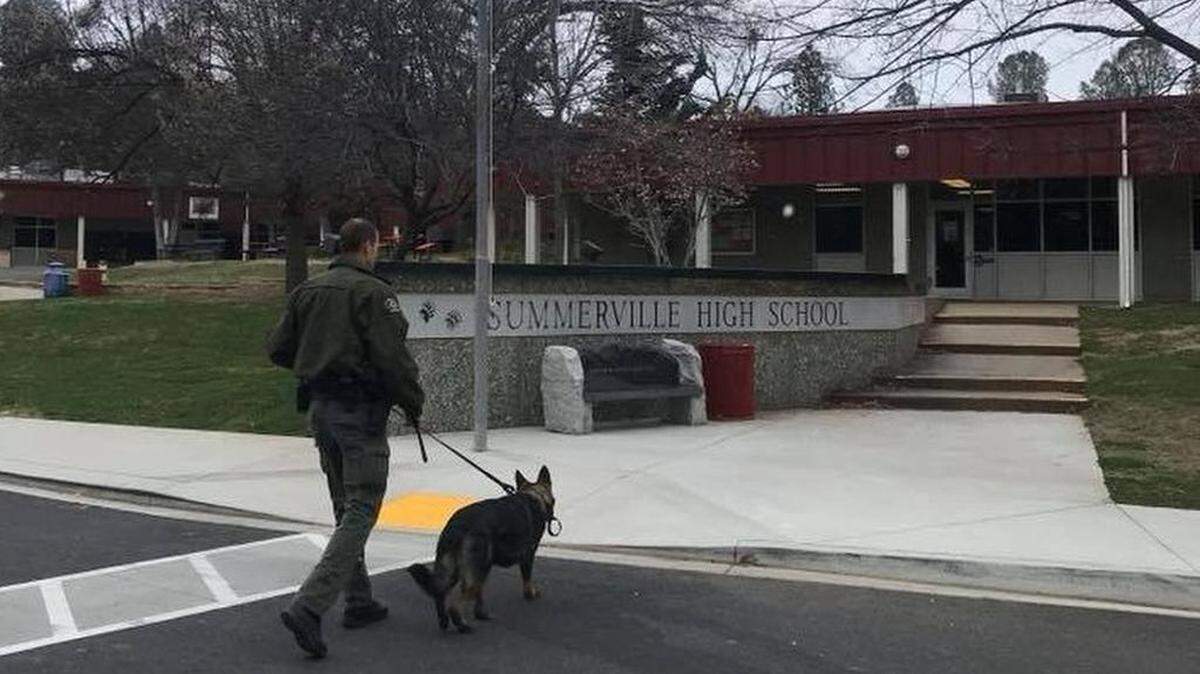
In Tuolumne County, the Sheriff’s Office and Sonora Police Department responded to a social-media threat of violence at “SHS” by increasing law enforcement’s presence at Sonora and Summerville high schools.
All four instances, as well as a rumored threat to Modesto’s La Loma Junior High, were determined not to be credible threats — locally, at least.
Sheriff’s deputies contacted the Gregori student, who said the threat was a joke among friends.
Investigation of the “bhs” threat determined the post originated in New Mexico and refers to Belen High School there. A student was arrested. Similarly, the “Central” threat was out of Indiana, where Corydon Central High was the target, resulting in five people being taken into custody. And police in Springfield, Ohio, report that “SHS” refers to Springfield High but the threat was a hoax.
At what cost?
“Our schools are safe,” Stanislaus County Sheriff Adam Christianson said in an interview Friday, noting extensive training of local law enforcement and strong partnerships among departments and with school districts.
Local police and school officials agreed and, in as many words, said there is no higher priority than the safety of the community’s children.
Even when a threat or a rumor of one clearly appears to be a prank, Christianson said, “We have to take it seriously. We can’t say it’s just kids being kids. When something like this happens, you’re going to get a full-blown investigation.”
Threats and their investigations carry a cost in a few ways. The most obvious is their draw on law enforcement resources.
The Modesto Police Department had officers at Beyer and Central Catholic for hours as it worked to determine the threats weren’t credible, said Lt. Steve Stanfield. “It’s worth every penny” to ensure the safety of students and staff, he said, “but it does result in people who are calling 911 being put on hold because threats to a school are prioritized and our resources are being used.”
Stanfield said he wonders how many communities across the country have schools with the initials BHS or “Central” in their name and had to respond in similar fashion. “Here we are less than a week away from the tragedy in Florida,” he said, “and kids in New Mexico and Indiana found it funny to do this. That it affected kids all the way to Modesto kills me. And that’s just this direction. Who knows how many BHS and Central Highs there are in other directions that also took the threat to heart.”
“Certainly it affects resources,” Christianson agreed. But rather than use on-duty personnel to provide extra security at Gregori (not within the city of Modesto), the sheriff said he pulled in deputies to work overtime. “The investigative resources, the overtime, all because one kid posted (a threat). That one social-media post probably put us in the ballpark of $5,000 to $7,000. But we have to do that, to reassure the district, the students, the parents that our schools are safe.”
The price beyond dollars and cents includes the fraying nerves of students afraid to go to school, and of parents afraid of sending them. Or flat-out refusing to do so.
As of Friday afternoon, the Sheriff’s Department’s Feb. 21 Facebook about the investigation of the Gregori threat had been shared more than 600 times. Among the 120-plus comments on the initial advisory were pleas for more information.
“My daughter is a student at this school ... Has anyone received a call about this? I haven’t. Why are we finding out about this via a FB post?”
“As a parent of two students that attend this school I WANT ANSWERS.”
“No word from the school at all.”
There also were voices of reassurance:
“Clearly they have a plan and have handled the situation using that plan, school is involved and Sheriff is involved ... and is continuing to investigate,”
“Seriously, people, do you not think our schools and Sheriff’s Dept have our children’s best interest at heart? To say the school has nothing in place in case of active shooting etc is absolutely ridiculous.”
The power of social media is clear from looking at how threats made to Indiana and New Mexico schools spread to rumors in Modesto. That power leads law enforcement and school officials to carefully consider how, when and where to share information as they investigate such threats.
“A lot of factors play into whether we put info on social media,” said Modesto Police Department spokeswoman Heather Graves. “One would be the severity (of the threat), how inundated we get with questions and/or concerns, and a couple of others would be how quickly incorrect information is spread and the validity of the threat. We work with the school districts to have a consistent message.”
Graves added, “We don’t want to alarm anyone unnecessarily, but if we can dispel any rumors as well as provide peace of mind, that’s what we would like to do.”
Statements from Modesto City Schools and Turlock Unified School District — which earlier this month dealt with “a perceived threat” to Pitman High — indicate they alert families when a threat is determined to be real.
In a message sent to MCS families and posted online, interim Superintendent Craig Rydquist said, “Should a threat ever be deemed credible, we would take immediate action to secure the safety of our students and staff and communicate with you the steps we are taking.”
District spokeswoman Becky Fortuna added, “We treat each occurrence on a case-by-case basis.” Site administrators work with law enforcement and district office staff to determine the best ways to inform families.
Turlock Unified spokeswoman Marie Russell said the district works with school resource officers and the Turlock Police Department to thoroughly investigate and determine credibility. “If and when a threat is determined to be credible,” she said, “we adhere to our TUSD protocols for notifying our student, staff and parent stakeholders.”
Turlock police typically let the school district take the lead in sharing information about threats, said department spokesman Sgt. Russell Holeman. “Just putting out that you’ve determined a threat is not credible causes a lot of phone calls,” he said. The department is prepared, any time an incident is reported, to receive a mixed response of compliments and complaints that police didn’t get information out fast enough, or say enough. “We’re always thinking of what we could have done better,” he said.
What does it mean to say a threat has been deemed credible?
If investigators can prove a person who makes a threat has no resources to carry it out, it likely would be termed not credible, Stanfield said. A credible threat is when the person not only makes the threat but has capability to execute it.
Making the determination involves a multitude of investigative techniques, Christianson said, including interviewing witnesses, school officials and, once a suspect is identified, that person and his or her parents.
In the Gregori case, “we knocked on the door at 2 or 3 in the morning and got Mom and Dad out of bed,” the sheriff said. “We asked them, ‘Do you know what Junior is doing? This is not a good idea.’”
Around that point, when deputies determined the threat was just a very poor joke, “it became a parental issue and not a criminal issue,” Christianson said.
Though according to Section 422 of the California Penal Code it can be a crime to make a threat “even if there is no intent of actually carrying it out,” the threshold for making a case for prosecution is high, the sheriff said. And a district attorney’s threshold of guilt “beyond a reasonable doubt” is higher still.
Another key part of an investigation is following the social media thread, Christianson, Stanfield and Holeman agreed. Tracking a post to its source isn’t as simple as “a couple of keystrokes,” Stanfield said. Generally, though, it’s not hard for investigators.
“Facebook is a little easier, you can backtrack to the original post,” Holeman said. “Snapchat is a little more difficult because they put something out and it disappears. It’s resent multiple times and often we’re 20th in line.”
A school’s students may well be the most valuable resource to detectives, Holeman said. “There’s a lot of trust between students and SROs (school resource officers), and we use those relationships to point us in the right direction. They’re not always correct, but more often than not, they have a good idea.”
Stanfield added that students at Beyer who saw the “bhs” post and immediately shared information with administrators should be proud of themselves.
In a message sent to Beyer families about the perceived threat, Principal Dan Park said the same: “One of the positive takeaways from this event was the response of our students. When they began receiving this post on their social media accounts, they immediately came to staff with the information. I am very proud of our students and their proactive response to a potential threat. They were model citizens today.”
This story was originally published February 25, 2018 at 4:21 PM with the headline "Gregori student behind 'threat'. How Stanislaus County law enforcement reacted.."