Stanislaus community pushes for full-time deputy. Sheriff says crime is too low
Denair, a community of about 5,500, doesn’t have enough crime for a full-time deputy. Some of its residents disagree.
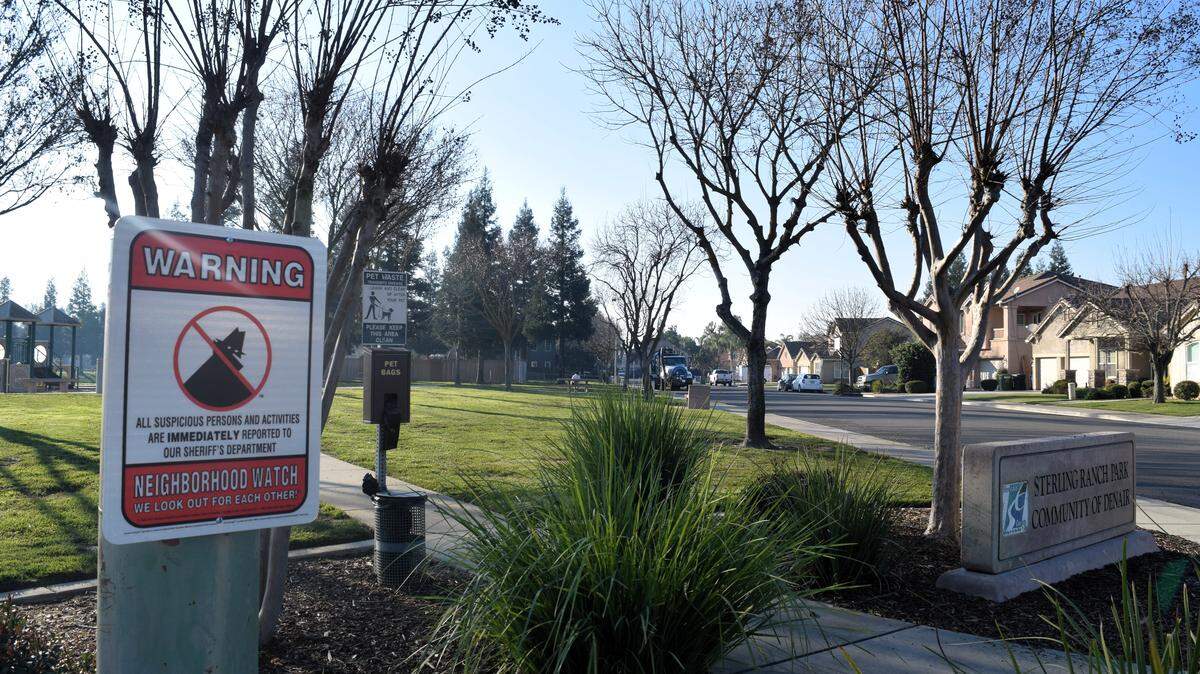
Last summer, Denair resident Michael Wagoner noticed vandalism at Sterling Ranch Park, including a swastika, a gang symbol and a slur scribbled in permanent marker on a playground slide.
Wagoner and some parents in the neighborhood tried but couldn’t remove the markings, so they contacted the Stanislaus County Parks Department for help.
“It was during the weekend, and we called the county, and they came on Monday and cleaned it up very well,” Wagoner said.
He said he has also seen what he believes are gang members at the park and has heard reports of groups of kids picking fights, including confrontations with children playing baseball He said he could tell they were gang affiliated because of his experience as a former correctional officer.
In August, Wagoner and other residents started a Neighborhood Watch program.
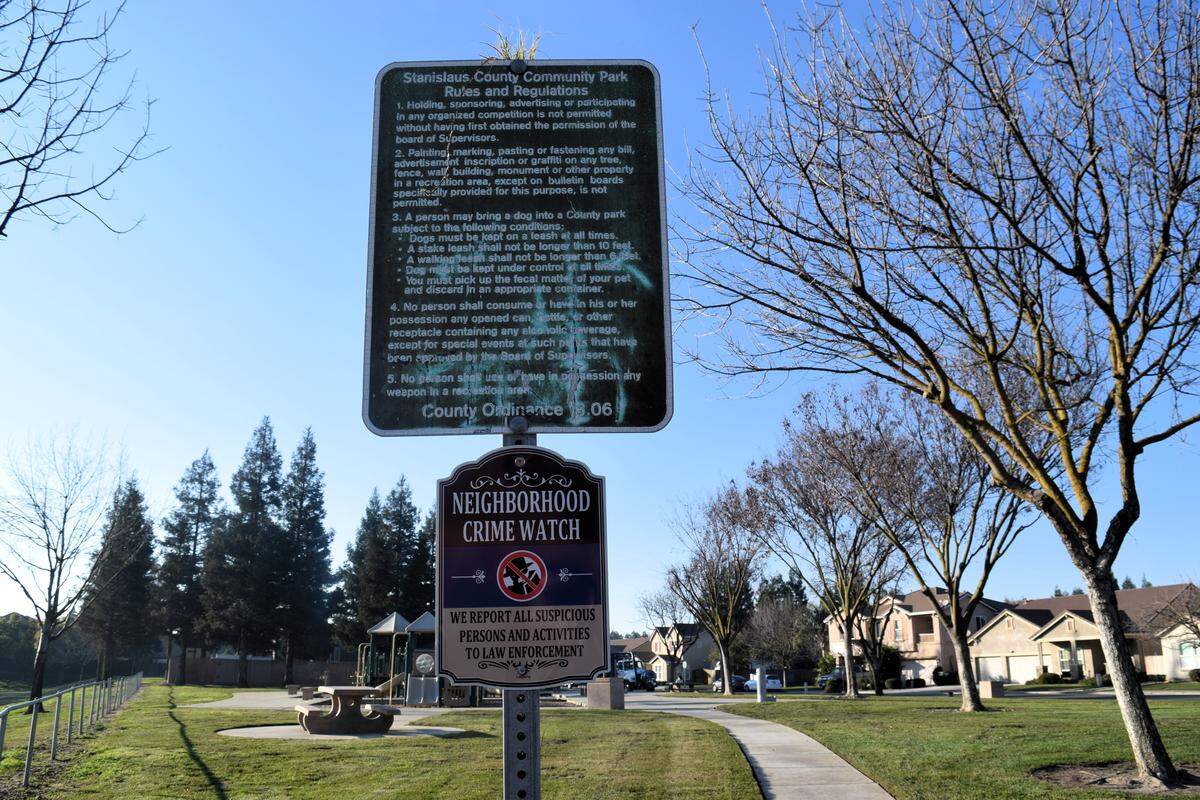
Sterling Ranch Park, where there no longer is any visible evidence of the vandalism, now has signs — which Wagoner helped install — warning that suspicious activity will be reported to the Sheriff’s Office.

In November, a petition was created by Denair resident Janisse Foresti, asking for the appointment of a full-time assigned patrol deputy in Denair. It had 470 signatures as of Thursday.
“Our town is a close-knit community, home to families and individuals who value peace and security. However, over the recent months, our community has witnessed an alarming rise in crime rates,” reads the petition. “Without a dedicated law enforcement presence, we feel increasingly vulnerable in our own homes.”
Denair has never had a deputy assigned exclusively to the town. Although a substation operated about 15 years ago, it was not staffed around the clock or supported by a dedicated team.
Instead, Denair is served by a Community Resource Unit deputy who splits time between Denair and Keyes, conducting patrols in and around the community and responding to neighborhood concerns. The deputy also attends Denair Municipal Advisory Committee meetings and provides updates.
“When I was on my way here, somebody from the audience … ran a stop sign right here around the corner. They saw that we were coming into the same parking lot, so they just turned around and left,” said Deputy Christian Izquierdo during his update in January. “Even when you’re coming to a MAC meeting, you still need to stop at the stop sign.”
Not enough crime or money
At a MAC meeting in December, Sheriff Jeff Dirkse said the town does not have enough crime to justify a full-time deputy. He said that even if the Stanislaus County Board of Supervisors were to fund and allocate such a position, he would advise against it because the call volume does not support the price tag.
The Sheriff’s Office is authorized for 208 operations deputies, though it employs only about 190.
Dirkse added that communities such as Keyes and Empire have a greater need for an assigned patrol deputy. Denair averages about three calls for service in a 24-hour period, most of which are not criminal in nature.
County Supervisor Vito Chiesa, who represents Denair, addressed Dirkse’s comments at the following MAC meeting Jan. 6.
He said the county has been more cautious in position allocations due to declining reserves, flat sales tax revenue and property tax growth coming in below projections. The county has been keeping vacancies open — besides the Sheriff’s Office and other critical positions — which can hire all the way to its allotment.
Chiesa said he has no say in how Dirkse allocates his positions, other than the power of the purse, but taking money away from the Sheriff’s Office would only make the county less safe.
He said reopening a substation in Denair is a nonstarter, but he would be open to discussions about community resource officers and speaking with Dirkse. Chiesa added that because Dirkse is elected countywide, he is likely focused on deploying resources where the need and impact are greatest.
In the last year, Denair had about 844 calls for service. The majority of calls included follow-up investigations, disturbances and family altercations.
Dirkse had said that crimes need to be reported — not just posted on social media.
At the meeting in January, Foresti said fear and intimidation might keep people from reporting, and that may explain the low number of calls for service.
“When people don’t feel safe enough to call 911, or don’t believe help will arrive in time, those instances disappear from the numbers, but not from the community’s lived experiences,” Foresti added.
Conversation over enforcement
During public comment, Foresti also raised concerns about what she and others perceived as a suggestion from Dirkse at the December meeting that residents should confront gang members and ask them to leave.
“With all due respect, that expectation places residents in an extremely dangerous position. Civilians are not trained, equipped or protected to confront gangs, and encouraging that kind of interaction could easily lead to someone getting hurt, or worse,” Foresti said.
In a statement to The Bee, Dirkse clarified his remarks, saying he does not advise residents to confront gang members or put themselves in danger. He said his comments were meant to apply only to situations where there is no immediate threat to safety and where a calm, respectful conversation could resolve a misunderstanding or stop unwanted behavior.
“In some circumstances, neighbors or community members may be able to talk with one another or with youth involved to resolve an issue, or even discover there was no malicious intent, without needing to involve law enforcement,” the statement said.
He cited an example shared by a resident who reported speaking with a juvenile who had made a gun gesture. After the resident raised concerns, the youth apologized and agreed not to repeat the behavior.
In another instance, deputies responded to a report of juveniles in a park who were believed to be gang members, only to find that the group was simply playing the card game Uno.
Chiesa, who used to represent Keyes, said he would encourage the baseball teams there to practice in the park and put up lights. Eventually, the community was able to take back the park from the gangs.
“Not by accosting them, but by bringing their kids out,” Chiesa said.