Under Trump, Stanislaus jail transfers to ICE are back. Here’s the process
During former President Joe Biden’s administration, detainee transfers from Stanislaus County jail into Immigration and Customs Enforcement custody dropped to zero. However, since President Donald Trump returned to the White House this year, they’ve resumed.
In Trump’s first administration, there were 147 transfers to ICE out of the Stanislaus County Public Safety Center. During President Joe Biden’s administration, the number dropped to zero, except for one transfer in 2023.
In the first quarter of 2025, there were six transfers.
While Stanislaus County has not experienced public raids or pickups similar to those that have made headlines across the country, people still are being picked up by ICE. Most of those, however, are transferred out of the county jail under specific circumstances.
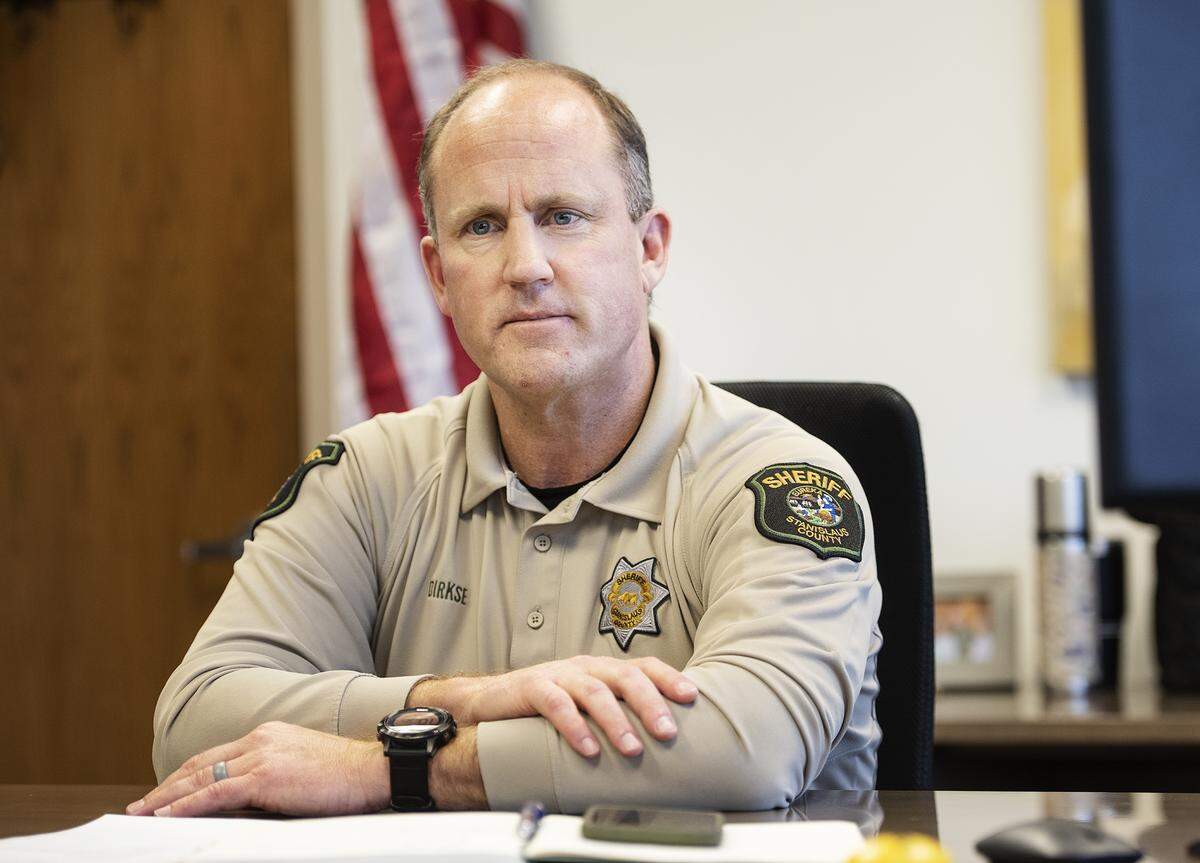
Stanislaus County Sheriff Jeff Dirkse met with ICE officials in February to discuss turnovers under state law, shortly after the immigration raids in Kern County. Dirkse told The Bee in July that this was to get everyone on the same page after the raids.
“Yeah, because it was a cluster. No one knew what was happening with the change of administration,” the sheriff said. “So we called them. … We had a meeting with them right here, to ensure everyone understood the rules. They were actually pretty good to work with.”
Working with ICE to transfer detainees is optional for local law enforcement. However, the Sheriff’s Office has done so for years.
What are the rules?
Anyone arrested by any agency in Stanislaus County, including the Modesto Police Department, is taken to the Stanislaus Public Safety Center, which is run by the Sheriff’s Office. The Sheriff’s Office is required to follow state law to transfer detainees to ICE.
When people are booked into the county jail, their fingerprints are entered into a digital federal database. Fingerprints are flagged by ICE if it believes someone could be in the country unlawfully.
Once ICE identifies someone of interest, it notifies the Sheriff’s Office, which then goes through a checklist to determine whether the person is eligible to be turned over per SB 54, a state law also known as the California Values Act.
SB 54 was enacted in 2017 amid changing immigration policies during Trump’s first term. The law limits how local agencies can work with ICE by prohibiting them from doing any type of immigration enforcement. It also places strict rules on if and when they can transfer someone into ICE’s custody. For instance, people cannot be held past their release time for ICE to come pick them up in California.
It is the burden of the Sheriff’s Office to make sure the detainee can be transferred to ICE under state law.
The checklist used to determine this asks if the detainee:
- Has a multi-source rap sheet
- Is currently arrested on a serious felony
- Is currently arrested on a violent felony
- Has been convicted of a serious felony within the last 15 years
- Has a conviction that requires registering as an arson or sex offender
- Has a misdemeanor conviction in the past five years that meets certain criteria
- Has a conviction of a federal crime that meets certain criteria
The list of what is considered a serious or violent felony is long. Some of the crime categories include drugs, assaults, gun-related charges, grand theft and crimes against children.
Some misdemeanors, known as “wobbler offenses,” also mean someone can be transferred to ICE. A wobbler is any crime that can be considered either a misdemeanor or a felony, such as organized retail theft.
Three outcomes can happen based on this checklist:
- If someone has prior qualifying convictions, a notification is sent to ICE to pick up the person before release.
- If someone doesn’t have prior qualifying convictions, but is arrested on suspicion of one, the Sheriff’s Office will wait to notify ICE until that person is convicted or a judge rules there’s probable cause the suspect may have committed the alleged crime.
- If someone has neither a prior qualifying conviction nor is arrested on suspicion of one, the person does not qualify to be transferred to ICE.
A very small fraction of the people booked into Stanislaus County jail during the last year of the Biden administration were flagged by ICE — less than 1%. Of the 112 people ICE flagged in 2024, the Sheriff’s Office found 87 of them could possibly be transferred under SB 54. But none were picked up by ICE.
Maria Romani, an immigration attorney with the American Civil Liberties Union of Northern California, said the Stanislaus County Sheriff’s Office in the past few years expended a lot of resources flagging people for ICE, but no one would come pick them up.
She said she believes this is because often, by the time ICE officers arrived, the person had been released, according to the parameters of the state law. Additionally, some detention centers closed in Northern California, which reduced the number of ICE agents available to pick up individuals. The closest federal facility to Stanislaus County is in Kern County.
“For [the Sheriff’s Office] to not see anything happen when they flag people must be frustrating,” Romani said.
While the number of Stanislaus County transfers to ICE since Trump retook office in January has increased, the pace still is well below what it was during his first term.
Romani wrote a report in 2022 on interactions between ICE and sheriff’s departments in the Central Valley. It found that the Stanislaus County Sheriff’s Office held at least three people past their release time in 2019 because its policy was still not in compliance with state law.
Emails from that time show confusion surrounding the process of transferring people under SB 54. In an email sent to ICE Deportation Officer Brian Faria, Sheriff’s Office Adult Detention Manager Sandy Beets was unsure if people could be held past their release date.
“I’m so sorry to bother you but we are really confused on this crap,” wrote Beets. “Can you review what our current policy states and let me know if it’s correct or not?”
Following Romani’s report, emails between the two agencies appear to show more caution as it relates to state law.
This story was originally published September 15, 2025 at 7:00 AM.