Some want to see stronger action against fentanyl dealers in Stanislaus, despite OD decline
What looks like a 13% decrease in fentanyl deaths in 2024 is encouraging for Stanislaus County. But the lethal street drug continues to kill residents and some families personally affected want to see more concerted action against dealers.
“It’s hard to believe they can’t find out who is selling these pills,” said Larry Hatfield of Waterford. “You can’t tell me that with 550 deaths, you only had (three) prosecutions.”
The deaths of Hatfield’s 42-year-old daughter and her boyfriend in January last year were among the first fatalities from fentanyl poisoning in this county in 2024.
Since 2018, fentanyl poisoning has been responsible for 541 deaths in the county.
The Coroner’s Office has confirmed 92 deaths due to fentanyl last year, but it’s estimated the 2024 total will be around 120 deaths, compared to 138 in 2023. A three or four month lag in reviewing cases means the total death toll won’t be known before April.
Public health officials are debating the reasons for last year’s nationwide drop in deaths tied to street fentanyl and other drugs. Officials variously cite awareness campaigns warning people about the lethal drug and how it’s combined with many street drugs. Other factors may be additional substance use treatment and more widespread distribution of overdose-reversing naloxone, which can save the lives of people addicted to opioids.
It’s possible drug cartels are selling less potent street fentanyl. The Drug Enforcement Administration reported recent laboratory data showing that 5 of 10 pills sold on the streets contained a lethal amount of fentanyl, down from 7 of 10 pills in 2023.
But county residents still are dying from fentanyl. The projected mortality last year works out to two to three deaths per week.
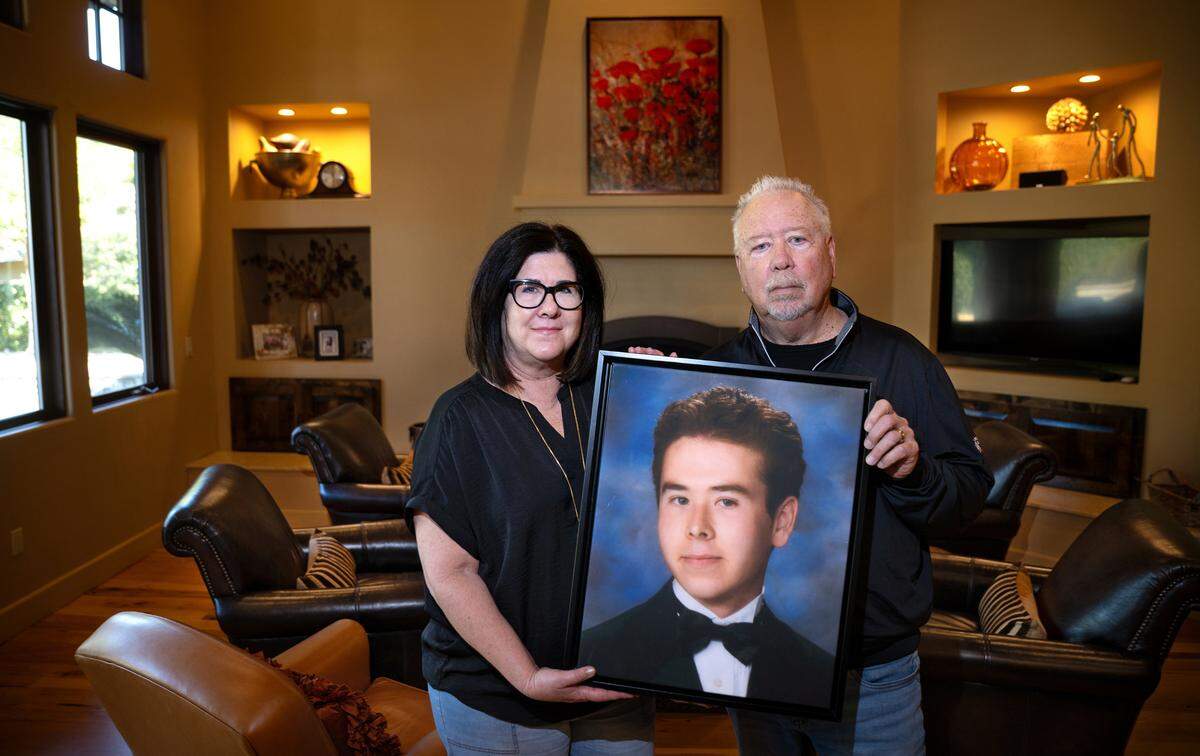
The drug scourge has upset the lives of numerous parents in the Northern San Joaquin Valley, including Steve and Kim Roland of Ripon. The Rolands lost their 23-year-old son, Max, while they were on a trip to Scottsdale, Ariz., in May 2023.
Max was on a PlayStation game with a friend online and went silent without explanation. The next day, the friend sensed something was wrong because Max uncharacteristically did not call to talk about the Golden State Warriors game, which was on TV.
The friend called the Modesto apartment complex where Max lived. The manager ran over to check on him, Steve Roland said.
“They called us when they found him and they called the police,” said Roland, a real estate broker. It took about two months to learn the cause of death, Roland said. Toxicology tests came back showing traces of fentanyl in his system.
The parents believe their son took Molly, or Ecstasy, that was laced with fentanyl. The synthetic opioid is so potent that only a few milligrams can be fatal.
Max was the only child of the Ripon couple, who used the in vitro process to conceive. Steve and his son enjoyed attending 49er football games and watching the Warriors and other sports.
Steve said Max was a passionate football fan and also was into music, both writing and recording rap songs. Last month, the Rolands suffered through a second Christmas season without their son.
“Every Christmas, he used to spend the night and get up in the morning with us and open presents,” Steve Roland said. “It seemed like it was tougher this last year. It was hard, a lot of tears.”
Critical of investigation into daughter’s death
Hatfield proposes a fentanyl task force with a rapid-response team and dedicated investigative unit to find who’s responsible for incidents of fentanyl poisoning. Under his plan, the county district attorney would assign the same prosecutors to fentanyl cases. The task force also would include experts on the subject matter, professionals in the substance use field and other agencies to tackle the crisis from different angles.
Hatfield said he educated himself about the street drug after the bodies of his daughter, Cory, and her boyfriend were found the evening of Jan. 7, 2024, at a Hart Road home west of Modesto. Her boyfriend was lying on the bed. Cory’s body was on the side of the bed.
Test results six weeks later showed a megadose of fentanyl in the pills Cory ingested. Hatfield believes she died the night of Jan. 5 or morning of Jan. 6, because Cory’s daughter had texted the name chosen for her baby Jan. 6 and never got a response.
Hatfield is critical of the law enforcement investigation into Cory’s death. He said a sheriff’s detective told him not to expect much. It took months for the forensics work on Cory’s phone, which attempted to determine who sold her the pills, Hatfield said.
He said the investigation was closed in mid-April after the investigator said no evidence was found on the phone, which remains in the possession of the Sheriff’s Department. The family told authorities about a suspected dealer’s home where Cory had obtained pills before, Hatfield said.
The only account of what was said during the investigation comes from Hatfield. A May 6 email from Sheriff Jeff Dirkse, shared by Hatfield, said investigators had no leads to pursue and the suspected dealer information was turned over to the department’s drug unit for follow-up.
Dirkse did not return messages seeking comment for this story.
‘The concept is ... it’s your fault you died’
Hatfield said his daughter was overprescribed pain medication for symptoms of multiple sclerosis, starting in 2005, which led to addiction to opioid painkillers. Cory was found with Narcan in her purse, suggesting to law enforcement she knew she was buying fentanyl-laced pills. That’s considered a stumbling block for criminal prosecutions.
“The concept is: You know what you were doing, therefore, it’s your fault you died,” Hatfield said. It reflects stigma and bias against substance use disorder and should not absolve criminal conduct, he argued.
District Attorney Jeff Laugero said Thursday that he will meet with Hatfield to discuss his task force proposal and hear about his experience. “Although it will be beneficial to explore these proposals, I want to assure the community that there is a protocol in place to effectively investigate these cases,” Laugero said by email.
Laugero said local agencies are using protocols and best practices when investigating suspected fentanyl poisoning deaths. The investigations are fact specific and ensure a thorough collection of evidence, he said.
“We have and will continue to file murder charges against fentanyl dealers when we have the facts and evidence and can meet our ethical obligations,” Laugero said.
Stanislaus County has had three fentanyl murder cases, two of them ending with guilty pleas to involuntary manslaughter. A third court case involves a 1-year-old victim in Riverbank and is pending in Superior Court.
Matt Capelouto, whose daughter died from fentanyl poisoning, said he’s seeing a shift toward more aggressive criminal justice in dealing with the drug crisis in California. In Riverside County, where he lives, the sheriff has promised every fentanyl death will be investigated, as a potential homicide, and the district attorney has filed charges of second-degree murder against dealers in dozens of fentanyl cases.
Capelouto, the president of Stop Drug Homicide, said drug overdose deaths in the nation still hovered around 100,000 last year and the decrease is not cause for celebration. Noting the biggest decrease was among teenagers and young adults, Capelouto said he believes parents talking with their kids and education in schools made a difference.
He also gave credit to law enforcement efforts and drug seizures and arrests at the border. “It’s going to take a multifaceted effort to stop this problem,” Capelouto said.
Proposition 36, approved by voters in November, includes Alexandra’s Law, named for Capelouto’s daughter. It requires an admonishment in court to drug offenders, making them aware of potential murder charges if they’re caught selling dangerous drugs.
Ultimately, stronger laws are needed in California to make it less challenging to prosecute fentanyl dealers, Capelouto said.
Crisis a tragedy for families
Steve Roland said it took four to five months for Modesto police to find what was on his son’s phone. According to Roland, police concluded that Max probably obtained the fentanyl-laced drug from a person in the Bay Area.
At this point, it would be hard to prove exactly who furnished it and that it contained a lethal dose of fentanyl, Roland said. But he said a task force would focus a variety of resources on a drug crisis that’s causing tragedy for families.

“The state is making small strides,” Roland said. “There is so much more they could do and should do.”
Roland said Max worked for a service giving cell phones to homeless people, which made his parents hopeful he would see where substance abuse leads. He went through drug rehab twice and seemed to improve, but would slip back, his father said.
The Rolands draw on support from attending meetings of the StanHOPE group, made up of people who lost family members to fentanyl. The couple participated in an awareness event at Modesto Junior College attended by 2,000 people, where Steve read a poem.
Cari Graham of Modesto also gave vocal support for the task force proposed by Hatfield. Graham said she first heard about fentanyl in August 2020 when her son, Eric, told his grandmother he had experimented with fentanyl and heroin, causing an uproar at home.
Two months later, 37-year-old Eric, a humble guy with a giving heart, was dead. The autopsy said the cause was fentanyl and a heart murmur.
“I found a fentanyl group and met a lot of people who lost their children,” Graham said via email. “They have a support system. I was grateful to have our group.”
This story was originally published January 19, 2025 at 6:00 AM.