Use-of-force expert says fatal shooting of unarmed man by Modesto cop was reasonable
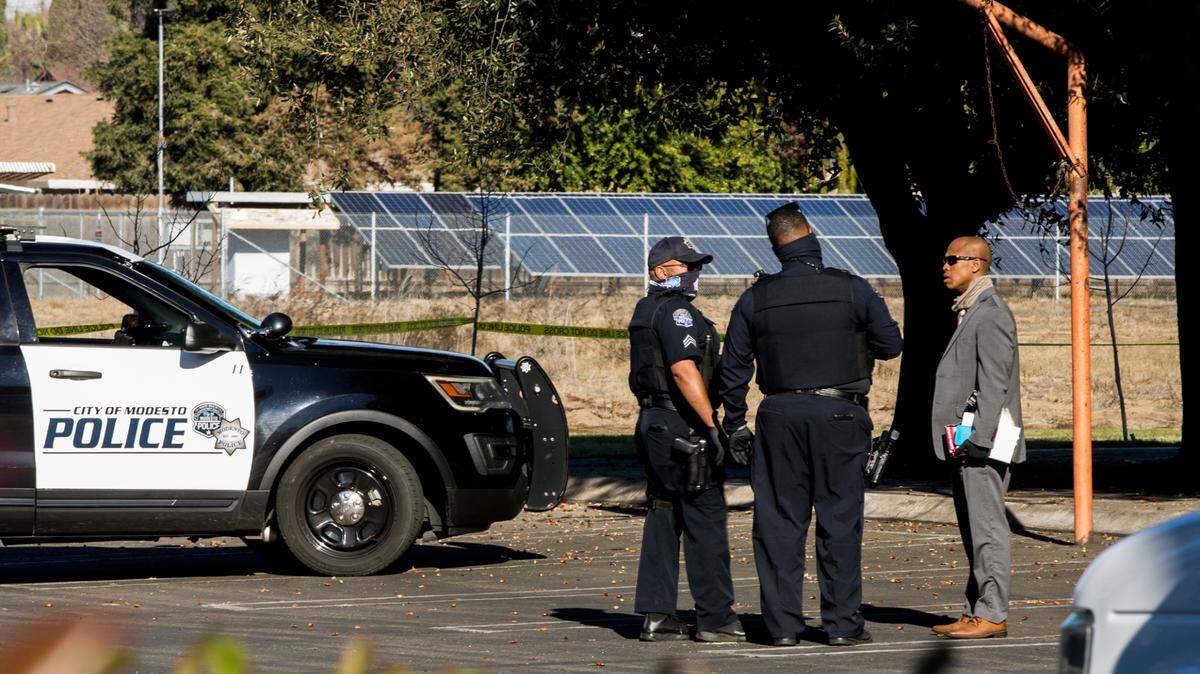
The deadly shooting of an unarmed man by former Modesto police officer Joseph Lamantia was reasonable because he believed he faced an imminent threat of death or injury, according to a use-of-force expert who testified in a preliminary hearing last week.
Jeffrey Martin was hired by the Stanislaus County District Attorney’s Office to give his opinion about the Dec. 29, 2020, shooting of Trevor Seever, but he testified as a witness for the defense on Friday, citing a 29-page report he drafted.
Lamantia was fired and charged with voluntary manslaughter three months after he fatally shot Trevor Seever at the Church of the Brethren on Woodland Avenue. He remains free on bail.
Lamantia began firing at Seever within three seconds of seeing him running away and within one second of giving the commands to “show me your hands,” according to testimony from Stanislaus County District Attorney’s Office Lt. John Locke.
Lamantia told Internal Affairs Sgt. James Reeves he could see that Seever was not pumping his arms, describing them as “stagnant in front of him,” and thought he was reaching for a gun in his waistband.
Martin testified that, given the totality of the circumstances, an objectively reasonable officer facing similar circumstances would reasonably believe himself in immediate threat of death or serious bodily injury.
Those circumstances include reports by Seever’s family that he said he had a gun, that the family fled its home as a result, and that Seever’s arms were not pumping in the normal fashion of someone who is running but rather were in front of him. It also included Lamantia’s knowledge of an officer safety bulletin about Seever’s posts on social media that said, “A good cop is a dead cop” and “All I want for Christmas is another dead MPD Officer.”
Martin said his conclusions are based on a law on use of deadly force that went into effect Jan. 1, 2020, the same year Lamantia shot Seever.
Under the law, an officer is justified in using deadly force to defend against an imminent threat of death or serious bodily injury to himself or to another person. It also can be used to apprehend a fleeing person who caused or threatened death or serious injury if the officer reasonably believes the person will cause death or serious bodily injury to another unless immediately apprehended.
The new law added definitions for “deadly force,” “imminent” and “totality of the circumstances,” as well as amended self-defense language to include “objectively reasonable force” as a standard by which an officer’s actions are judged, according to the California Commission on Peace Officer Standards and Training. The definition of “imminent” says a reasonable officer must believe that the subject of the force has the “present ability, opportunity, and apparent intent to immediately cause death or serious bodily injury to the peace officer or another person.”
Though Seever never had a gun, Martin said that with the set of knowledge Lamantia had, it was reasonable to conclude that Seever had the ability and the opportunity to harm him and that Seever’s intent should be implied based on his movements while running.
“Because if the officer waits to see a ... movement that clearly demonstrates what that intent is, by the time that movement is completed, muzzle flash might be what the officer is seeing and it might be too late for the officer to effectively defend (himself),” Martin said.
While Martin believes it was reasonable for Lamantia to conclude the threat he faced was imminent, he did not believe it was reasonable for Lamantia to think there was an imminent threat against Seever’s family, which was a block away at a different church.
Martin is a retired Bay Area police officer who teaches courses in officer-involved shooting investigations, use-of-force law and human factors. He also does consulting and expert witness services.
He also testified for the defense in the trial for Justin Wall, the Stanislaus County sheriff’s deputy who was acquitted of voluntary manslaughter in 2021.
The preliminary hearing for Lamantia started in November but was postponed after he broke his foot while visiting his family in Montana for Thanksgiving. The hearing is held for a judge to determine if there is enough evidence for the charge to stand and proceed to trial.
The prosecution rested its case Friday after testimony from Locke and Reeves concluded.
Both Stanislaus County Deputy District Attorney Rick Mury and Lamantia’s attorney Roger Wilson led Reeves through a line of questioning that supported each of their cases.
Wilson focused on the portion of the law about the reasonableness of force.
Reeves agreed it is reasonable for an officer who is told a suspect is armed to believe the suspect is armed and to draw his weapon in response because the suspect could kill or seriously injure him.
Reeves also agreed that a suspect reaching for his waistband is a concern because guns often are stored there, that an officer needn’t wait for a firearm to be pointed at him to use force, and that a suspect can fire a gun while running.
Mury asked Reeves about what Lamantia said his state of mind was during the incident.
In his line of questioning, Mury emphasized that Lamantia never considered that Seever might not have a gun or might not fire it.
From the time he started responding to the call at McHenry and Briggsmore Avenues to the time when he arrived at the church, Lamantia was convinced Seever was planning to find and kill his family, Reeves testified. When he drove into the church Lamantia then thought Seever was going to ambush and kill him. And when he saw Seever running away he switched back to thinking he was again after his family.
Since the shooting, Seever’s family has said that he was in the middle of a mental health crisis and needed help. They have filed a wrongful death lawsuit in the case.
The hearing in the criminal case will continue on Feb. 9 with additional testimony from Martin, as well as testimony from Modesto Police Officers who worked on the SWAT team with Lamantia.
This story was originally published January 23, 2023 at 4:05 PM.