Juror in deputy’s manslaughter case talks about why they acquitted, dismissed jurors
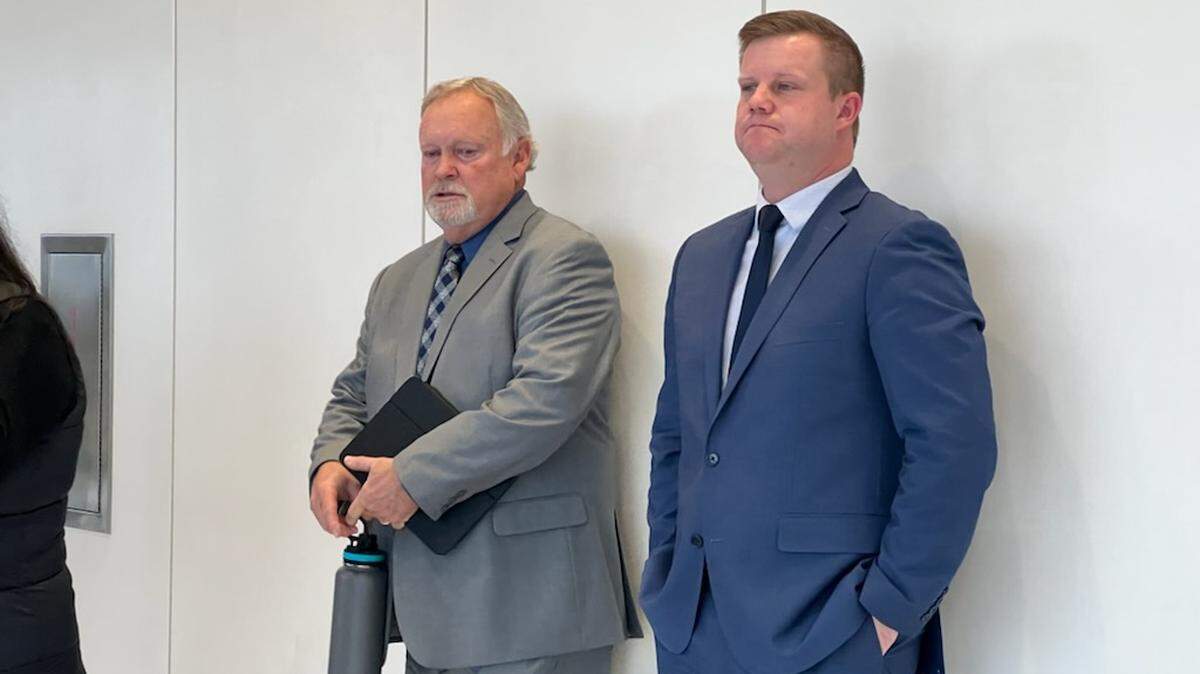
Stanislaus County Sheriff’s Deputy Justin Wall will soon return to full duty following his acquittal last week on a voluntary manslaughter charge for a 2017 on-duty shooting.
The jury forewoman in his case spoke to The Bee following the Dec. 13 verdict, providing insight into how they reached their decision and the reason two jurors were dismissed three days into deliberations.
“There was so much reasonable doubt that was still left in us at the end of the day,” Sarah Jones said. “There’s a lot of buts and what-ifs that we didn’t feel was proven from the DA’s side no matter how we looked at it.”
Wall was charged with voluntary manslaughter more than a year after shooting 46-year-old Evin Olsen Yadegar in a residential neighborhood in Ripon on Feb. 26, 2017, after a pursuit from a Salida hotel.
Wall fired four shots into Yadegar’s vehicle as she was pulling away from officers. Wall testified that he never perceived the vehicle moving forward, only backward, and that he fired because he feared for the lives of the deputies and officer who were behind it.
The shooting was captured on a Ripon Police officer’s dash camera.
“The video’s extremely horrific and it’s very emotional and you can clearly see what transpired but you can only see one angle (and) ... there’s no machine stuck to (Wall’s) mind to tell us what he’s thinking or reading,” Jones said.
She said she and other jurors didn’t agree with San Joaquin County Chief Deputy District Attorney Robert Himelblau’s argument that Wall’s body actions, lunging forward as Yadegar’s vehicle moved forward, demonstrate that he perceived the vehicle moving forward, not backward.
A use of force expert testified that Wall experienced “change blindness” because, once he perceived the threat to the deputies and officer behind the vehicle, he attempted to holster his Taser and drew his firearm.
“At the end of the day, there just wasn’t enough proof to say that’s not what had taken place,” Jones said.
Jones said she and other jurors were not particularly moved by any one person’s testimony, including Wall or the other deputies and officer at the scene.
Those law enforcement officers who were near the rear of Yadegar’s vehicle when it went in reverse testified they were in fear for their lives.
Jones said the actions of the deputies and officer seen on the dash camera video solidified their testimony.
They jumped away from the vehicle, one pushed off the vehicle with his hand, and one or more of them could be heard saying, “Whoa.”
“There’s action there to show that some of those officers were really afraid that they were going to get hurt,” Jones said. “And for that we felt that it was justified that he shot.”
Jurors dismissed
The jury started deliberating late in the afternoon on Tuesday, Dec. 7.
Three days later jurors went back into the courtroom with several questions. Testimony about the Sheriff Department’s policy at shooting at moving vehicles was read back to them and Wall’s defense attorney explained that they had to evaluate Wall’s actions based on what a reasonable peace officer would do under the same circumstances.
Jones said after that she was asked to meet with the judge. She said she was instructed not to talk to anyone about the nature of the discussion, which was closed to the public.
Not long after that meeting, two men on the jury were dismissed.
“Unfortunately we had disagreements with some jurors and it got kind of heated and disrespectful,” she said. “It was not getting anywhere, it was becoming very personal and disruptive.”
At least one of the men thought Wall was guilty and was the first to speak in the deliberation room. Jones said before all the jurors had even put their coats on their chairs he said that he’d made up his mind and the other jurors had until the next day to change it.
He wanted to make an example out of Wall, and spoke of holding accountable officers who kill people in the line of duty, Jones said.
“It’s almost like he said what he needed to say ... to get on (the jury) and then he walked into deliberation saying something completely different,” Jones said. “It really just blew all of our minds.”
The other juror, Jones said, didn’t think the deputies and officer who testified were sincere about being in fear for their lives.
Jones said everyone assumed there would be a mistrial and they were surprised when the judge dismissed the jurors.
The Bee tried to talk to one of those dismissed jurors as he was leaving the courthouse, but he said he couldn’t discuss the case, which at that point was still ongoing.
Gabriel J. Chin, a professor of law at the University of California at Davis, said jurors can be dismissed for a number of reasons, including lying to get on the jury or refusing to participate in the deliberation processes.
He said they must agree to listen to all views and to consider the arguments of others on the jury and participate in weighing the evidence.
“The trick is discriminating between someone who has legitimately made up their mind and has a firm belief based on the evidence and jury instructions and listened to what other jurors said … and has heard enough, versus someone who is not willing to listen to jurors on the other side,” Chin said. “It’s a fine line.”
Chin said if a judge removes a juror from the panel because of their refusal to deliberate and there’s a conviction, the defense would certainly appeal. But the prosecution cannot appeal an acquittal because of double jeopardy.
Two alternates were sworn in on Dec. 13 and in less than four hours the new jury had reached its verdict.
‘A punch in my gut’
The case was difficult for everyone involved, Jones said, including the jurors.
“A lot of people said … it’s not going to be something that is easily forgotten,” she said. “It is definitely going to stay with us for a long time and it will probably play a big factor in how we perceived things going forward.”
Wall, through his attorney Paul Goyette, has declined to comment for any story but Goyette said, “Regardless of the outcome of the trial it absolutely is going to stick with him. He feels terrible there was a loss of life but in all honesty, he feels like he was doing his job” by protecting his fellow officers.
“Here’s a kid who goes to work a regular shift, gets involved in an incident such as this and then is looking at his whole life being turned inside out and possibly going to prison,” Goyette said. “Going to prison as a police officer is a whole different animal than going to prison as a civilian. It’s a daunting prospect, it’s incredibly stressful.”
Evin Yadegar’s widower, Hanibal Yadegar, said as much as he’d prepared himself for the possibility of an acquittal, “This has been a punch in my gut. This just hurts. But you know what, I need to move forward, for me and my son.”
“I’m going to leave him, the shooter, to God, destiny, whatever your beliefs are,” Hanibal said. “If he is OK with what he’s done, it’s his business.”
He said Himelblau gave Evin Yadegar her day in court and represented her professionally and capably. “That is what I am at peace with,” he said.
Prosecuting the police
Himelblau said he has prosecuted homicides for the past 26 years at the San Joaquin County District Attorney’s Office. As far as he is aware, this is the first time the office has prosecuted a law enforcement officer for an on-duty shooting.
“We are in uncharted territory,” he said; there’s no class on how to prosecute these cases or studies about how jurors typically react to them.
But prosecutors are increasingly charging peace officers with crimes related to use of force as a national debate rages over police brutality and misconduct, which came to the forefront with protests following the death of George Floyd.
Himelblau said two other deputies were prosecuted under similar circumstances in other counties around the same time as Wall. All the cases involved officers shooting into vehicles and their claims of self defense or the defense of others.
Los Angeles County Sheriff’s Deputy Luke Liu, charged with voluntary manslaughter for a 2016 shooting, was the first law enforcement officer in the county to be charged for an on duty shooting in more than two decades, according to the Los Angeles Times.
Liu shot and killed 26-year-old Francisco Garcia in the back as he was driving away from him in a stolen vehicle at a gas station.
The defense said the vehicle struck Liu, but multiple witnesses disputed that description and a doctor who treated him testified he had no significant injuries, according to the newspaper.
Liu’s attorney also said Garcia reached for something in the vehicle, which he feared was a weapon. Garcia did not have a weapon.
The news site reported the LA County Sheriff Department’s policy prohibits shooting into moving vehicles under nearly all circumstances, while the Stanislaus County policy uses softer language saying it “should” not be done in most circumstances.
Unlike Wall, Liu did not testify.
While Wall was on his third day of trial on Nov. 19, a jury in Liu’s case delivered a not guilty verdict.
A few weeks before that, a Contra Costa County jury reached a verdict in a case against a sheriff’s deputy there.
Deputy Andrew Hall fatally shot 33-year-old Laudemer Arboleda in November 2018 but the District Attorney’s Office there didn’t charge Hall until April 21, 2021, a day after Minneapolis police Officer Derek Chauvin was convicted of killing Floyd, according to CNN.
Like with Wall, the shooting followed a slow-speed pursuit and Hall used his vehicle to try to box in Arboleda’s vehicle.
Hall fired 10 rounds when Arboleda attempted to slowly maneuver between Hall’s patrol vehicle and another vehicle, according to The Mercury News.
The defense argued that he fired in self defense to avoid being crushed while the prosecution said the shooting was unreasonable and unnecessary.
Unlike in a case involving a civilian who claims self defense, the law allows for a peace officer to be the “aggressor” and put himself in the situation that led to the shooting, Himelblau said.
The jury in Hall’s case was hung and a mistrial was declared on the charge of involuntary manslaughter but jurors found Hall guilty of the charge of assault with a firearm.
Having been cleared by internal affairs, Hall had continued working as a sheriff’s deputy and was involved in a second fatal shooting before he was charged, according to the Mercury News. The felony conviction now makes Hall ineligible to continue serving as a sheriff’s deputy.
The jury in Wall’s case didn’t have any other charges to consider.
Himelblau said voluntary manslaughter was the only appropriate charge in this case. “Anything less would have been unacceptable.” Moreover, he said, “No lesser or other charge would have eviscerated the defense.”
Wall has been working on modified duty, in an “unarmed support capacity” since he was charged.
His acquittal means he can now return to full duty. Sheriff Jeff Dirkse said an exact date for Wall’s return has not been determined but he must first go through “additional updated training before returning to the streets.”