
Gas prices rise for first time in weeks, cap-and-trade effect cited
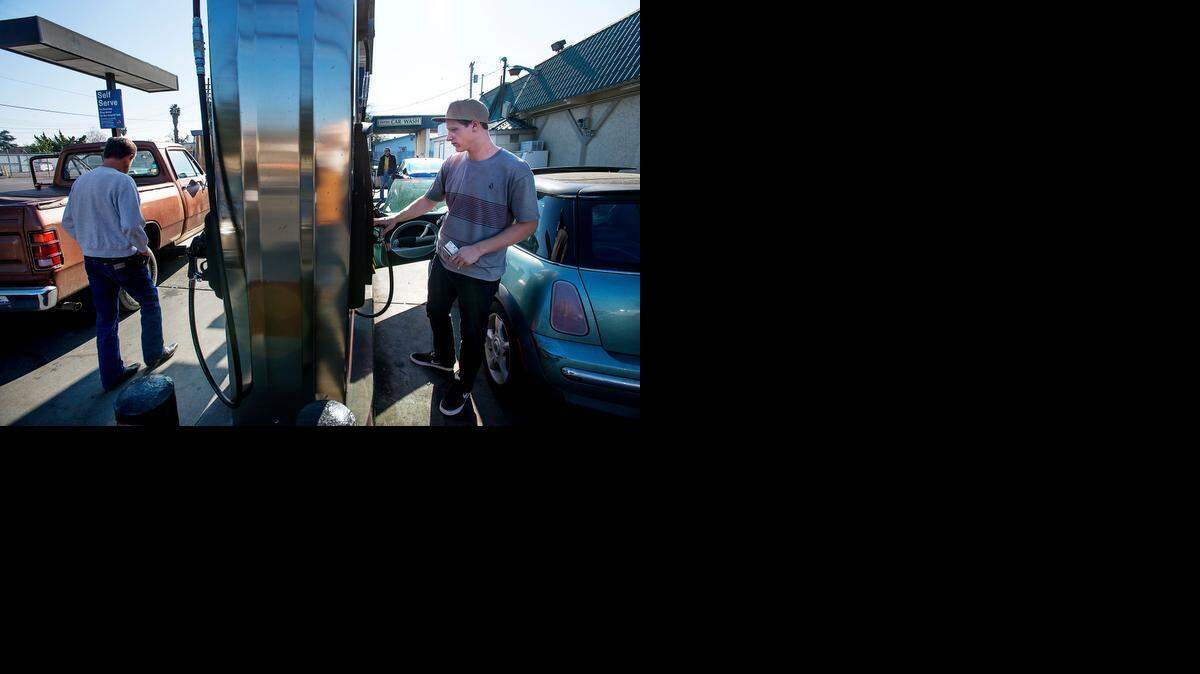
As New Year’s revelers slept, gas prices across California reversed their downward slide and crept higher, marking the Jan. 1, 2015, opening of the state’s cap-and-trade market.
In Modesto, price changes waited for Friday, bumping up 3 cents a gallon on average to $2.49, according to the website www.modestogasprices.com. Even so, the average remained a penny below a week ago, when most motorists last filled up their tanks. A month ago, the price of a gallon of gas hovered around $2.86.
At the Fast & Easy Mart Chevron station on McHenry Avenue, the cost of a gallon of unleaded regular hopped up 6 cents Friday. Clerk Dar Muhamma said no one had complained about the change as of mid-day Saturday.
Honestly, she had not noticed, said customer Maria Sanchan. “It matters. Of course, it matters; gas is so expensive,” she said before pumping the $2.59 a gallon fuel.
On Yosemite Boulevard in Empire, prices jumped 10 cents a gallon Friday at the pumps at Fastrip by Empire Liquors, manager A.J. Shah said. “We have no control of gas prices. Fastrip decides what price they want to sell it,” Shah said Saturday.
No one pumping gas there complained about the increase either, but they noticed. “$2.19 is still cheap,” said customer Vincente Rojas, who drove from his home on the far side of Modesto to fill up with what he thought would cost $2.09 a gallon. “I noticed how cheap it was coming back from Yosemite (National Park) the other day,” Rojas said.
“I was on my way to Modesto anyway,” said Sean Dunkirk of Waterford. “It’s always cheaper here.”
Cheap, in the world of gas prices, is always relative. In the first week of January in 2014, a gallon of unleaded regular in Modesto averaged $3.56.
Experts called this week’s uptick a subdued response to the state’s new requirement that oil companies buy credits to offset the carbon emitted by cars and trucks.
Wildly different predictions swirled in recent weeks for how much gas prices would rise when the industry was included in California’s cap-and-trade market. State officials and some environmentalists insisted California’s effort to combat climate change would cost travelers just a few cents a gallon.
Oil industry leaders raised fears of spikes as high as 75 cents or more a gallon. On Friday, the statewide experience was much like Modesto’s, a small bump largely masked by the steep decline in gas prices over the past year. National gas price tracker GasBuddy.com said the average retail price of gas in California on Friday was $2.64 a gallon, up 2 cents from New Year’s Day.
The added tax, at least initially, failed to override market forces that have pushed the prices down all year – plentiful fuel supplies and plunging prices for crude oil, which closed below $53 a barrel Friday on the New York Mercantile Exchange.
Dave Clegern, an Air Resources Board spokesman, said the board does expect gas prices to edge up in January: “We don’t see them going up more than a dime, at the most, based on any current cap-and-trade compliance costs. We won’t speculate on fuel price projections, but the high-end numbers would require the cost of carbon allowances to increase more than six times beyond where they are now.”
Patrick DeHaan, senior petroleum analyst for GasBuddy, attributed the New Year’s price bump to cap and trade, but he offered a similarly humble projection of price increases over the short term: “I think (gas) station margins will be affected more than consumers,” he said, predicting a rise of 6 to 10 cents over the next week.
It is too early to say what the long-term effects will be of California’s cap-and-trade market, the regulatory mechanism that puts a price on carbon spewed into the atmosphere.
Under the program, a centerpiece of the state’s landmark 2006 climate change law, big companies have to pay for the right to emit greenhouse gases. They must purchase carbon allowances, either at quarterly state-run auctions or on the open market.
The market-based approach gives companies flexibility for complying with the regulation. Most of the emissions allowances are given for free. But if their emissions exceed the cap, companies can buy more credits or find ways to reduce their carbon footprint. The total amount of carbon that can be emitted in the state, the “cap,” declines slightly each year.
Mark Glover of The Sacramento Bee contributed to this story.
Bee education reporter Nan Austin can be reached at naustin@modbee.com or (209) 578-2339. Follow her on Twitter @NanAustin.
This story was originally published January 3, 2015 at 6:36 PM with the headline "Gas prices rise for first time in weeks, cap-and-trade effect cited."