
SPECIAL REPORT: Stanislaus County food inspections turn up an array of eye-opening violations
In this day and age, surely every chef and short-order cook knows to wash hands and cook meat thoroughly so no one gets sick. Right?
Well, maybe. But to improve the odds against food poisoning and its ugly side effects – diarrhea, vomiting and sometimes worse – the government regularly sends inspectors into restaurants, markets, gas station convenience stores and school cafeterias to make sure the rules are being followed.
Inspectors pop unannounced into more than 2,300 food service providers throughout Stanislaus County at least twice a year. In the past two years, they’ve suspended licenses 43 times for violations ranging from lack of hot water and warm refrigerators to roach and rat infestations and sewage on the floor.
“We hope all our businesses stay viable, but our job is health and safety,” said Jami Aggers, director of the county’s Department of Environmental Resources. Her office deploys 14 inspectors throughout the county. In addition to food service, they also check wells, septic systems and tattoo shops.
Most of what they find, good or gross, is available to anyone with Internet access. Those who aren’t tech-savvy can ask to see hard copies of inspection reports, which must be produced at every food service business.
Some areas of California go a step further, posting letter grades in eateries’ windows reflecting general sanitation and food safety practices. Momentum for such seems lacking in the Northern San Joaquin Valley, although Aggers isn’t opposed.
Neither is Deirdre Schlunegger of Food Safety News, a national group combating foodborne illness, whether from restaurants or other sources. “People are still getting sick” despite years of advocacy, she said. “When 3,000 people a year still die from eating, that’s unacceptable.”
That statistic is an estimate from the federal Centers for Disease Control and Prevention, whose network surveys 15 percent of the nation’s population to chart problems and detect trends. The agency blames food poisoning for making 48 million Americans sick each year, sending 128,000 to hospitals.
Salmonella continues to sicken more people than the nine other pathogens tracked by the agency’s FoodNet, or Foodborne Diseases Active Surveillance Network. But the rate of salmonella poisoning for every 100,000 people is about the same as it was from 2006 to 2008, while campylobacter infections, often linked to contaminated chicken, have increased 13 percent. Vibrio sicknesses, linked to raw shellfish, have gone up 75 percent and are at their highest level since 1996.
Five deaths were reported in a multistate listeria outbreak from caramel apples, including one in California, and 24 others sickened, the CDC reported a week ago.
Aggers’ inspectors hope to keep bad numbers at a minimum in these parts. For a look at the inspection process, click here.
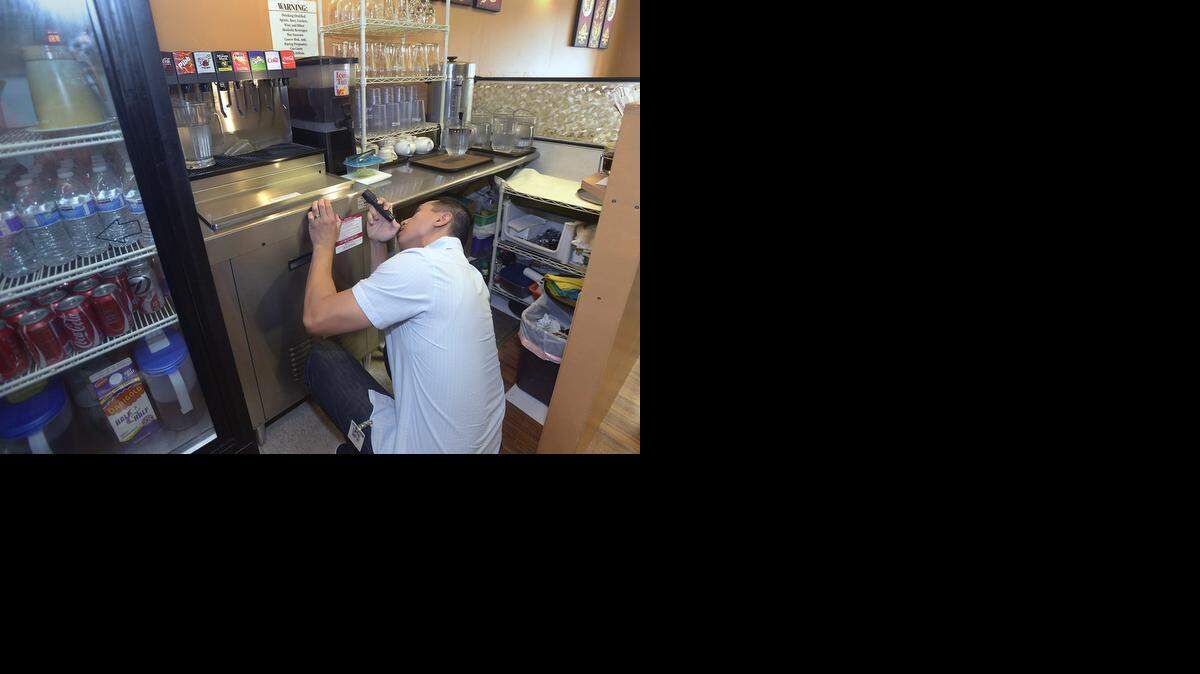
“I’m protecting the public from potentially getting sick,” said Wallace Low, who never leaves home without his trusty thermocouple.
He sticks it under running bathroom faucets to see if water gets hotter than 100 degrees. Another probe makes sure restaurant refrigerators aren’t warmer than 41 degrees. Low also tests temperatures of broccoli, olives, abalone – whatever businesses offer people to eat.
He whips out a small flashlight and leans behind a stove, looking for grease and bugs. He sees if soap and paper towels are in dispensers. He puts a small paper test strip on dishware just coming out of a sterilizer; if it was washed with the proper concentration of sanitizer, the strip turns bluish-purple.
Most operators don’t cop an attitude, Low said, because they know he has power to shut them down if everything is not in order.
When that does happen, it’s usually a short-lived closure until violations are fixed. Repeat offenders, or people who seem to need a wake-up call, can be ordered to appear at the Department of Environmental Resources for office hearings with scowling administrators. Those are relatively rare; only three shops have been hauled in within the past five years.
That almost always brings people around, Aggers said, but if not, she can ask the District Attorney’s Office to bring action to close a scofflaw. Janis Mein, director of health and code enforcement, recalls threatening a Wendy’s restaurant some 25 years ago and none since.
Before she was promoted, The Modesto Bee followed Mein on inspection rounds – like Low – for a similar report 10 years ago. At the time, Stanislaus didn’t have money to put inspections on the Internet for easy consumer access. That changed in 2006 with the introduction of an online searchable database.
Stanislaus’ website is the only one in the Northern San Joaquin Valley to post inspection reports of each of its more than 2,300 facilities. The website is limited, however, because the user must know a restaurant’s name or address from a broad field. Also, there is no way to search for time-based reports in case someone wants to avoid eateries with recent problems. To see for yourself, go to http://sbtapp1.co.stanislaus.ca.us/DERFoodFacilities.
Reports on San Joaquin’s website are color-coded, allowing a user to quickly see if an eatery has had major problems (red) as opposed to minor (blue) or those that have been corrected (green), but no specifics are listed. Go to www.sjcehd.com/Programs/Consumer_Protection/food_and_restaurant_inspections.htm.
Merced’s website – the first offered in this area, in 2003 – seems the most helpful because it includes a grading system based on “bad” points awarded for various findings in each inspection. Viewers can spot underperformers by simply scrolling through a list on the homepage, and can dial into specific problems noted in an inspector’s comment field. Go to http://apps.co.merced.ca.us/PublicApplets/pages/FoodInspect/FoodInspect.aspx.
Merced’s civil grand jury investigated its environmental health department this year and last after receiving complaints that inspectors had fallen behind in their work.
Bee staff writer Garth Stapley can be reached at gstapley@modbee.com or (209) 578-2390.
This story was originally published December 27, 2014 at 4:00 PM with the headline "SPECIAL REPORT: Stanislaus County food inspections turn up an array of eye-opening violations."