
Conference zeroes in on Valley economy
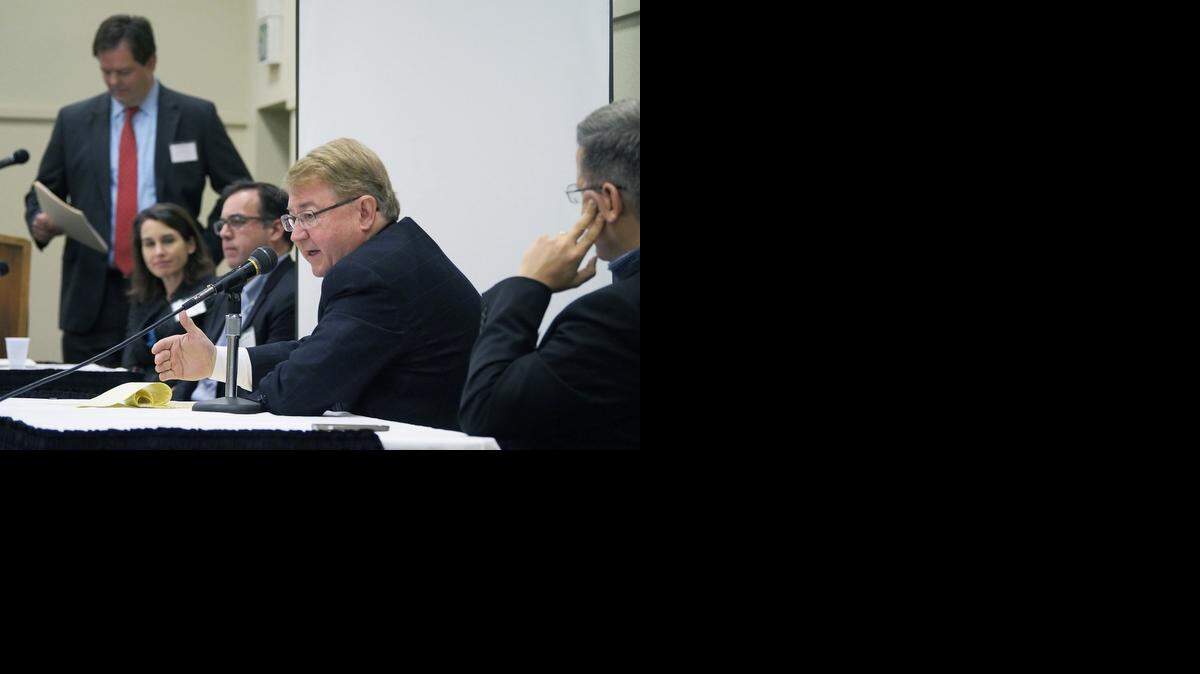
Officials gathered Wednesday at Modesto Centre Plaza to talk about why the Northern San Joaquin Valley should define itself as a region distinct from the rest of the San Joaquin Valley and align its economic destiny with the Bay Area and Sacramento region.
This was one of the key points from the University of the Pacific’s North San Joaquin Valley Regional Economic Assessment Conference, which drew about 75 people. UOP’s Business Forecasting Center has spent about a year compiling data for the conference.
Business Forecasting Center Director Jeff Michael said the Northern San Joaquin Valley’s three counties – San Joaquin, Stanislaus and Merced – have gotten lost in economic planning efforts for the eight-county San Joaquin Valley, which stretches from Stockton to Bakersfield.
He added that while the Northern San Joaquin Valley shares some characteristics with the San Joaquin Valley, such as agricultural-based economies and high unemployment, the three counties are closer to and more economically integrated with the Bay Area and Sacramento region. For instance, as of 2010, about 70,000 Northern San Joaquin Valley workers commuted to jobs in the Bay Area.
The Northern San Joaquin Valley economy also is less dependent upon agriculture and has more jobs in warehousing, transportation, logistics and manufacturing than the rest of the San Joaquin Valley.
The conference featured panel discussions with officials from the three counties who work in economic development. It also featured Robert Burris, executive vice president of the Sacramento Area Commerce & Trade Organization, and Tracey Grose, vice president of the Bay Area Council Economic Institute, who talked about their experiences in regional economic development.
Besides making the case for defining the Northern San Joaquin Valley as its own region, a case also was made for a regional approach to economic planning and development. While panelists agreed that their organizations need to work together to market the Valley, there was not consensus on a cohesive effort for planning and development.
The conference provided some arresting details:
▪ When asked how Bay Area companies perceive the Valley as a place to relocate or move part of their operations, Burris said they generally have little or no understanding of the Sacramento region and the Valley. “There is no real vision of what it means to move 70 or 80 miles to the east or northeast,” he said.
▪ In 1970, per capita income in the Northern San Joaquin Valley was 10percent higher than the national average and just a little less than the Bay Area’s. In 2012, the Valley’s per capita income was 15percent less than the national average, while the Bay Area’s was 35percent higher.
▪ The Valley’s decline in incomes started in the 1980s when agriculture went through a rough patch and the Valley experienced some of the larger trends affecting the national economy, such as the decline of manufacturing and the rise of knowledge and service workers.
▪ The Valley’s population has more than doubled from 1970 to 2012, from about 600,000 residents to about 1.5million, but the number of people employed on farms has held steady at about 40,000.
▪ The Northern San Joaquin Valley has the second-lowest level of what is called human capital in California, with only the rest of the San Joaquin Valley having a lower level. Human capital includes such measurements as the number of college graduates in a region.
▪ Panelists said the Valley can build on its strengths in agriculture by taking part in the effort to marry technology with agriculture to produce self-sustaining, healthy food. This is what UC Davis is doing with its World Food Center in Sacramento.
Michael, the Business Forecasting Center director, said the assessment is about 80percent complete. Once the project is finished, he said, the center will produce a final report. He said one purpose of the conference was to gauge the interest in seeing the Valley as its own economic region and for a more regional approach to marketing and developing the Valley.
Bee staff writer Kevin Valine can be reached at kvaline@modbee.com or (209)578-2316.
This story was originally published November 19, 2014 at 6:49 PM with the headline "Conference zeroes in on Valley economy."