
Family of Turlock woman struggles with loss, fights for damages
More than 20 months ago, Nicole Dias of Turlock died after hospital staff allegedly failed to diagnose and treat a dangerous infection that rampaged through her body.
Her husband and other family members continue a slow process of seeking damages for the 27-year-old woman’s death Jan. 19, 2013, at Kaiser Modesto Medical Center.
While they wait on the legal process, they mostly deal with loss.
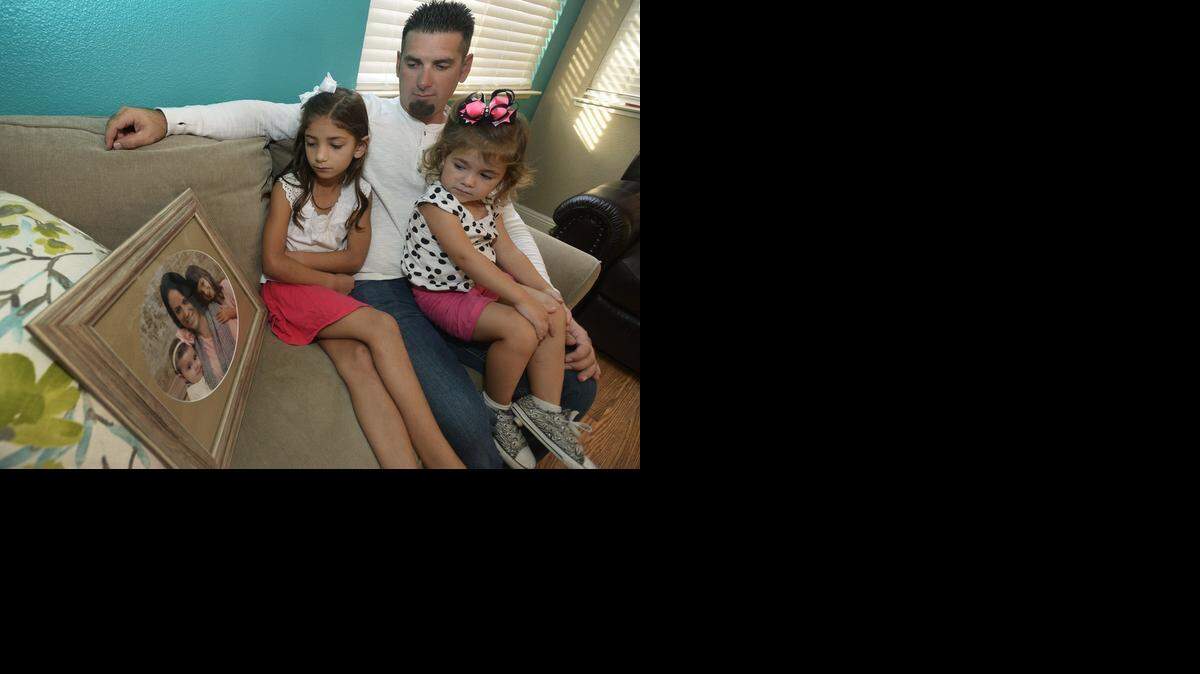
Ryan Dias no longer has a wife to provide comfort when their 2-year-old daughter, Aubree, cries or to nurture the two other children they were raising.
“It’s hard to think that our daughter won’t have any memory of her mom,” Dias said. “I see her mom in the way she acts and talks. Nicole isn’t there to see how she’s growing and how she’s so much like her mom.”
Genna Cousineau of Patterson said her best friend was her sister Nicole, and she liked the idea of naming her seventh child after her. But Nicole wasn’t there for the birth in April 2013. Cousineau was sick with grief for the last three months of her pregnancy, she said.
“It tore me apart to see her suffer like that,” Cousineau said. “I was in and out of the hospital sick and could not keep food down. The stress was horrific.”
Dias finds it hard to bear the ads that portray Proposition 46 as a boon for lawyers and leading to skyrocketing health care costs. He found out the hard way about California’s $250,000 limit on pain and suffering damages in malpractice lawsuits.
If Nicole Dias had not been working, a state law enacted almost 40 years ago would limit the payment of damages for her death to that quarter-million. As his lawsuit progresses, Dias will try to recover economic damages for his family by citing the lost earnings from her former job at E.&J. Gallo Winery. Those damages are not subject to a cap.
Any amount awarded for emotional distress would be spread among Dias and the children.
“It does not begin to make amends for what they did,” he said. “The law is supposed to protect people, to save lives by making doctors accountable for their actions.”
Proposition 46, opposed by a $58 million campaign funded by insurers, would raise the pain and suffering cap to just more than $1 million, to account for inflation, if voters approve the initiative Nov. 4.
Negligence admitted
A month ago, Kaiser agreed in a stipulation that it was negligent in not admitting Nicole Dias to the hospital during an emergency room visit Jan. 17, 2013. If she had been admitted, it’s probable her staph infection would have been diagnosed and successfully treated with antibiotics, said the stipulation in Cousineau’s case against Kaiser. The nonprofit health care giant still contests that it owes Cousineau for emotional distress.
Deborah Friberg, interim manager for Kaiser’s Central Valley area, declined to comment on details of the allegations out of respect for patient privacy and confidentiality laws. “In cases where the outcome is not what we expected or up to our standards, we vigorously investigate to understand the cause and modify, change or improve our practices and procedures where needed,” Friberg said. “Ms. Dias’ death is a tragedy and we express our sorrow and condolences to her family and friends.”
On Jan. 14, 2013, a Monday, Dias went to her primary care doctor with excruciating pain in her lower back. She could barely walk and also had pain in her right buttocks that shot down her legs. The doctor advised her to visit the emergency room and have an MRI done at Kaiser’s Dale Road hospital in Modesto.
Dias was told by emergency room staff she likely faced a daylong wait for an MRI. She was diagnosed with sciatica and sent home with pain medication. Sciatica is pain down the back of a leg often caused by a bulging spinal disc pressing on the nerve.
Family members said Dias was in terrible pain and vomiting the next day. Cousineau agreed to drive her back to the emergency room and was shocked by her sister’s appearance as she struggled to get into her car. At the hospital, they asked the doctor for an MRI to look at her lower back but were told the procedures have to be scheduled.
“They were telling my sister she had to wait her turn and she wasn’t sick enough,” Cousineau said. She asked if something else could be done to find out what was wrong. An X-ray revealed nothing, and Dias was poked and prodded with needles as she lay in excruciating pain, Cousineau said.
According to records, Dias was given five medications to reduce her pain and was discharged.
After four days of intense pain, Nicole was in bed screaming and breaking down mentally Jan. 17, Ryan Dias said. The throbbing pain had spread to her chest, upper back and arms. He was convinced she was suffering from more than sciatic nerve pain.
“She was talking to her mother, who had passed away 10 years prior, telling her she wanted to go with mom and can’t handle the pain she was in,” Dias recalled. “If anyone touched her slightly, she screamed in pain.”
He asked Cousineau to come over and help persuade Nicole to return to the hospital. They called an ambulance, and when she was moved from the bed to gurney, “I will never forget the screams she let out,” Cousineau said.
This time, an MRI was performed at the hospital, but it did not reveal any problem in her lower spine. An echocardiogram was run because her heart rate was elevated, Dias said.
The doctor again diagnosed her with sciatica and declined to admit her to a hospital bed. Family members argued with the on-call doctor, insisting she be admitted for more tests. They heard the doctor say, “That’s not my call to make.” Nicole was discharged with instructions to see her primary care doctor and a pain specialist – and not return to the hospital, family members said.
As she left the hospital, she looked at her sister and said, “I love you,” three times. “Those were the last words I would hear from her,” Cousineau said.
On suicide watch
Nicole called her primary care doctor and the pain clinic the next day, but the calls were not returned, her husband said. That afternoon, she told her husband she needed to return to the ER, and he carried her to the car.
She lost all patience as she talked with hospital staff that day. She said if she did not get relief from the pain, her husband should shoot her in the head. Based on that comment, staff placed her on suicide watch in a room with no monitors and a security guard posted at the door, family members say.
Wesley Pratt, Ryan Dias’ attorney from San Francisco, said that action further delayed any attempt to diagnose her illness. Dias said they waited for three hours until a new nurse arrived on a shift change. The nurse looked at Nicole’s pale, clammy face and yellowing eyes and called for help.
By that time, Cousineau said, her sister was hallucinating and her vital signs were unstable. The medical staff concluded she had sepsis, a toxic response to an infection in her bloodstream, and she was moved to intensive care, where doctors pumped an array of antibiotics into her veins.
Family and friends who gathered at the hospital waited into the late hours. After a few hours, a doctor told Dias they had maxed out the doses of medication and it was only a matter of time before Nicole’s heart would fail. When asked if the medical staff should try to resuscitate her, Dias said every effort should be made to save her.
Cousineau was outside the room when she heard the code blue. She ran into the room and saw doctors and nurses trying to revive her sister. Feeling faint, Cousineau was walking toward the door when she started to fall and a nurse helped her into a chair.
Nicole Dias was pronounced dead at 7:35 a.m.
“I was holding her hand when she took her last breath,” her husband said. Cousineau stayed in the room for hours and snipped a lock of her sister’s hair that she now keeps on a necklace.
According to records, doctors thought Dias’ organs failed because of septic shock that stemmed from pneumonia. The family did not learn the true cause until receiving results of a Jan. 23 autopsy performed at UC Davis Medical Center in Sacramento.
Dias had a staph infection from an abscess in her right pelvis, which had caused those initial shooting pains down her leg. The autopsy said the necrotizing inflammation spread through her blood vessels and severely damaged her lungs, heart and kidneys.
Family members allege that Kaiser staff disregarded signs of infection that week, such as chest pain that worsened with breathing, progressive illness, nausea, low-grade fever and a pulse of 139 beats per minute Jan. 15.Dias might have exhibited a higher fever if not for the fever reducers in the pain medications, they said.
The autopsy noted that sepsis frequently progresses to severe sepsis, septic shock and death if it goes unrecognized and is not treated.
“If they had just run a blood test, there would have been multiple markers for infection,” said Daniel Glaser, attorney for Cousineau. “The liability portion of this case is astoundingly sad. They had multiple opportunities to figure out what was wrong with her.”
Wrongful death claim
Ryan Dias filed a wrongful-death lawsuit in May 2013, naming Kaiser Foundation Health Plan, Kaiser Foundation Hospitals, the Permanente Medical Group, Dr. Aliasgar Saifuddin Chinwala and other defendants. Cousineau, her father, Nick Rivera, and brother Andrew Rivera are seeking damages for negligent infliction of emotional distress.
Chinwala was the doctor who saw Nicole Dias in the ER on Jan. 17, 2013. He graduated from medical school in 2009 and had practiced medicine in California for six months.
An arbitration hearing in Cousineau’s case is set to begin Nov. 5. Glaser said they face the challenge of showing that Cousineau was traumatized by observing the negligence.
Kaiser has contributed $5 million to the $58 million campaign to defeat Proposition 46, according to the secretary of state’s office, compared with $7 million raised by the Yes on Proposition 46 campaign. If the initiative is approved, it would raise the cap for these cases and all others resolved after Jan. 1.
Attorneys said Kaiser health plan subscribers don’t always know they sign away their right to a jury trial for claims of negligence. According to the terms of Kaiser health plans, those issues are handled through binding arbitration. An independent arbitrator will consider the complaints filed by Nicole Dias’ family members and the decisions will be binding.
Nicole, who was married to Ryan Dias for about two years, worked in customer service for E.&J. Gallo Winery and had received an award for her efforts. The couple enjoyed camping with the kids, theme parks and off-road vehicle “rock crawling” on their favorite trails in the Sierra.
Ryan said he took a month’s leave from work to deal with overwhelming grief and depression after Nicole’s death. “The only thing that kept me going was the kids. If it wasn’t for the kids and what they needed, I don’t know what would have gotten me out of bed,” he said.
He leaves home at 5:30 each morning to build dairy facilities, which has forced him to scramble to get the kids ready for day care or school. He has often left work early to pick them up from school.
Besides trouble with her pregnancy, Cousineau said she suffered from loss of sleep and nightmares and underwent counseling for her emotional distress. She beat herself up with thoughts that she did not do enough to help her sister.
Cousineau’s youngest daughter was named Madeline Nicole and has the same feisty traits as her late aunt, Cousineau said. She has no guarantee an arbitrator will award damages in her case, but “I want justice for Nicole, just the acknowledgment that this happened. It happens more than we think,” she said.
This story was originally published October 18, 2014 at 6:11 PM with the headline "Family of Turlock woman struggles with loss, fights for damages."