Police, experts warn of growing e-bike safety concerns in Stanislaus County
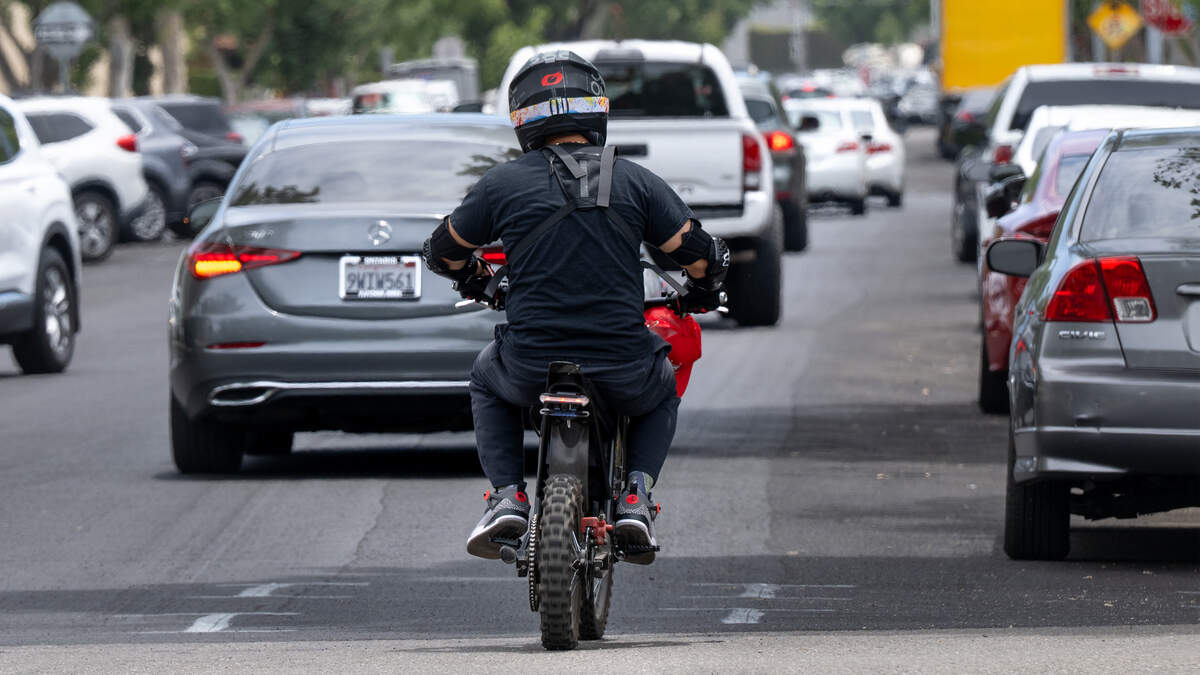
Law enforcement agencies across Stanislaus County say they are responding to a growing number of crashes, complaints and dangerous riding involving e-bikes and other motorized two-wheel vehicles. The activity has prompted increased enforcement, safety education and discussions about potential policy changes.
Police officials in Modesto, Ceres, Turlock and other communities in the county told The Bee they have seen a rise in unsafe riding behavior in recent years, with many of the incidents involving juveniles. Common complaints include riders running stop signs and red lights, riding against traffic, weaving among vehicles, performing wheelies, riding without helmets and operating high-powered electric motorcycles commonly mistaken for e-bikes.
Transportation researchers say the trend is being seen well beyond Stanislaus County. But they also caution that many crashes attributed to “e-bikes” may actually involve vehicles that do not meet California’s legal definition of an electric bicycle.
“We are seeing a rise in rash, reckless riding, crashes and injuries,” said Asha Weinstein Agrawal, director of education at the Mineta Transportation Institute at San Jose State University and lead researcher on the institute’s recent California e-bike safety report.
“But one of the most important things people need to understand is that many of the vehicles being called e-bikes are not actually legal e-bikes.”
Modesto reports dozens of injury crashes
Among local agencies, the Modesto Police Department provided the most detailed data illustrating the trend.
According to the department, officers documented 97 injury collisions involving e-bikes or electric scooters in 2025, including nine collisions resulting in severe injuries.
Through the first half of 2026, officers had already documented 34 injury collisions, including two severe head-trauma cases. Both victims are expected to survive.
As e-bike and e-scooter incidents increase, violations by riders of basic bicycles continue to be a problem as well. Officers have responded to 227 calls for service involving bike groups this year. Enforcement efforts have resulted in 71 bicycle impoundments and approximately 25 citations, according to the department.
Modesto police said public concern extends beyond official calls for service.
“When MPD references an increase in community concerns regarding e-bikes and scooters, those concerns include both formal calls for service and concerns shared directly with officers during community interactions and patrol activity,” department spokesperson Herman Sahota said.
The department said riders frequently fail to stop at stop signs and traffic signals, ride against traffic and disregard other traffic laws — behaviors that officers believe contribute to injury collisions.
City officials are also researching possible updates to Modesto’s municipal code governing e-bikes and motorized scooters, although no proposed ordinance changes have been finalized.
Similar concerns in Ceres, Turlock and across the county
The same pattern is emerging elsewhere in the county.
Ceres police said calls related to bicycles and motorized e-bikes have increased, with juveniles accounting for most violators.
Department spokesperson Lt. Jeffrey Godfrey said officers commonly encounter riders performing wheelies, swerving toward oncoming traffic, running stop signs, occupying multiple traffic lanes, riding against traffic and failing to wear helmets.
“I think this is a growing problem in all communities, as well as Ceres,” Godfrey said. “Parents need to be aware and have conversations with their minor children about the dangers of riding their bicycles unlawfully.”
Ceres police have partnered with Stanislaus County Health Services Agency and Ceres Unified School District on bicycle safety education while also conducting enforcement operations funded through an Office of Traffic Safety grant.
In Turlock, city public affairs analyst Dominique Roton said officers have also seen an increase in complaints and incidents involving e-bikes and electric motorcycles.
The department said common violations include riding in traffic lanes, traveling against the flow of traffic, running stop signs, performing wheelies and riding after dark without lights.
Turlock police recently investigated two crashes involving minors — one resulting in a possible broken foot and another in minor scrapes because the rider was wearing a helmet.
The department said parents often mistakenly believe electric motorcycles are toys rather than motor vehicles capable of speeds exceeding 50 mph.
The Stanislaus County Sheriff’s Office said it has also experienced an increase in calls for service involving e-bikes, electric motorcycles and electric scooters.
Spokesperson Sgt. Michael Carranza said most incidents involve juveniles riding erratically, including steering toward moving vehicles, parked cars and pedestrians.
Deputies commonly encounter unsafe riding behavior such as abrupt turns into traffic, taking over travel lanes, performing wheelies and other stunts that impede traffic.
Carranza said minors make up the overwhelming majority of complaints handled by the Sheriff’s Office.
Recent crashes in Patterson and Riverbank involved minors operating illegal electric motorcycles or adult-size electric scooters, he said. In each case, investigators determined the juvenile rider was the party at fault.
The Sheriff’s Office has begun distributing safety flyers through schools and social media and is producing a public service announcement focused on the issue.
CHP: Know what qualifies as a legal e-bike
The California Highway Patrol has also observed an increasing number of e-bike crashes.
Data provided by the CHP’s Modesto area office showed reported e-bike crashes increased from 18 in 2023 to 53 in 2024, a 194% increase.
Officer Aaron Fay, the agency’s public information officer, said many riders and parents remain unfamiliar with California’s e-bike laws.
Under state law, a legal e-bike must have fully operational pedals, a motor producing less than 750 watts and fall within one of three classifications based on speed and motor assistance. Vehicles without pedals generally are not considered e-bikes and may instead be regulated as electric motorcycles.
“Before parents purchase or allow their children to ride around public streets with an e-bike, they need to first familiarize themselves with the dangers and with the laws regarding e-bikes,” Fay said. “Most importantly, talk to their children about it as well.”
Researcher: Many crashes may involve illegal vehicles
Agrawal, of the San Jose State transportation institute, said one of the biggest challenges is that the public often uses the term “e-bike” to describe nearly any two-wheeled electric vehicle with pedals, even though many do not legally qualify as e-bikes under California law.
She suspects many serious crashes involving young riders actually involve higher-powered electric motorcycles that are being marketed and sold as e-bikes.
“My suspicion is that a very large fraction, particularly the youth who are involved in crashes and injuries, are likely riding these overpowered devices,” she said.
Agrawal pointed to informal surveys conducted by Bay Area bicycle advocates who examined electric vehicles parked at high schools. They estimated that more than 80% appeared not to meet California’s legal definition of an e-bike.
While the surveys were not scientific, Agrawal said they illustrate what many transportation experts believe is a widespread misunderstanding among consumers across the state.
“I don’t think people understand what they’re buying,” she said. “People assume it’s a bike because it has pedals and a motor, but many of these devices have much more powerful motors or reach much higher assisted speeds than are legally allowed.”
She said California could improve safety by doing a better job educating consumers about what qualifies as a legal e-bike before families purchase one.
What California law says
California law recognizes three classes of street-legal e-bikes. All legal e-bikes must have fully operable pedals, an electric motor producing no more than 750 watts and a permanent manufacturer label identifying whether the bicycle is a Class 1, Class 2 or Class 3 e-bike.
- Class 1 e-bikes provide motor assistance only while pedaling and stop assisting once the bicycle reaches 20 mph
- Class 2 e-bikes can be propelled by a throttle or while pedaling but also stop providing assistance at 20 mph
- Class 3 e-bikes provide pedal assistance up to 28 mph but may only be operated by riders who are at least 16 years old and are required to wear a helmet
California Attorney General Rob Bonta and district attorneys across the state issued a consumer alert earlier this year warning that many vehicles marketed as e-bikes are actually electric motorcycles or mopeds under California law. Vehicles that exceed California’s speed or power limits—or that lack fully operable pedals—may instead be subject to motorcycle or moped laws, including registration and licensing requirements.
The consumer alert urges buyers to remember: “If it’s too fast, it’s not an e-bike.”
Education, infrastructure both part of solution
Asked what works best to reduce injuries, Agrawal said there is little rigorous research evaluating whether specific education or enforcement programs are most effective.
Still, she believes several steps could make an immediate difference: educating parents and young riders, removing illegal high-powered vehicles from public roads and improving the state’s public information about e-bike laws.
“I don’t think anybody, with enormously tiny numbers of exceptions, understands the classifications,” she said.
She noted California offers no simple public handbook explaining e-bike rules similar to the driver’s handbook motorists receive.
“The state could help by publishing, even if it’s only online, an official guide explaining the rules people need to know,” she said.
Agrawal also said communities should not view enforcement as the only answer.
She argued safer infrastructure — including physically separated bike lanes — can reduce crashes involving cyclists, pedestrians and motorists alike.
For now, local agencies say the message remains straightforward: Parents should understand what they’re buying, ensure young riders know the rules of the road and remember that many vehicles marketed as e-bikes may actually be subject to an entirely different set of laws.