
Central Valley Sikhs live under cloud of ‘transnational repression.’ What is it?
AI-generated summary reviewed by our newsroom.
- Sikh activists in California report threats linked to foreign government actors.
- Senate Bill 509 proposes law enforcement training to combat transnational repression.
- Supporters say SB 509 protects free speech and diaspora communities statewide.
Anonymous calls. Stalking. Threats of violence. These are only some of the troubling incidents faced by Central Valley Sikh community members for their activism, signaling a larger trend of transnational repression.
The FBI defines transnational repression, or TNR, as cases when foreign governments extend beyond their borders to intimidate, harass or silence members of their diasporas or exile communities. TNR takes many forms, including assassinations and threats, most commonly targeting activists and religious and ethnic minority groups.
“You would think you’re reading the plot of an action movie, but it is not exciting and it’s not entertaining,” said Puneet Kaur, the Sikh Coalition’s senior state policy manager and a Modesto native. “(TNR is) a very alarming, real-life situation that could have killed somebody on U.S. soil.”
California is home to 250,000 Sikhs, the majority residing in the Central Valley, comprising roughly 40% of the Indian American diaspora population in the state. However, in India, Sikhs are a minority, making up less than 2% of the population.
In response to the rise of TNR, a bill championed by Central Valley Assembly members is making its way through the state Capitol. Senate Bill 509 was introduced by Sen. Anna M. Caballero, D-Merced, and co-sponsored by Assemblymembers Esmeralda Soria and Jasmeet Bains.
It would provide training to California law enforcement to recognize and respond to transnational repression. According to advocacy groups, the bill does not create new crimes but rather provides ways to respond to TNR.
“Local law enforcement is often the first to respond when victims are targeted, and they must be equipped to recognize and stop these abuses,” said Kiran Kaur Gill, executive director of the Sikh American Legal Defense and Education Fund. “By defining transnational repression as a serious violation of human rights and training those on the front lines, this bill protects free speech, defends American sovereignty and ensures Californians are not silenced by foreign governments.”
SB 509 emerged as a reintroduction of a similar bill, AB 3027. The previous bill, authored by Bains, was written following the June 2023 killing of Hardeep Singh Nijjar, a prominent Canadian Sikh activist, outside a gurudwara — a Sikh place of worship — in British Columbia, Canada.
Nijjar was an activist in a movement to create an independent Sikh homeland called Khalistan. Following the incident, Canadian Prime Minister Justin Trudeau said Canada was investigating “credible allegations” of Indian government agents being involved in the murder.
Nijjar’s killing had ripple effects in California and the Central Valley. The Sacramento Bee reported that Sikh activists in the Central Valley received threats three days after the shooting.
In September 2023, a Stockton gurudwara known to be supportive of Khalistan was visited by a man who claimed to represent the Indian government and who warned of immigration consequences if the gurudwara “did not back off its pro-Khalistan activism.” Members of Stanislaus Gurudwaras refrained from sharing with The Modesto Bee their experiences with TNR, out of fear of repression.
“When these threats are hitting home so closely, especially at our own houses of worship, it warrants a strong governmental response,” Kaur said. “California is also home to the largest and oldest Sikh population in the entire U.S. and Sikhs have been contributors to the very fabric of this state. We deserve protection, we deserve peace of mind and public safety, and we deserve the right to live and express ourselves freely.”
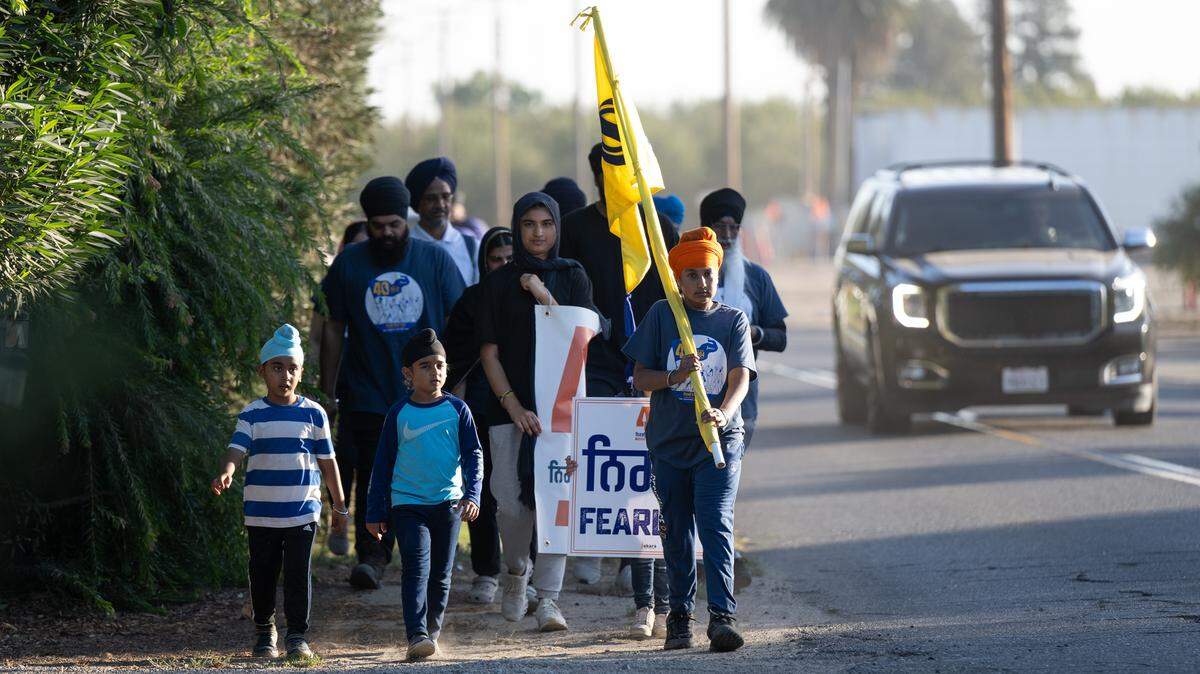
In October 2024, Jakara Movement organized the Fearless for Justice March, where community members, religious leaders, activists and elected officials marched from Bakersfield to Sacramento, including members of various gurudwaras in Stanislaus County. Soria marched along where she heard community concerns, leading her to advocate for SB 509.
“The conversations I had with many Sikhs from Fresno were ones involving harassment, threats and other vile behavior exhibited towards them for simply being Sikh,” Soria said in an emailed statement. “Is that not transnational repression? We will NOT tolerate this repression here in California, period. That’s why I’m proud to support SB 509, and we look forward to it arriving on the governor’s desk this year, and for it to be signed into law.”
The bill isn’t specific to the Sikh community, but rather, all diaspora and exile communities that experience TNR. Hindu, Muslim, Kashmiri, Iranian, South Asian, immigrants’ rights, human rights and law enforcement organizations have come in support of the bill, according to Kaur.
“From many of these diasporas, especially from the Global South, people come here for that very reason (freedom of expression) because they were not able to express their identities or their beliefs in their countries of origin,” Kaur said. “This bill is a first step in the right direction to addressing this very large problem.”
According to Modesto Police Department spokeswoman Sharon Bear, MPD is aware of crimes that may fall under the category of transnational repression impacting diaspora communities. She added that the department maintains “open lines of communication and established procedures with the FBI” to help refer incidents that extend beyond borders and holds officers assigned to federal task forces to address international and interstate cases.
When asked about cases of TNR, Stanislaus County Sheriff’s Office spokesman Sgt. Erich Layton said the department hasn’t dealt with it. He added that it will comply with any mandated training by law.
Hamid Yazdan Panah, co-executive director of the California-based Immigrant Defense Advocates and a member of the Iranian diaspora, advocated for SB 509 having experienced TNR firsthand. His experiences have informed his work as an immigrants’ rights advocate, as he has seen the ways that among asylum seekers and victims of torture, community members are often hesitant to seek assistance from law enforcement. He notes that California is home to more torture survivors compared to other states, estimated to be as high as 500,000 people.
“If immigrants are too afraid to come forward or can’t seek local assistance, then this issue will remain underreported and people will consistently be forced to remain in the shadows,” Panah said. “For individuals who have survived incarceration, detention, and torture, feeling safe and feeling like they can approach the authorities or law enforcement is oftentimes a difficult decision because for them, the experience of they have with law enforcement is not one of protection, but potentially one of persecution.”
The earlier version of the bill, AB 3027, eventually failed to become law during the Senate process. This time around with SB 509, advocates are hopeful about the bill’s trajectory and coalitional support. The bill passed out of the California State Senate unanimously on Sept. 11. Gov. Gavin Newsom has until Oct. 12 to approve or veto the bill.
Bee staff writer Dean Condoleo contributed to this report.