Who is responsible for air quality oversight in Stanislaus County?
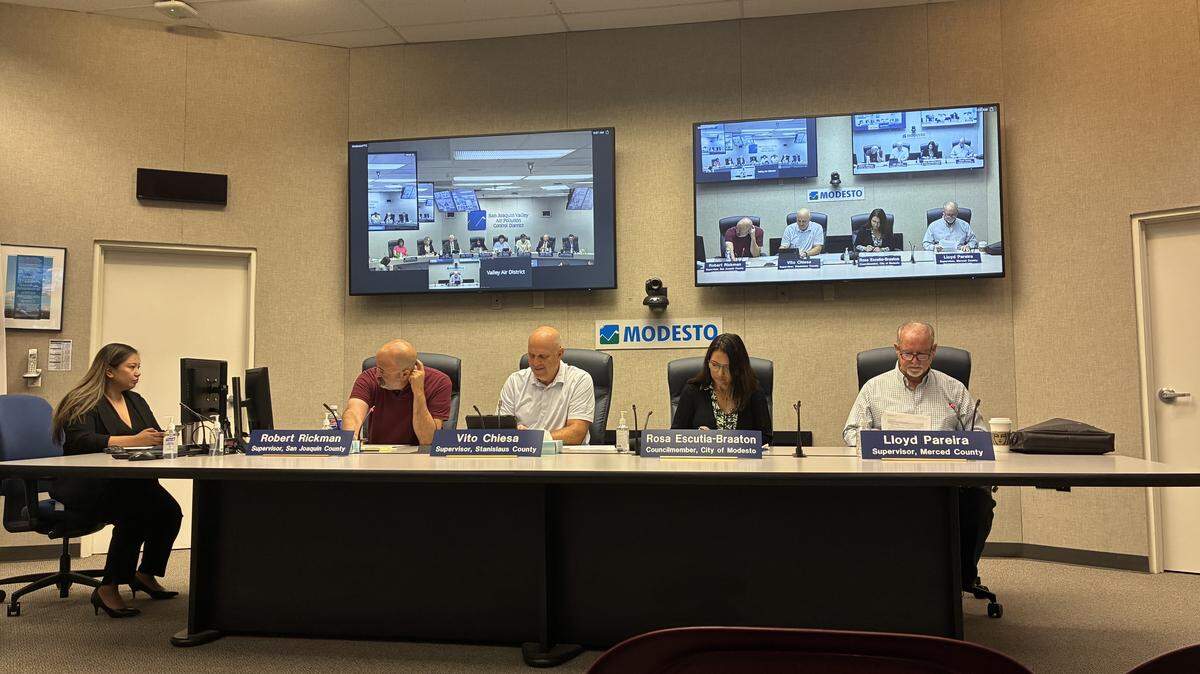
As San Joaquin Valley Air Pollution Control District board members entered a meeting room in a Modesto business park one recent Thursday, the outside air was hazy the day after a Riverbank vegetation fire. The stagnant conditions were all too typical of issues the district addresses.
The 15-member governing board represents the largest air pollution control district in California, overseeing eight counties in the Central Valley, all known for having below-standard air quality.
A week prior, on Aug. 13, community outreach representatives from the air district gave a presentation to local residents at the King-Kennedy Memorial Center in west Modesto. It was part of an air-quality workshop coordinated by Valley Improvement Projects.
“A general mission of our district as a public health agency is to educate the public and really work with you all, community residents, stakeholders, businesses, and agencies, to improve air quality through these strategies,” said Danny Gonzales, outreach and communications representative with the district.
One of the biggest issues facing the Central Valley is its geography. Surrounded by mountains, the region is a bowl, leaving pollutants hanging in the air with nowhere to dissipate.
“We face different challenges compared to the Bay Area or L.A.,” Gonzales said.
The other air issue is that the county is a major throughway for transporting goods. Both Highway 99 and Interstate 5 are full of heavy trucks, major contributors to Valley smog.
“Because of high traffic, we often see an increase in air pollution and air quality that impacts us,” Gonzales said.
The district regulates only pollution coming from stationary sources, like chimney smoke or factory outputs, not vehicles like cars or trains. But it is tasked with helping to meet the standards set by the California Air Resources Board, which does regulate these vehicles.
The Central Valley is not meeting the air quality standard set in 1997 in terms of eight-hour ozone emissions. Though the district has been making steady progress since 2004, it still falls short of that and two other more stringent standards put in place in 2008 and 2015, respectively.
Stanislaus County is meeting 2012 standards for PM 2.5, but still falling short of 2024 standards according to the two stationary monitors placed in downtown Modesto and Turlock. Advocates say those two monitors don’t give the whole picture.
“The public agencies only have two regulatory monitors in Stanislaus County,” Garibay said. “So if you live in Patterson, or if you live in Riverbank, you won’t know what your air quality is.”
The progress that has been made was attributed in large part due to opt-in incentive programs for farmers to replace gas-guzzling farm equipment, discouraging open burning, and for residents to replace older cars. The funding for these programs was pushed to the newly coined “Cap and Invest” budget, currently on the table in Sacramento.
“The bottom line is, changing habits have helped us,” said Vito Chiesa, Stanislaus County supervisor for District 2. “There’s a lot of reasons, but having the incentive money to convert out of ag burning and large investments is really where we found our success.”
Edgar Garibay, project manager for VIP, said the organization has worked to get members of the community out to the air district’s board meetings with the intention of getting more engagement on issues directly impacting them.
On Aug. 21, Turlock resident Maria Ramos spoke to the board during public comment. There was no translator available at the Modesto office, so the Fresno office provided one.
“I’m very interested and involved,” Ramos said, “and would like the representatives from the Modesto area to come visit my area so that you are informed and well aware of what we are doing here in our community.”
Stanislaus County has two representatives on the air district board: Chiesa and Rosa Escutia-Braaton, councilmember for Modesto’s District 1.
“There is an opportunity for public comment. Speak up, speak up,” Gonzales, the air district outreach representative, said to the west Modesto community members. “I encourage you guys to come and raise your voice.”
Perfecto Muñoz, CEO of the West Modesto Community Collaborative, said it can be difficult for members most impacted by poor air quality to make it to the morning meetings.
“Not all of the time can the community attend these meetings, because of the time,” he said. “If we could find a person who’s interested to serve, then he or she can come back and say, ‘This is what we talked about.’”
Bianca Lopez from Valley Improvement Projects spoke during public comment at the board meeting and said she wants to see more interaction between her government representatives and members of the public.
“We have yet to see Rosa Escutia-Braaton or Vito Chiesa at any of our workshops or meetings,” she said. “Nobody in the community knows who you are, that you are our representatives on this board.”
Meetings are co-located between Fresno, Bakersfield and Modesto. In Modesto, the board meets on the third Thursday of every month at 9 a.m. at 4800 Enterprise Way.
This story was originally published August 26, 2025 at 11:34 AM.