Modesto-area Muslims react to Trump’s latest travel ban and its impact
AI-generated summary reviewed by our newsroom.
- Trump Administration issued a travel ban affecting 19 countries on June 4.
- Ban disrupts visa processes and reunification efforts for Stanislaus Muslim families.
- Advocacy groups condemn ban as discriminatory and urge limited international travel.
On June 4, the Trump administration issued a proclamation restricting travel from 19 countries, including many predominantly Muslim countries that have large communities in Stanislaus County. At midnight five days later, the new “travel ban” was in full effect, creating anxiety and confusion among Muslim community members.
The ban affects those with immigrant or nonimmigrant visas traveling from Afghanistan, Burma, Chad, the Republic of Congo, Eritrea, Equatorial Guinea, Haiti, Iran, Libya, Somalia, Sudan and Yemen, with additional partial restrictions on seven other countries.
Roderick Conrad, acting site director for the International Rescue Committee in Turlock, said his office has received 5,248 refugees since 2005, many of whom left behind family members now being impacted by the ban.
“It’s really detrimental for people who want to be together with their loved ones,” Conrad said.
The ban impacts people who have applied to immigrate to the United States and also anyone who plans to travel to the United States temporarily for work, business, school or tourism.
Nassar Alvabani, a Modestan originally from Yemen, said he is aware of people who had been in the process of immigrating to the U.S. to join family members over the last five to six years but were suddenly stopped midprocess.
“They have their paperwork and everything, they were ready to get their visa appointment, and when they went to their appointment, they told them ‘no’ because of the ban,” he said. “They stopped it, they got rejected.”
This is not the first time a ban like this has been put in place for many of the same countries. In 2017, during Trump’s first term in office, he signed an executive order that banned travel from seven Muslim-majority countries and came to be known as the “Muslim ban.”
The original order was restrained by the court because it discriminated against people based on their religion. But revised versions of the travel ban did go into effect and were later revoked by the Biden administration.
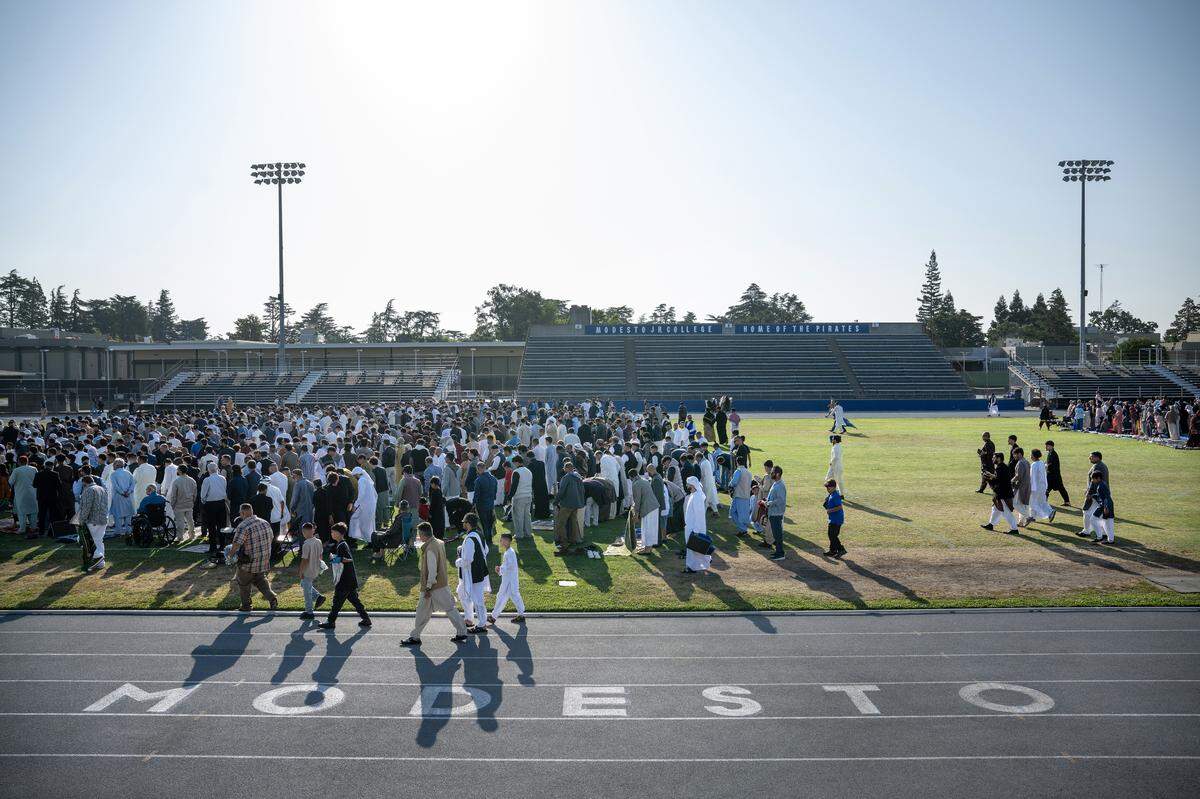
Amer Dougish of Stockton moved from Yemen to the United States when he was 19; he’s now 58. He said he didn’t know why the ban was put in place for Yemen, maybe it had something to do with Houthis in Northern Yemen, but “sometimes, you know, the politics — you don’t really know what the real reason is.”
People arriving from Afghanistan do have a carve-out for those with special immigrant visas, specifically created for people who aided U.S. troops overseas.
“That’s significant for the people in this area because there’s quite a few people with these visas that come through,” Conrad said.
There is an exception for religious minorities coming from Iran, including Christian Assyrians, through a program that is currently on hold. There are also carve-outs for diplomats, dual citizens of non-banned countries and athletes. Some, though, like the exception for asylum seekers and refugees, are rendered moot due to the suspension of the refugee resettlement program.
In addition to the full ban, the proclamation put a partial suspension on tourist and student visas from seven other countries: Burundi, Cuba, Laos, Sierra Leon, Togo, Turkmenistan and Venezuela. Though Egypt is not currently listed on the travel ban, it has essentially been put on notice that the administration is considering adding it.
“We just want to be clear, we as CAIR condemn this ban for its anti-immigrant, Islamophobic and ideologically driven motives, even though it’s presented as a measure to increase national security,” said Moona Siddiqui, managing immigrant rights attorney at the Council on American-Islamic Relations, during a June 13 virtual town hall.
The proclamation does not affect the current status of people in the United States who already have visas, but CAIR still suggests that people from a country on the full or partial ban list keep their documents with them at all times.
During the virtual town hall, CAIR advised attendees to avoid unnecessary travel even if they do have permanent residency.
“Generally, if you are from one of the countries listed, whether on the partial ban or the full or complete ban, you shouldn’t be considering travel outside of the country at this time,” Siddiqui said.
The travel ban rhetoric coming from the White House has been blamed for reduced foreign travel to the San Francisco Airport during one of its busiest travel periods.
Saavrah Abdul of Oakland is a member of the Northern California Yemeni Community Association, which met in Modesto on July 3. He said the last time he went to the airport, he was concerned he would be stopped by U.S. Customs agents, but thankfully, he wasn’t. The organization brings together community members and business owners throughout Northern California, including the north Central Valley region, for events and networking.
Still, because of the ban, he is concerned about travel to and from Yemen in the future.
“Trump’s decisions, every day, are different,” he said. “To be honest, that’s the concern, [that] they could find any reason.”
This story was originally published July 11, 2025 at 3:52 PM.