Central Valley doctor returns from Gaza: ‘Nothing comes close to this’
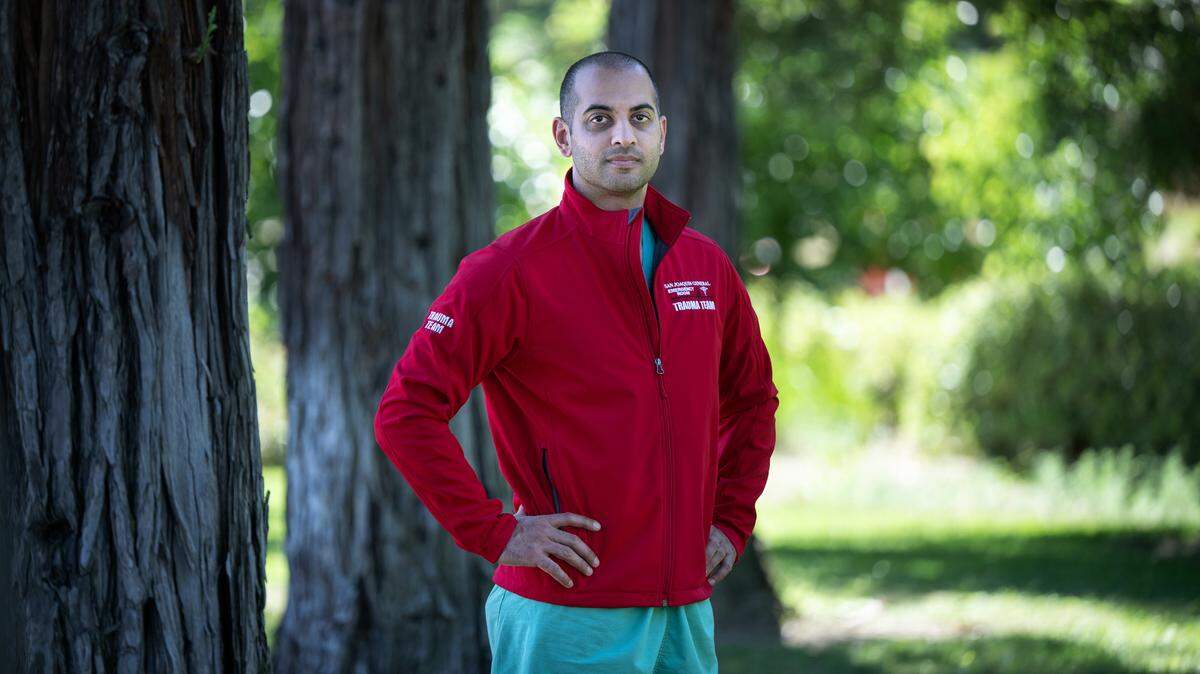
A Central Valley trauma surgeon recently returned from volunteering in Gaza. The destruction there was unlike anything he had seen.
“Nothing comes close to this,” said Dr. Feroze Sidhwa, who works at San Joaquin General Hospital in French Camp.
Sidhwa volunteered at the European Hospital in Khan Younis, Gaza, from March 25 to April 8, 2024, with the World Health Organization, and again from March 3 to April 1 this year with the American nonprofit MedGlobal at Nasser Hospital. He has also worked in conflict zones and underserved areas in Ukraine, Haiti, Zimbabwe and Burkina Faso.
But nothing, he said, compares to Gaza. Ukraine, he said, “doesn’t involve this level of depravity and insanity.”
In Gaza
Sidhwa has given numerous lectures about his time in Gaza, but said he always spends the first 25 minutes just explaining what has happened there since Oct. 7, 2023, when more than 52,000 Palestinians have been killed.
There’s no access to clean water, and Nasser Hospital has only 450 beds. His role often was reduced to one grim task: trying to stop people from bleeding to death.
On March 18, when heavy bombing resumed across Gaza, he and five other surgeons treated 221 patients in just six hours at the hospital in Khan Younis. Half of the patients were children. One-third didn’t survive.
That same day, one of the lead surgeons learned that among the dead was his soon-to-be father-in-law. He had been scheduled to celebrate his engagement party that night.
“He took two seconds to close his eyes, put his hand on his heart, he probably said a quick prayer, and then he went right back to his job,” Sidhwa said.
Sidhwa’s colleague never got the chance to see his father-in-law’s body before it was buried. A few hours later, he walked to the graveyard, said a prayer at the grave, then returned to the hospital to continue operating.
“The Palestinians, there’s something about these people,” he said. “They’re quite resilient. But these are not the things that people should be having to do.”
When the bombing resumed, most of the patients Sidhwa treated were children, many suffering from shrapnel wounds. He said families often had plans for which child each parent would grab when the bombs began to fall.
Sidhwa could stabilize some of the injured, but many died afterward due to the lack of critical care resources.
He remembered one 5-year-old boy whose heart he managed to restart. The child was moved to the ICU but died hours later. Sidhwa said that in other countries, even poorer ones, the boy might have survived.
“Gaza’s hospital system has just been starved and destroyed for so long,” he said. And not just since Oct. 7, but before then, too, he added.
Blood supplies are limited, and surgeons often are forced to decide who receives a transfusion, based on the patient’s chance of survival.
Sidhwa said that while he’s used to treating severe injuries at the trauma center in San Joaquin County, working in Gaza was entirely different — the resources simply aren’t there.
Becoming a doctor
While studying public health at Johns Hopkins University, Sidhwa knew he wanted to be a doctor, following in his father’s footsteps.
During his freshman year, the Second Intifada broke out, becoming a major political topic on campus. The following year, 9/11 happened, and two years later came the invasion of Iraq. These events made him question whether medicine was truly the best way to help people.
After graduation, he spent a year living in Israel, working with a Palestinian-Jewish cooperative. During that time, he toured the West Bank and met a delegation from Physicians for Human Rights–Israel.
One of the men from the delegation pulled him aside and pointed out that Palestinian doctors don’t live privileged lives — they aren’t well-paid, respected or protected, and their work comes with hardship. He told Sidhwa that only those willing to be doctors under such conditions should pursue the profession.
Sidhwa said he understood the message: It’s important to have pure intentions in medicine. But he also recognized that he came from a wealthy American family and wouldn’t ever face the same struggles as Palestinian doctors.
Instead, he felt that working directly in the West Bank could be a meaningful form of protest. It was then that he decided to become a doctor and felt compelled to return to Gaza to volunteer.
Returning to the Central Valley
Back home, Sidhwa said, he sometimes dreams about Gaza but is generally able to cope emotionally. One doctor he knows felt similarly at first, but was seeking therapy six months later for symptoms of post-traumatic stress disorder. Another doctor broke down in tears while hearing testimonies at the Democratic National Convention.
“The psychiatric response to trauma is very unpredictable, so who knows what will happen in the future?” he said.
He described the U.S. as a mercenary in the Gaza conflict because of the foreign aid it provides. As a taxpayer, he feels complicit. He noted that unlike conflicts like Ukraine, this one doesn’t carry the risk of nuclear war — and the U.S. could end it simply by stopping its funding.
He pondered this while treating patients. Caring for a little girl with a torn lung and spleen, he thought, “Did I pay for the shrapnel that’s in this girl’s head? Or did my neighbor?”
This story was originally published May 27, 2025 at 3:58 PM.