Modesto’s recent protests, rallies are reminder of activism in the past. What to know
Recent rallies and marches around Modesto are a reminder of the history of protest movements in the Central Valley, which includes anti-war and farmers’ rights movements.
Tatiana Lopez, a 27-year-old wedding planner from downtown Modesto, said she recently became interested in protesting for the first time and has since protested all around Northern California.
“I looked around and saw no one my age was actually interested in this stuff,” she said. “Which is crazy, because politics are our entire world.”
Chessie Thacher is a senior staff attorney for democracy and civic engagement at the Northern California chapter of the American Civil Liberties Union.
“The First Amendment and California’s free speech protections are extremely powerful, but they do have limits, so people should know what their rights are going into a situation,” she said.
There are new attempts to place restrictions on the right to protest throughout the United States, with the threat of defunding universities or in some cases, deporting participants.
What is the ‘right to protest?’
Protests are a form of expression protected under the First Amendment under free speech and include “the right of the people peaceably to assemble, and to petition the Government for a redress of grievances.”
“The government cannot discriminate on the basis of viewpoint ever,” Thacher said.
“Protest” is an umbrella term that can mean different things, including demonstrations like marches or rallies, sit-ins, handing out flyers, petitions, signed letters, boycotts and walkouts.
“That is a pretty impressive group of protections, but California sort of expands our free speech protections further still,” Thacher said.
Article One, Sections II-IV, of the California Constitution lays out what the state considers the right to freedom of speech.
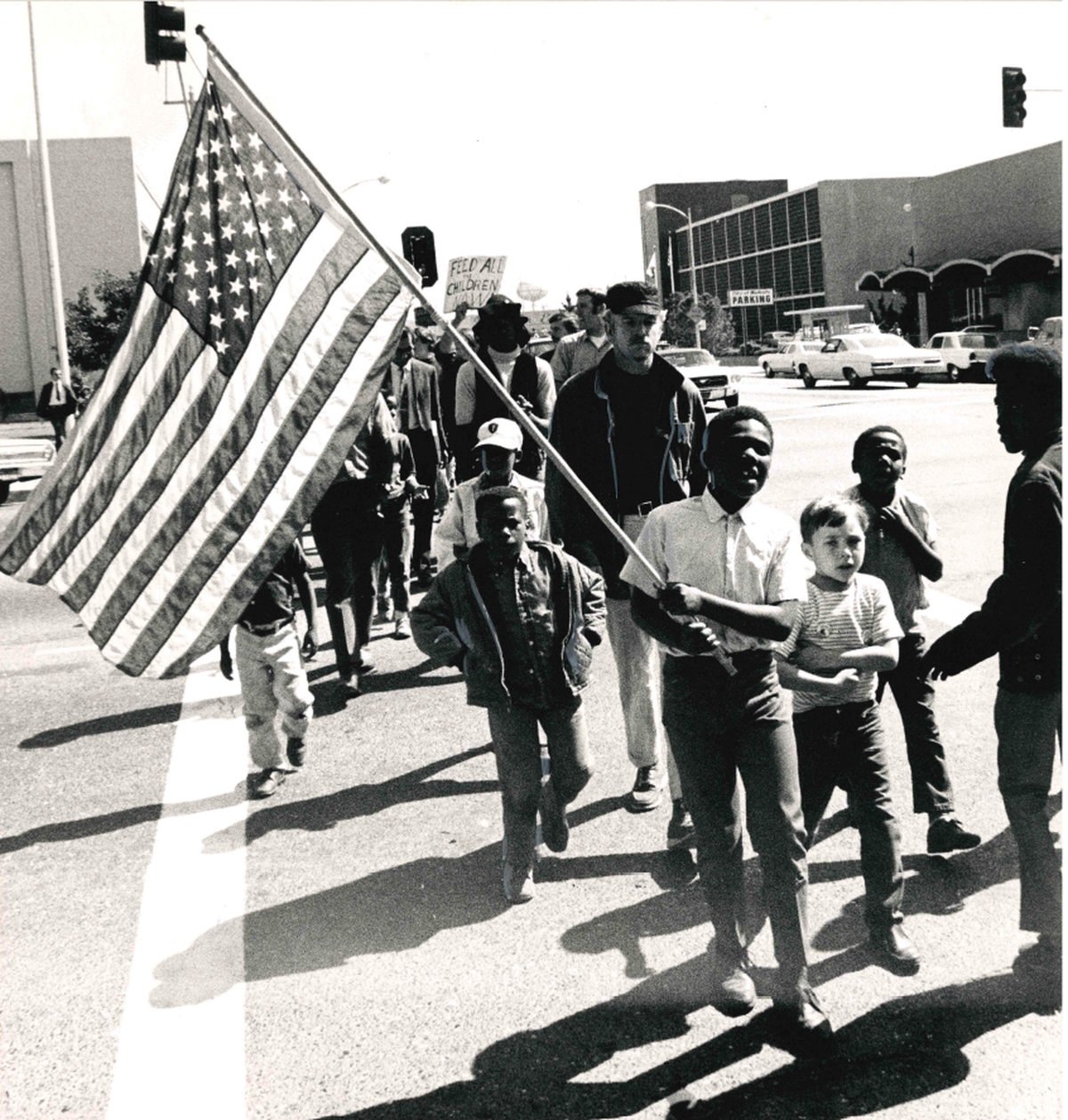
This right extends to all protests but does not protect a person or group from consequences for what would otherwise be considered an illegal activity.
Though people can be arrested for not adhering to an established law, they cannot be arrested solely based on their political speech unless it violates the rights of others.
The right to free speech does not extend to “true threats,” incitement, fighting words or harassment.
Movements in Modesto
Collective action is political action taken by a group of people and is usually organized in advance around a mutually understood goal or shared issue.
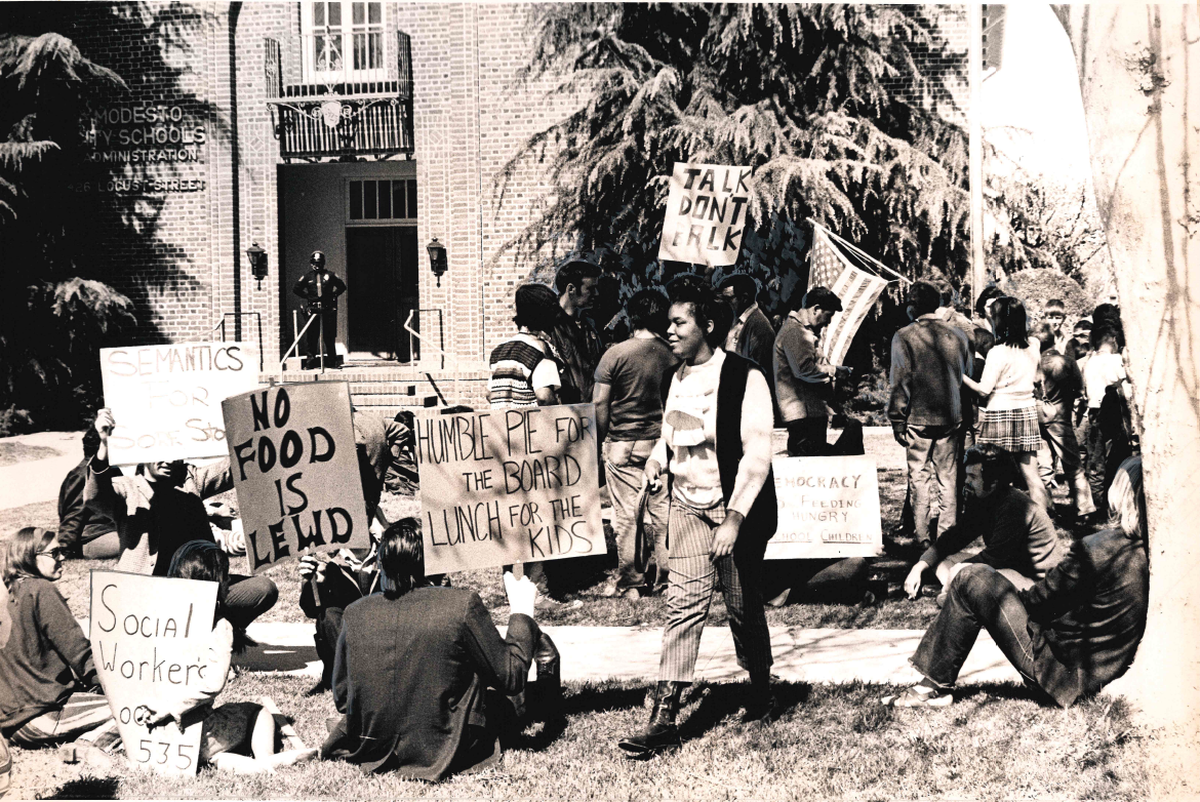
For example, in 1975, Cesar Chavez and the United Farm Workers were responsible for organizing a protest march that covered San Francisco, Fresno, Stockton and ended in front of E.&J. Gallo Winery in Modesto with 15,000 people. The trek spanned over 1,000 miles and took almost 60 days.
As a result, Cesar E. Chavez Park was named after his and the movement’s contributions in organizing Gallo workers and boycotting the winery in protest of farmworker conditions in vineyards.
Chavez and Delores Huerta, who co-founded the UFW, are depicted on a mural outside of the Peace/Life Center, painted by artist Joel Aguilar last year.
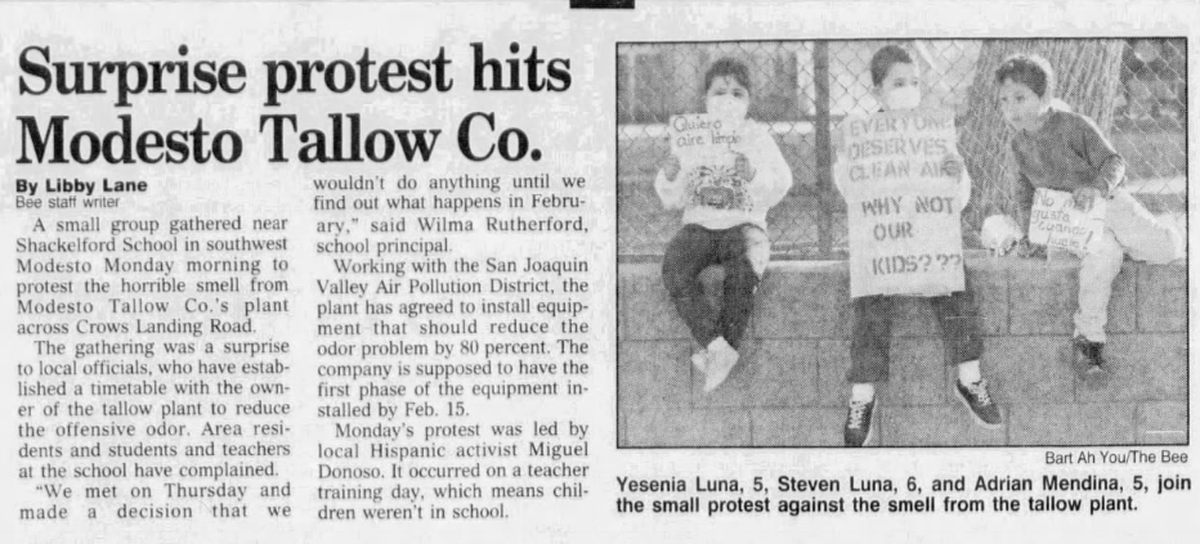
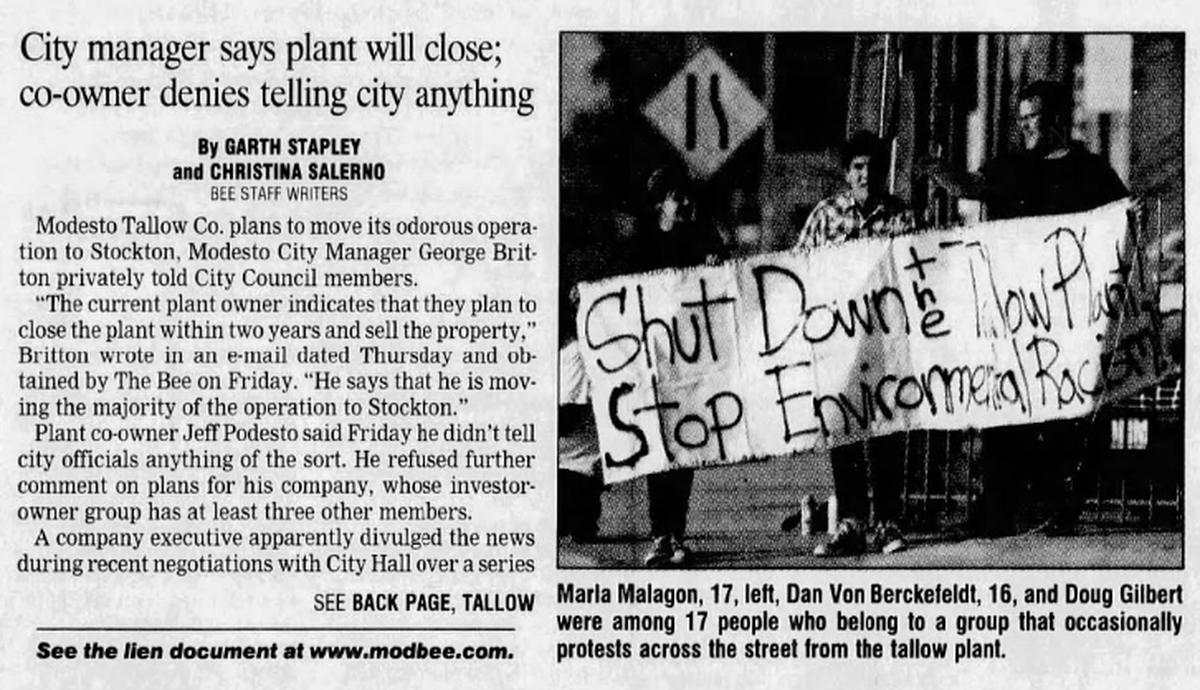
In 1997, a group of Stanislaus County residents protested against the Modesto Tallow Co., which had caused bad smells and poor water quality issues since its inception in 1918. In 1999, the owner was convicted of falsifying water quality records. And in 2006, the company finally shut down.
James Costello is a board member for the Peace/Life Center, which was born out of the anti-war movement in Stanislaus County 55 years ago.
It started with “draft counseling,” a practice of providing support and guidance for people who had been drafted to the Vietnam War, then branched off into other issues like nuclear nonproliferation.
%20McHenry%20Museum.png "Anti-war protest (undated) McHenry Museum.png")
“We’ve had demonstrations at the Livermore Lab in the past where people were arrested,” he said. “When the Gulf War started, we were protesting that. And then, of course, the war in Afghanistan.”
Members also have testified before the Modesto City Council on issues of homelessness.
Once a month, the organization holds a vigil at Five Points to protest issues that matter to members, including war, immigration and civil rights. Their last vigil was on March 3, where approximately 65 people showed up with signs, cowbells and whistles to protest actions by President Donald Trump they saw as a threat to democracy.
In 2020, more than 1,000 people marched along McHenry Ave. to protest police brutality. After the organized protest ended, there was a clash between Modesto and Ceres police and Stanislaus County Sheriff’s officers and people who remained in the area.
Five days later, several hundred people held another protest at Tenth Street Place, which was entirely peaceful and included a “die-in,” where protesters laid on the ground for eight minutes and 46 seconds, to symbolize the time it took for George Floyd to suffocate.
On Feb. 3, hundreds of protesters marched from Tenth Street Plaza to Five Points in the “Day Without an Immigrant” protest to express concern over new immigration policies and increased enforcement.
How to safely and effectively defend your rights at a protest
The rights of protesters can vary depending on the location of the action, but generally, people have a right to protest in traditional “public forums.” including sidewalks and streets, as long as they do not obstruct traffic.
“The public has the most rights to speak and First Amendment freedoms in public spaces that are traditionally open to the public, so that’s your market square, that’s your sidewalk in front of a government building,” Thacher said. “Those are the spaces where the government needs a really good reason to be able to restrict your speech.”
She added that even then, they need to have “time, place and manner” restrictions, meaning they “have to be reasonable, they can’t be too broad and they have to leave you space to express yourself.”
In Modesto, this is usually Tenth Street Plaza outside the city-county government building.
On the other hand, if you are in the lobby of a government building or trying to access an office or a place closed off to the public, you are on less solid footing.
“Depending on who you are, if you have immigrant status right now more than ever, you need to be very careful about what consequences you are prepared to experience from this administration or from the government,” Thacher said.
Do you need a permit for a march or rally?
If protesters are on a public right of way and are not impeding foot or vehicle traffic, they’re not required to get a permit to exercise their right to protest.
“Each person that’s planning to organize a protest should familiarize themselves with the rules of whatever municipality or county they intend to protest in,” Thacher said.
To plan a march or rally that may require blocked-off streets, organizers should try to get a permit through the city or county where the protest is taking place.
“If you are planning a protest and you want to shut down a thoroughfare, or you think that may happen on a major street or take some public space out of use from others, and you have the lead time to apply for a permit, it would be best to do that,” Thacher said.
The city of Modesto requires a 90-day notice before an event, but for protests reacting to major current events, the city or county cannot use that alone to deny a permit.
“A lot of the time, we need spontaneous responses to government activity, and then you don’t have the benefit and opportunity to plan time to even apply for a permit,” Thacher said.
Government also cannot deny an event permit because the topics are controversial or unpopular.
Though permits can and often do cost money, there should be a waiver for those who cannot afford the application fee.
“We should be allowed to take to the streets and public spaces and express our opinions, so we don’t want to have too onerous a permit system,” Thacher said.
Some organizations, like the Peace/Life Center, have created guidelines they follow to maintain peaceful protests among their members.
“Over the years we’ve followed regulations that need to be followed by the city,” Costello said. “Like if you’re going to do a march down McHenry, you can stay on the sidewalk, but you can’t walk in the middle of the street – all that kind of stuff.”
Thacher suggested that if you decide to join a protest and are worried about mass arrests, leave your cellphone at home and just bring your ID.
Dispersal orders, which police officers can give if there is a reasonable concern or threat to public safety, must be given with a reasonable opportunity for protesters to comply. The order should be clear and contain specific information like how long they have to comply, the consequences for noncompliance and the route they should follow to exit the area.
The ACLU has guidelines for protesters to help them navigate the ins and outs of their rights. Here are some takeaways:
What does a violation of your rights look like?
Police officers cannot demand access to or take your property without a warrant. They additionally cannot delete your records.
Police officers cannot detain you without reasonable suspicion you’ve committed a crime or plan to do so.
What to do when stopped or detained:
If stopped, ask an officer if you are free to go. If yes, leave calmly.
Remain calm and do not physically resist or argue with an officer.
You can calmly remind them that taking photographs/video is protected under the First Amendment and that you are not disrupting anyone else’s activity.
If detained, a protester can ask the officer what crime they’re suspected of, otherwise, protesters can exercise their right to free speech and ask for a lawyer.
Don’t sign anything outside of the presence of your lawyer.
Police can pat down protesters to check for weapons, but protesters do not have to consent to searches of their belongings.
If a protester’s rights are violated by police officers, Thacher recommends participants write down the details, like the location, officer badge numbers, patrol cars’ ID numbers, how often they were told to move or if they heard an order to move, if they experienced nonlethal force like pepper spray or rubber bullets and what the reasoning was, if given, for using them.
“It can be stressful and very loud and adrenaline is racing, but it’s worth it to try to take note soon after the event for yourself,” Thacher said.
After collecting the information, participants are encouraged to file a formal complaint with the agency covering enforcement at the protest and to file a formal complaint to the jurisdiction of the officer be it local, county state or federal, according to the ACLU.
Counterprotesters also have an equal right to free speech. Police can separate groups of protesters and counterprotesters, but should allow them to be in sight and earshot of each other. Police can intervene if protesters and counterprotesters become violent toward one another.
“You have a right to counter-protest, but one does not have a right to heckle someone to the point where they can’t express their speech that you disagree with,” Thacher said.
This means you cannot shout down someone expressing a controversial opinion or block people from hearing or gaining access to a controversial opinion and be protected by the First Amendment.
“Personally, I think the Constitution is kind of a miracle,” Costello said.
This story was originally published March 12, 2025 at 6:00 AM.