New docu-series revisits Salida’s 1990 Elm Street murders. What happened? How to watch
“So when I arrived at the scene, there was a body lying on the sidewalk with a mask between his legs. There were deputies on the scene and they were very, very, spooked. They described going into the house and locating one body and locating another body and described it almost like a Freddy Krueger coming out of the closet.”
This chilling recollection from former Detective Gary Deckard of the Stanislaus County Sheriff’s Office is in the opening scene of the recently released limited docuseries called, “The Real Murders on Elm Street,” streaming now on Max
“These were big, muscular type, of deputies and they don’t scare easily. When I went in and I see exactly what they were talking about, I‘ve never seen anything like that in my life,” Deckard goes on to say.
Playing off the horror movie “Nightmare on Elm Street,” this series covers murders and other crimes that have occurred on Elm Streets throughout the country.
In the third episode, titled “Wheel of Punishment,” viewers are introduced to one of the most chilling crimes ever committed in Stanislaus County, the 1990 quadruple homicide in Salida.
With accounts from former law enforcement officers, lawyers, family members of the victims, and even a retired Bee reporter, the episode is unnerving and chilling. It starts on the night of the crime, or rather the early morning hours of May 21, 1990.
Officers responded to a call at 5223 Elm Street about people fighting in the street. Upon arrival, officers found a male victim deceased outside of the house with a discarded knit mask between his legs. He was later identified as 25-year-old Richard Ritchey. Once inside, the horrors were laid bare.
Inside officers find three additional victims: Franklin Raper, 51; Dennis Colwell, 35; and Darlene Paris, 23. All were bludgeoned and stabbed and appeared as if they had been taken by surprise. Officers noted that it did not look like a home invasion robbery because nothing seemed to have been stolen and the aggressive nature of the killings suggested something more sinister.
Outside, they found muddy footprints leading from the house to an area near the railroad tracks where they discovered baseball bats and knives with blood on them and tire tracks suggesting the getaway car was parked there.
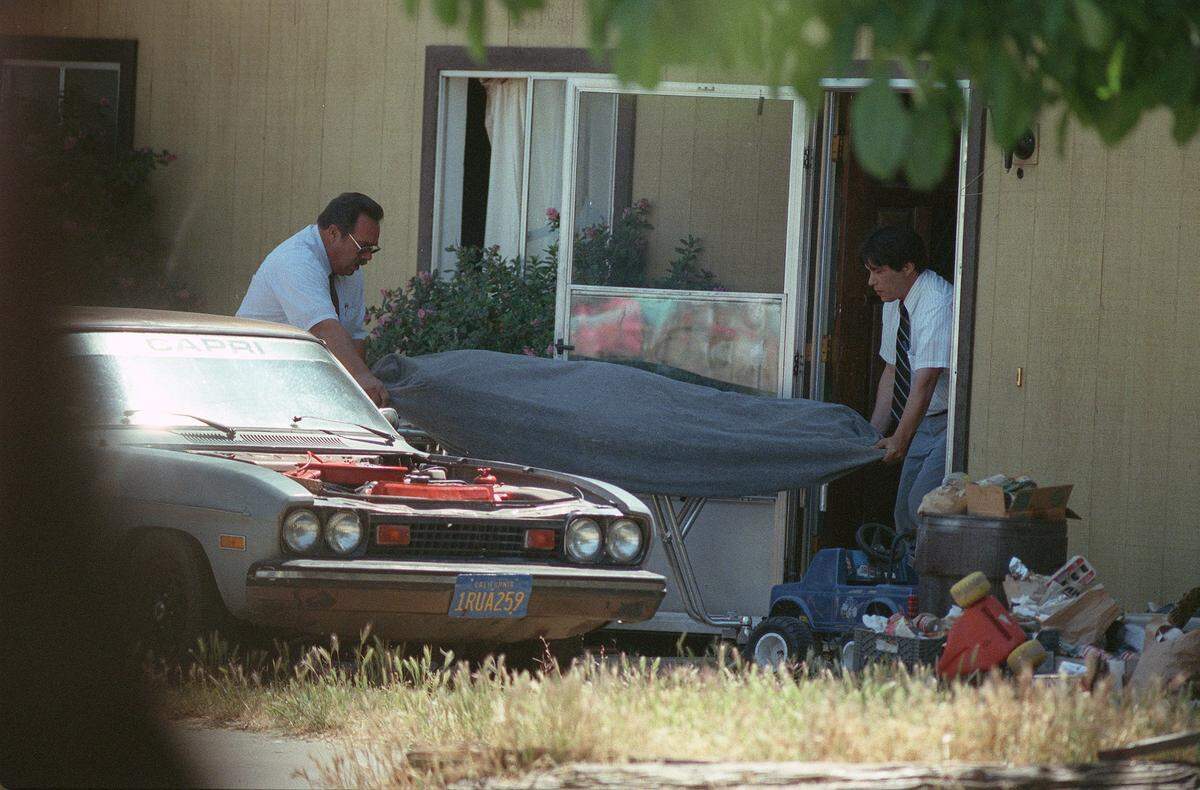
As officers worked the scene, and neighbors watched in horror as the victims were carried out of the home, a young woman ran up to the crime scene agitated and screaming that she witnessed the murders. The woman was Donna Alvarez, the sole survivor of the massacre.
She told investigators that it was her first night staying at the house; she had arrived with Richard Ritchey and was offered one of the bedrooms to sleep in. She said that hours later, she awoke to sounds of distress and when she opened the door to check, she was confronted with a masked man holding a gun saying he was going to kill her and to get into the living room. The show describes this man as removing his mask and then becoming distracted and moving away from Alvarez.
Seizing this opportunity, Alvarez went into the garage and hid under a pile of laundry. A story in The Modesto Bee by reporter Diane Nelson published on Tuesday morning, May 22, 1990, recounts her hearing “people beating each other up in the living room” and when she heard people running away, she waited and escaped under the garage door.
The news story also describes her running through the neighborhood pounding on doors for help, and eventually arriving at the home of Suzanne and Ken Casner. Hysterical, Alvarez described her encounter and Casner grabbed his shotgun and two more armed neighbors and headed to the duplex while Suzanne tried to calm her down and called the police. One neighbor saw “four dirtball guys trying to escape” and gave chase through a field.
Investigators took Alvarez for questioning and got the first clues of potential suspects. She described the man she saw and investigators determined she may have been describing a local man named Jason LaMarsh, 23. LaMarsh had had previous arrests and detectives pulled his mugshot for confirmation. Upon seeing the photo, Alvarez became visibly shaken. “She pulled away from me and almost crawled under the seat of the car, she was so upset,” Deckard is quoted as saying in a Bee story about how Alvarez reacted when she saw the photo.
The series mentions another early suspect, an owner of a local body shop who had issues with Franklin Raper but his involvement was quickly ruled out. In speaking to family members of the victims, Raper’s son told police that his father had asked him about getting a gun and stated that LaMarsh had made threats on his life.
Weeks before the murders, Raper’s car was stolen and set on fire by LaMarsh. With this lead, detectives went to where LaMarsh lived and encountered 28-year-old Gerald Cruz. He told them LaMarsh stayed on the property but was not there. Police noted a clothesline with sets of camouflage clothes, similar to the ones witnesses say the assailants were wearing.
They also questioned LaMarsh’s girlfriend, 20-year-old Michelle Evans. She said she did not know where he was, but provided another key link to the victims. Her sister had been staying at the house on Elm St., though she was not there the night of the murders.
Armed with this information, investigators served a search warrant at the property where LaMarsh stayed just 13 hours after the murders. What they found inside would shock locals and law enforcement alike.
The property, called The Camp, was the home base of a group calling themselves The Cause and another Bee article of the time noted they also referred to themselves as The Order of The Lion. They took residence in an abandoned, derelict labor camp and neighbors described seeing members of the group patrol the area with guns and perform odd rituals and labor.
Upon entering the house, investigators found a cache of weapons and explosive devices and arrested resident James Beck, 34, and LaMarsh’s girlfriend Michelle Evans. Detectives also discovered disturbing items like extremist pamphlets, diaries of group members, books on the occult, and a leather-bound book with bloody thumbprints. This was later found to be part of the initiation ritual to induct members into The Cause.
Back at the station, investigators were unsuccessful at getting information from either suspect, until they put them in the room together. Evans whispered that she had not said anything to the police while Beck motioned for her to keep quiet. Seizing on this exchange, detectives got Evans to talk and the plot came to light.
In the weeks before the murders, Raper had befriended the group and even stayed at The Camp for some time. Family members in the series describe him as becoming uncomfortable with the group’s activities and often clashing with group leader Gerald Cruz. He left the group and encouraged others to leave which angered Cruz.
Evans later testified that Cruz had summoned her and four other members to The Camp the night of the murders to plan the assault at the house on Elm St. Though Raper was the main target, Evans testified that Cruz said, “They were going to do them and leave no witnesses,” according to a Bee article from that time.
Cruz instructed Evans to draw a map of the residence and assigned her as the first person to enter the house as she had done many times when visiting her sister and no one would suspect anything nefarious. She was instructed to open the windows as a sign for them to enter.
At around 1 a.m. on Monday, May 21 Cruz entered the home with Beck, LaMarsh, and 22-year-old Richard Vieira and 24-year-old Ronald Willey. The violent attack focused on Raper, who was found slumped over in a chair in the living room. Paris and Colwell were found in the kitchen and Ritchey had made it outside but was beaten and stabbed before he could escape. Evans left the house shortly after the attack began and made her way past Ritchey’s slain body to wait in the car.
Over the next few days, all the suspects were arrested except Jason LaMarsh who had fled to Oregon. The series shows that he was traveling with a young woman to whom he confessed his involvement in the murders. Upon arriving in Oregon, she called the police and LaMarsh was arrested and taken back to California.
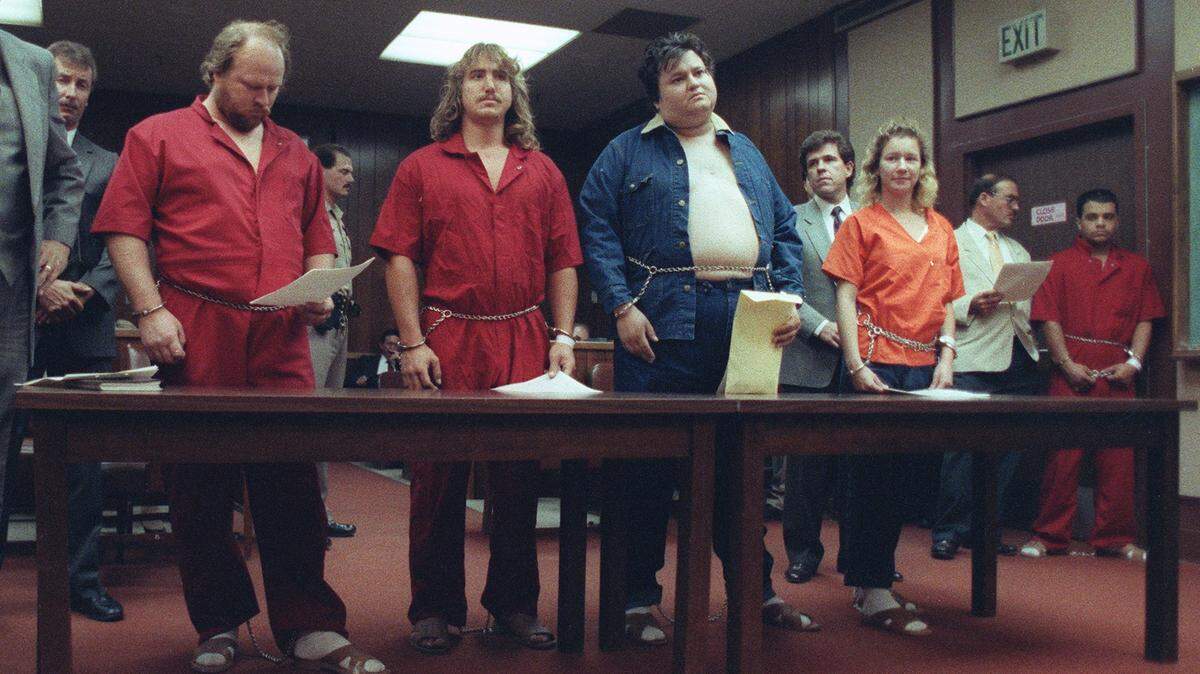
During the trial, jurors heard disturbing testimony about the group’s activities from former members. They described Cruz as ruling with an iron fist, quick to anger, and unyielding in punishment. Cult experts testified that Cruz would lure naive youth into his cult promising shelter, food, and community but would manipulate them to do his bidding. Cruz used a “punishment wheel” made of wood divided into pie-shaped areas with different cruel activities on them. Members who disobeyed Cruz were made to throw the wheel in the air and catch it and wherever their thumb landed would be their fate. Punishments included sleep deprivation, torture, forced sodomy, and hard labor. Both Vieira and LeMarsh’s defense said they were coerced into committing the crime out of fear of retaliation from Cruz.
The jury didn’t agree and convicted Jason LaMarsh and Ronald Willey on four counts of second-degree murder and sentenced them to 62 years in prison. Gerald Cruz, James Beck, and Richard Vieira were each convicted on four counts of first-degree murder and sentenced to death. All three are on death row at San Quentin. Michelle Evans agreed to testify against the men and pleaded guilty to being an accessory to murder serving only 6 months of her year-long sentence.
“Pure evil came to that house on Elm St. that night,” said former Bee reporter Daryl Farnsworth in the series. Lives were forever changed and a community will never forget what happened.
The Real Murders on Elm Street is currently streaming on Max, Discovery Plus, and Hulu among other streaming services. For an archival view of The Modesto Bee’s coverage of the murders when they happened, scroll through our photo gallery below.
The_Modesto_Bee_1990_05_22_1.jpg "(A1)The_Modesto_Bee_1990_05_22_1.jpg")
The_Modesto_Bee_1990_05_22_12.jpg "(A2)The_Modesto_Bee_1990_05_22_12.jpg")
The_Modesto_Bee_1990_05_23_1.jpg "(B1)The_Modesto_Bee_1990_05_23_1.jpg")
The_Modesto_Bee_1990_05_23_18.jpg "(B2)The_Modesto_Bee_1990_05_23_18.jpg")
The_Modesto_Bee_1991_08_30_18.jpg "(C2)The_Modesto_Bee_1991_08_30_18.jpg")
The_Modesto_Bee_1990_05_25_1.jpg "(D1)The_Modesto_Bee_1990_05_25_1.jpg")
The_Modesto_Bee_1990_05_25_24.jpg "(D2)The_Modesto_Bee_1990_05_25_24.jpg")
The_Modesto_Bee_1990_11_27_11.jpg "(E1)The_Modesto_Bee_1990_11_27_11.jpg")
The_Modesto_Bee_1990_11_27_12.jpg "(E2)The_Modesto_Bee_1990_11_27_12.jpg")
The_Modesto_Bee_1992_11_06_22.jpg "(G1)The_Modesto_Bee_1992_11_06_22.jpg")
The_Modesto_Bee_1992_12_19_4.jpg "(H1)The_Modesto_Bee_1992_12_19_4.jpg")