Mother, district at odds over treatment for Modesto teen who threatened school shooting
The mother of a 14-year-old boy is imploring Modesto City Schools to help after her son made threats to bring an AK-47 assault rifle to school and shoot fellow classmates.
“I am literally begging you to help keep the school safe, help keep our community safe and help my son get well,” she said during a Modesto City Schools meeting last week. “I am telling you, I’m a psychiatric nurse, this isn’t something to play around with … he’s a ticking time bomb.”
The mother said she believes the best way to ensure the public’s safety is for the district to give approval for her son to enter a residential treatment program. She said the district has approved intensive home therapy services and agreed to assess the boy’s need for residential treatment, but she doesn’t think that is enough.
She also spoke at Tuesday’s City Council meeting during public comment, asking council members to urge the school district to place her son in residential treatment.
The mother told The Bee her son made the shooting threat at La Loma Junior High School in October but it took a month before it was reported to administration and seven months before Modesto police were notified.
District officials acknowledged a one-month delay in reporting to the site administrator but said the threat was an isolated incident that was investigated and determined not to be credible. They stressed that a gun was never brought to campus.
Spokeswoman Krista Noonan said it was “promptly addressed in conversations with the student when it occurred.”
Guns have been removed from home
The mother said she had guns locked in a safe in her home at the time of the threat but has since moved the safe and guns to a friend’s house. She said she is a firm believer in Second Amendment rights but, given her son’s psychiatric history, she has never let him shoot anything beyond an airsoft gun.
The mother has asked not to be identified in this story in order to protect her son’s privacy.
Among the boy’s diagnoses are autism spectrum disorder, attention deficit disorder, bipolar disorder, intermittent explosive disorder and unspecified trauma and stressor-related disorder, according to documents provided by the mother.
He has been on medication and in psychiatric treatment since he was 7 years old but his behavior has become increasingly violent this year and especially over the past two months, his mother said.
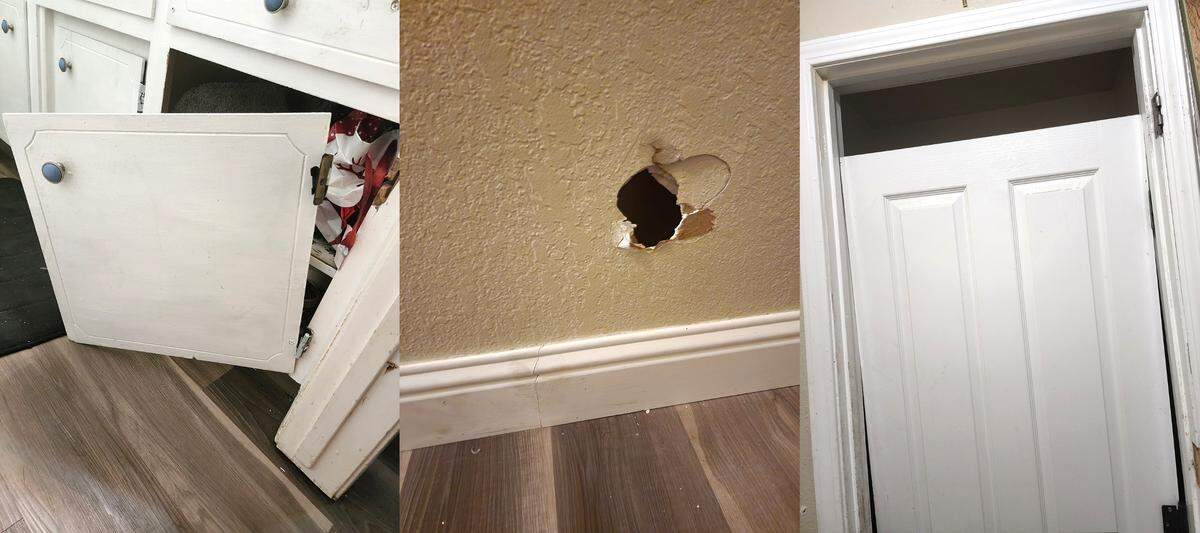
“There are holes in my walls, and almost every door in my house is broken,” she said. “If I ever have to go anywhere, I have to have two sitters — one for my 14-year-old and one for the other three.”
In video recordings shared with The Bee, the boy talks about using a skewer to kill his older brother and says he’ll “hang his guts.” In another clip, he yells and struggles to break free as his older brother holds him in a headlock, someone else restrains his arms and legs and his mother tells him he needs to take his medication. She said the incident followed an episode in which the boy was running into traffic.
The mother, a single parent to five boys, said she fears for the safety of herself and her three younger sons and for the safety of the entire community.
She said she hasn’t called the police yet to have him evaluated for a mandatory psychiatric hold because she doesn’t want it part of his record, which in most cases is confidential but can be disclosed under some circumstances. But she said his behavior has become so extreme, she will call police it if continues.
“I am trying to get him help without getting him a criminal record,” she said.
Residential treatment urged
Her son’s psychologist and psychiatrist agree the boy needs more intensive treatment. In letters the mother says were sent to the school district, the boy’s psychiatrist said she “strongly recommends” residential treatment and his psychologist said “outpatient therapy is not intense enough to meet (his) complex emotional and behavioral needs.”
The mother said a care team at a secure residential facility in Utah has agreed to accept him on one condition: The school district needs to agree to it as part of his Individualized Education Plan (IEP).
An IEP is a legal document for special education students that outlines their specific needs. It is developed by a team that includes teachers, administrators, school psychologists and the student’s parents.
The IEP team must meet annually but a parent can request additional meetings.
The 14-year-old boy’s mother said she has met with his IEP team three times since he threatened to shoot classmates in October.
During a meeting May 26, she brought the letters from her son’s psychiatrist and psychologist and showed the team videos of his behavior, as well as photos of the damage in her home.
The IEP, which includes notes from the discussion during the meeting, was shared with The Bee by his mother.
She stressed to her son’s team the urgent need for him to be in residential treatment.
According to the IEP, the team decided to complete a functional behavioral assessment to determine the level of services he needs. It also added wraparound services, which are more intensive therapeutic services at home and placement in a therapeutic summer school program.
In general, according to the district, those services include clinical sessions that can take place in the home and address concerns brought up by the parent; support counseling that gives the child tools and resources that assist in reducing risky behaviors; and weekly child and family team meetings aimed at collaboratively making progress toward goals in the child’s treatment plan.
There is also a parent-partner team member who provides direct support to the parent and works closely with a facilitator whose job is to streamline communication among all members of the wraparound and IEP team.
Finally, the wraparound services include 24-hour crisis support in which a team of clinicians can be dispatched to the home.
Residential treatment called ‘restrictive’
Mark Herbst, associate superintendent of student support services, said he couldn’t by law discuss a specific case but generally described the services offered through an IEP and how those services are determined.
He said, “The IEP teams determine what is the least restrictive environment for a student based on the unique needs of that particular child” by assessing data including information provided by the parent(s), any outside providers and the information gathered by the district.
“Residential treatment is considered a restrictive level of service,” Herbst said. “While I have seen residential treatment work well for children in the past, I have also seen the detrimental effects this type of placement can have on students and their family.”
Nothing in the IEP notes explicitly says why residential treatment wasn’t granted, but the mother said the team tells her the majority of her son’s aggressive behavior is at home, not at school.
She also feels they aren’t taking it seriously or don’t believe what she is telling them, which is why she started recording her son’s behavior and comments and taking photos of the damage he’s caused. “I feel like the school (district) is challenging everything I am saying,” she said.
“I am telling them how bad it is here,” said the mom. “It’s just a matter of time until it’s that bad at school. Why wait for that?”
She also believes the lack of incidents at school is more the result of lack of documentation, leading back to the school threat in October.
The mother said when her son’s resource teacher became aware of the threat, he notified her but not the school principal. The mother told her son’s psychiatrist, who told her the boy immediately needed to be put on a 1:1, meaning a teacher had to be with him at all times.
It wasn’t until the mother relayed this to the resource teacher that the principal was notified, the mother said.
District spokeswoman Krista Noonan said it was an isolated incident and “more importantly, no weapon was brought onto the campus.”
“Upon learning of the alleged threat, Site Administration took prompt steps to address it and engage in conversations directly with the student and family, and in the end, all staff and students remained safe,” Noonan said in a statement to The Bee. “The District acknowledges that there was a slight delay that occurred in the process of entering the information into our discipline record-keeping system. However, Site Admin had already engaged in conversations with the individual to ensure the threat was thoroughly vetted and, after those discussions, it was determined to be noncredible.”
District email notes mishandling
But the mother shared with The Bee an email from Herbst, the assistant superintendent, that acknowledges mishandling of the school threat.
“The threat by (the boy) was not reported to administration for follow up as it should have been,” he said in the email.
Herbst also said the mother should have been getting daily reports about her son’s behavior in accordance with his IEP but that didn’t start until the issue was discovered in May.
Following the May 26 IEP meeting, district staff called Modesto police to request a security check on the boy due to the concerning behavior they’d seen in the videos. The staff member also relayed at that time the threat the boy had made in October, according to Police Department spokeswoman Sharon Bear.
She said an officer responded to the family’s home, viewed the video, confirmed the boy did not have access to firearms and advised the mother to call 911 if his behavior continues to escalate so that he can be evaluated for a psychiatric hold.
Bear said the department has detectives who are specially trained in threat assessments for school and workplace shootings and they thoroughly investigate every shooting threat reported to them.
She said there is no way to quantify how many threats go unreported by schools.
“The number one thing is you have to report it to us immediately for us to investigate it,” Bear said.
Noonan said in a statement, “MCS and our school sites take any and all threats very seriously. If there are situations that arise where threats are being made either toward an individual or a school site, we immediately investigate and involve law enforcement to hold those responsible accountable. Threats of violence targeting school sites have not been a regular occurrence on our campuses or in our district..”
The mother said the intake process for wraparound services started Monday, but she will keep trying to get the boy into the residential treatment center.
She said the assessment has not yet started because she wants to choose who does the assessment, rather than use someone the district contracts with. She is also consulting with an attorney about how to proceed and has another meeting with some of her son’s IEP team in late June.
Modesto Bee reporters Ken Carlson and Kevin Valine contributed to this report.
This story was originally published June 15, 2022 at 8:43 AM.