Trains every 12 minutes through Altamont? Project easing Valley commute takes key step
A plan to greatly increase passenger rail through Altamont Pass has taken a key step toward federal funding.
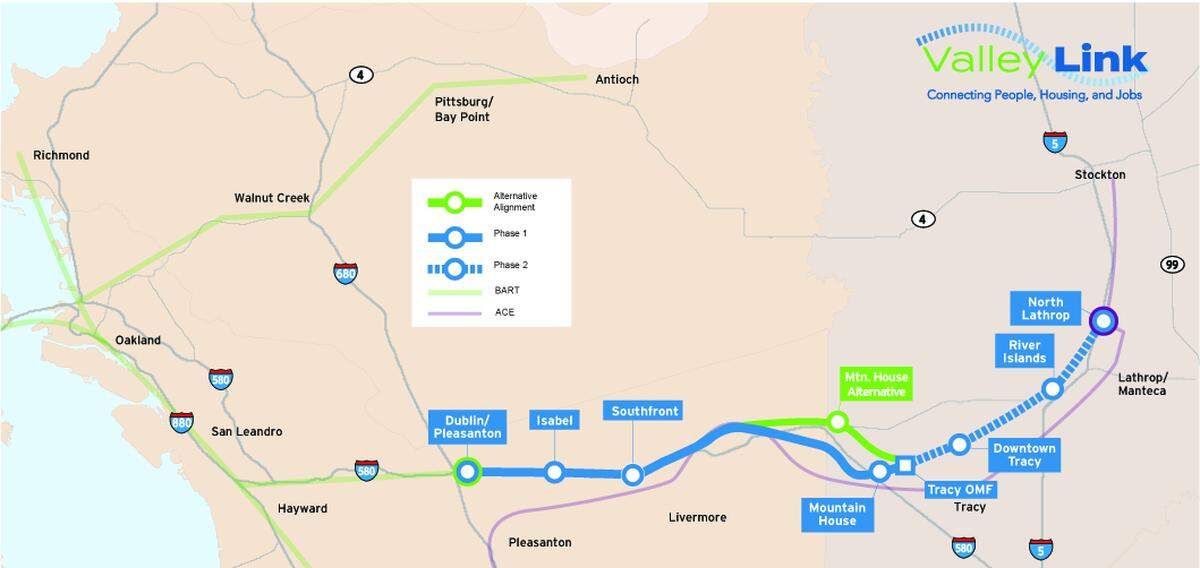
The new Valley Link service would run between Lathrop and the BART station in Dublin. The partners hope to attract many of the 100,000 or so commuters who endure Interstates 205 and 580, along with leisure travelers.
The first phase, between Dublin and Mountain House, just qualified for a Federal Transit Administration program that could eventually pay part of its $1.8 billion cost.
This segment could start operating as soon as 2027 if other funding comes together on top of the $700 million already in hand. The second phase out to Lathrop could be ready a few years later and bring the total cost to about $3.8 billion.
The Altamont Corridor Express already runs four round trips each weekday between Stockton and San Jose. But ACE does not connect with BART, which branches through much of the Bay Area.
Valley Link aims to start off with trains every 24 minutes, seven days a week. By 2040, they could run every 12 minutes during peak demand, matching the BART timetable from before dawn to around midnight.
“The Valley Link project has the potential to help thousands of commuters get out of traffic and more quickly back to their homes and families,” said U.S. Sen. Alex Padilla, D-Calif., in a June 1 news release.
Part of huge infrastructure act
The FTA accepted Valley Link into the “project development” stage of its Capital Investment Grants program. It is a $23 billion piece of the $1.2 trillion infrastructure package signed by President Joe Biden in November. The money will be allotted around the nation over five years.
Valley Link planning began in 2018 under the Tri-Valley/San Joaquin Valley Regional Rail Authority. Its board consists of local elected officials in Alameda and San Joaquin counties.
Valley Link’s first phase would have two stations in Livermore and another at Mountain House. The second phase would have depots in downtown Tracy, the River Islands area of Lathrop, and north Lathrop.
ACE would share the north Lathrop station with Valley Link. ACE is expanding into Stanislaus and Sacramento counties by 2024 and into Merced County a few years later.
Valley Link funding so far includes about $400 million from an Alameda County sales tax for transportation, $235 million from Bay Area bridge tolls and $65 million from fees on developers.
The partners also could tap into state rail programs likely to be bolstered by California’s $97 billion budget surplus. And other local transportation taxes could help.
Powered perhaps by hydrogen
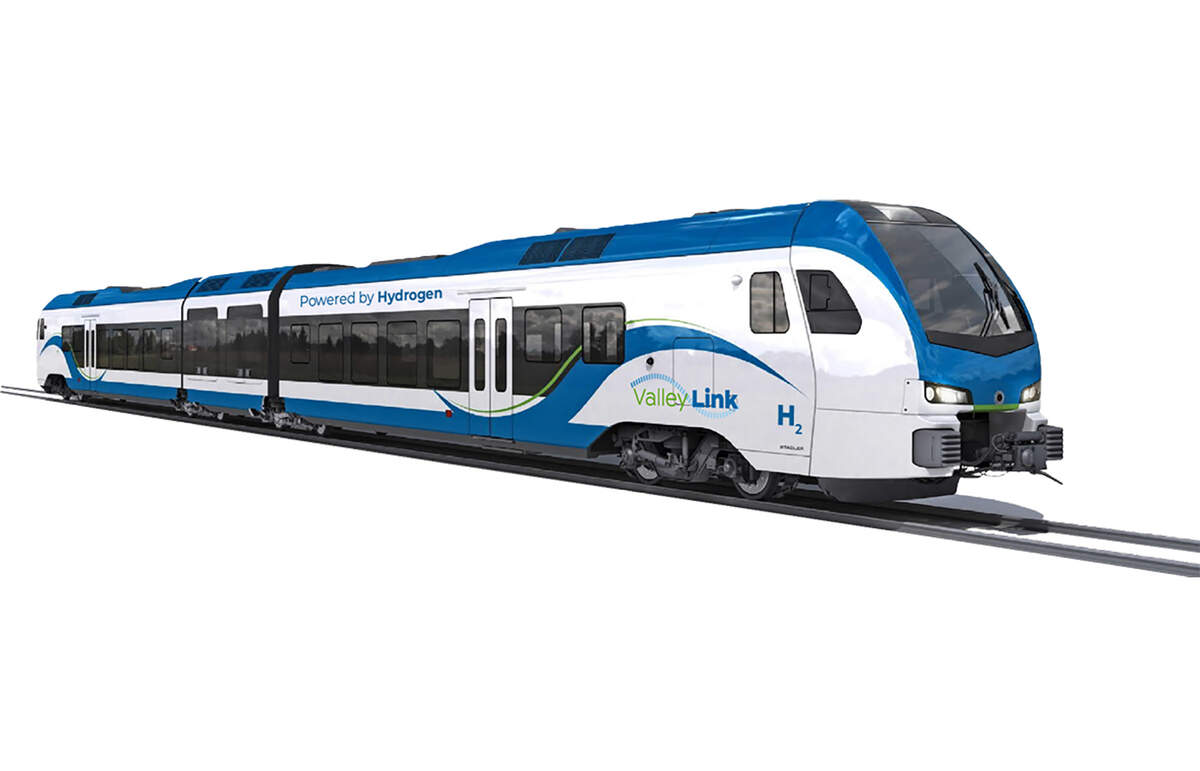
Valley Link backers tout its potential for reducing climate-harming emissions from cars. And they hope to power the trains with hydrogen, an emerging source, rather than polluting diesel.
The hydrogen could be produced at a proposed plant in southwest Tracy. The process involves combining hydrogen and oxygen molecules, which generates electricity for the train batteries. Nearby solar panels or wind turbines would run the plant, further greening the Valley Link brand.
The westernmost segment of the tracks would be laid in the I-580 median east from Dublin. They would serve stations at Isabel Avenue and Southfront Road in Livermore.
The trains would ascend the west side of Altamont Pass on new tracks placed in an abandoned freight right-of-way. On the east side, Valley Link would share an active corridor with the Union Pacific Railroad all the way to north Lathrop.
The project board approved the route last year, but it could be amended to better serve the region. This includes moving the Mountain House station north and easing curves through the pass.
ACE has operated since 1998, using a different set of freight tracks than Valley Link’s plan. It has stations in Stockton, at the Manteca/Lathrop border and in Tracy, Livermore, Pleasanton, Fremont, Santa Clara and San Jose.
ACE plans to grow from four to 10 round trips a day if it can fund track and other upgrades in the coming years. It has long-range goals of all-day service from Stockton to San Jose and on the branches to Sacramento and Merced.
The federal action on Valley Link drew praise from other leaders besides Padilla. They include Rep. Josh Harder, D-Turlock, whose district stretches to the Tracy area.
“Valley Link will save our workers the stress, time and money that comes from these ridiculously long commutes,” he said in the release. “I can’t wait to see it up and running.”
This story was originally published June 7, 2022 at 6:00 AM.