What’s it like being trans in the Central Valley? Day of Visibility provides insight, stories
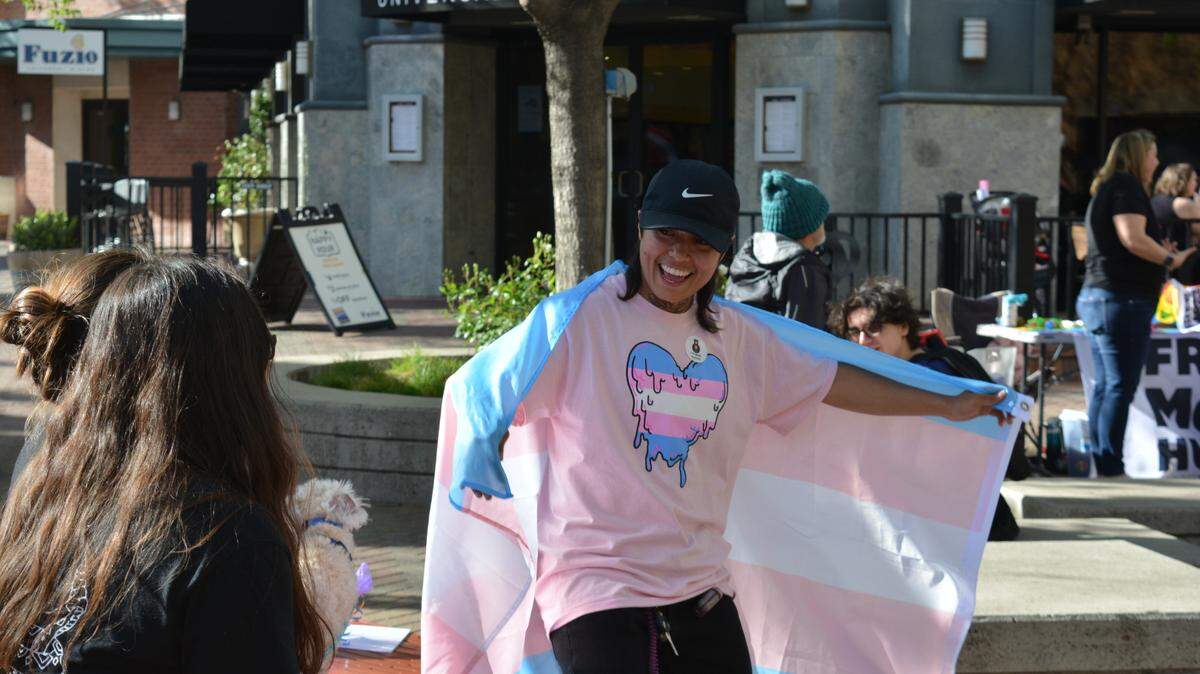
Modesto resident Stefan Serrato held the transgender flag out behind him Thursday and swayed his whole body, dancing to the music with a smile on his face.
It was International Transgender Day of Visibility, and he was ready to celebrate his identity.
“To be able to have this gathering is really empowering and uplifting,” Serrato said.
The Modesto-area LGBTQ community and allies gathered together Thursday afternoon at Tenth Street Plaza for an International Transgender Day of Visibility event hosted by the LGBTQIA+/2S Collaborative. The event was filled with music, resources and people celebrating their identities.
International Transgender Day of Visibility began in 2009 as a way to both celebrate transgender, nonbinary and gender nonconforming people and highlight the work that still must be done to protect these groups.
Trans people are more likely to live in poverty, experience violence or have attempted suicide in their lives, according to the Human Rights Campaign.
This year, the day took place against a backdrop of bills targeting trans people and the LGBTQ community as a whole making their way through multiple state legislatures.
Florida Gov. Ron DeSantis on Monday signed a law that opponents have dubbed the “Don’t Say Gay Bill,” claiming to support parental rights by prohibiting lessons about gender or sexuality from kindergarten through third grade.
Multiple other states have passed bills banning trans student athletes from sports teams matching their gender identity, with Oklahoma Gov. Kevin Stitt signing one into law Wednesday.
Jackie Westcott, a youth peer advocate with the collaborative, said discrimination sometimes comes from ignorance. One of the purposes of having the event downtown was so people would be more likely to run into it and feel like they could stop in, Westcott said.
She hoped people who didn’t have much understanding of the trans community would come meet people, ask respectful questions and try to educate themselves.
“If there’s people that have never met a transgender person before, they can meet a whole bunch of them in one day,” Westcott said.
There were about a dozen booths for members of the LGBTQ community, allies and passersby to receive information or shop. Representatives from the collaborative, Modesto Police Department and city health services hosted tables alongside vendors selling jewelry and tie-dye shirts.
Mayor Sue Zwahlen attended the event to present a proclamation marking Thursday as Trans Day of Visibility in Modesto. It recognized both the struggles and successes of the trans community.
“Today, we are proud to celebrate Transgender Day of Visibility and celebrate the efforts to advance inclusion,” the proclamation read.
Ava Price, a genderqueer Modesto Junior College student, said they believe Modesto’s progress to become more accepting of the LGBTQ community over time shows how the community’s odds are continuing to improve.
“I know, despite everything, we’ll come out on top,” Price said.
Being Trans in the Valley
Four people from the LGBTQIA+/2S Collaborative also sat with The Modesto Bee and spoke about their experiences being trans in the Central Valley.
Katalina Zambrano (she/her), advocacy director
Katalina Zambrano was around 3 or 4 when she realized she felt like a girl and promptly told her mother.
“I’ve never come out because I’ve always been out,” she said. “I never even knew what I was doing was different.”
Zambrano’s parents and brothers supported her from then on, but in Merced that wasn’t always enough.
When she began publicly transitioning in the seventh grade, Zambrano found it “insanely difficult.” Teachers would often treat her worse than students did, and she was once given Saturday detention for wearing too much makeup.
Although her school eventually let her graduate as a girl, the damage throughout middle and high school took its toll.
By 15, Zambrano was addicted to methamphetamine. She couldn’t get a job because she was trans, so for years she turned to sex work and drugs. During that time, she was arrested and her mother kicked her out of the house.
“It was a horrible life,” Zambrano said.
At her lowest around 25, Zambrano tried to kill herself by walking in front of a train. But her heel caught on a rock, sending her tumbling down an embankment as the train whizzed by, and she realized she’d been given a sign.
She stopped using drugs and felt like she’d changed her life around. Her first job was at Stanislaus County Behavioral Health and Recovery Services. She also worked for MoPride as a gender spectrum coordinator before coming to the Collaborative.
While the first LGBTQ people she knew came from drug circles, she slowly began to find other places to fit in. In the 1990s, the Brave Bull gay bar served as a new home.
“At that time, it was a beacon,” Zambrano said. “It was like, ‘Oh my God, I found my family, I found my tribe’.”
Zambrano said many struggles faced by the trans community do not come from identity alone. Instead, the lack of support and increased discrimination from those around them cause people to suffer more than their cisgender counterparts.
Since she was a child, more resources have popped up in the Central Valley. She has more hope for trans kids even as the collaborative works to help educate more schools and provide resources for institutions lagging behind.
“Help us not be alone,” Zambrano said. “You don’t need to know the answers to help us feel safe.”
Jackie Westcott (she/her) youth peer advocate
Transitioning wasn’t linear for Westcott, who first tried to come out to her family around 2012.
Although she’d already been out as gay, she knew she was really a trans woman. But people in her Turlock community didn’t take her seriously at the time, she said, and she felt she didn’t have the resources to be herself.
“I just basically went back in the closet essentially,” Westcott said.
She tried again around 2019, making a Facebook post telling everyone what was going on and asking them to use she/her pronouns. To her surprise, people she didn’t think would be accepting treated her with kindness.
“The reaction was actually very positive,” Westcott said. “It was a very pleasant surprise, and I just needed to wait until the right time to do it.”
Since being out, she still faces harassment.
She said recently some men drove up to her at the bus stop and tried asking her if she needed a ride. Even as Westcott turned down the offer and lied about being on her way to a friend’s house, the car didn’t move as quickly as she’d hoped.
“It just happens to people,” she said.
Jupiter Dalby (he/they), youth peer advocate
Dalby was kicked out of their parents’ house shortly after coming out around the age of 18 or 19.
They thought their parents were fine with them being a transmasculine nonbinary person at first, but there was a strange tension that broke when they were asked to leave a month or two later.
Dalby ended up homeless in Washington state for about four months. Their time in Washington was marked by that homelessness, harassment by police and passersby and a bad relationship that eventually led to them moving back home.
“Thankfully my family have kind of come around a little bit,” Dalby said.
Their experience was more difficult because they lacked resources and had no community to turn to.
“I felt like I was the only trans person that existed, honestly,” Dalby said.
Dalby said they got into the advocacy field to combat that void and help other people get the help they wish they would have had.
They’ve helped clients with similar backgrounds navigate their trans identity, feeling they can often relate to the people they’re working with.
“I want to be the person I needed when I had nobody,” Dalby said,
Alexzander Silva (he/him/il), health and equity director
There are still tiny pieces of concrete embedded in Silva’s face from the night he got attacked at a Lodi bar for trying to use the men’s restroom.
A few years ago, when Silva was about 27 and at the beginning of his transition journey, he said, he was attacked because of his androgynous look, but his continual anger and alcohol abuse exacerbated the situation.
Fighting had been a coping mechanism for Silva most of his life. He felt masculine by the time he was around 6 but struggled to understand what his identity was and how to cope.
He started drinking around fourth or fifth grade, about the same time his family moved from Orange County to Stockton.
His situation improved slightly when he transferred to a high school with better resources his freshman year and was able to use sports and band as an outlet.
“That’s what helped me finish school,” Silva said.
Silva still faced anger issues and other challenges into his young adult years. He got married but was arrested for domestic violence and couldn’t hold a job, and the alcohol abuse continued.
Eventually, he found help at the San Joaquin Pride Center and realized he was trans.
“My life really changed for the better when I was able to transition,” Silva said.
Four years into his transition, Silva said he has the privilege of presenting as cisgender in many situations, which can also be called going or living stealth.
When Silva was employed with Amazon, other men would treat him like just another guy for the first time in his life.
And just last weekend, he used this privilege to escort a trans woman to the bathroom at a bar in Los Angeles and protected her from harassment.
Silva said he feels conflict between his trans and Latinx identities, especially because of Latin traditional ideals of masculinity and ties to the Catholic church.
His family is supportive for the most part, especially his sister and gay brother, but his father still misgenders him in English and Spanish. He said that even when relationships with people in his life are strained because of his identity, he’s learned to put himself first.
“It’s just kind of like, I now respect myself for who I am and I’m moving forward with it,” Silva said.
This story was originally published April 1, 2022 at 8:49 AM.