More residents with tainted wells can get free bottled water in Stanislaus and Merced
More free bottled water is coming to parts of Stanislaus and Merced counties with tainted residential wells.
The Valley Water Collaborative has expanded a program that began last May with nitrate. Eleven other pollutants have been added thanks to a $5.5 million grant from the State Water Resources Control Board.
The program is for rural residents whose private drinking water has been contaminated by past practices on farms and other sites. It is not for customers of public water systems, which can treat the substances or retire problem wells.
The expansion could benefit users of perhaps 4,000 wells, said Parry Klassen, executive director of the group, during a news conference Thursday.
The program covers the Modesto and Turlock groundwater sub-basins. It is bounded by the Stanislaus River on the north, the San Joaquin River on the west, the Merced River on the south, and roughly the Tuolumne County line on the east.
The expansion is for “economically disadvantaged communities,” where the median income is no more than 80% of the statewide level. Much of Stanislaus and Merced counties is classified this way. Renters as well as homeowners can apply for free water.
.jpg "Kym Brinkman (2).jpg")
About 200 homes already are getting it because of excessive nitrate. Among them is Kym Brinkman, who lives off Crows Landing Road near Ceres. She signed up two homes on her property with a total of five residents.
“I was spending anywhere from $300 to $400 a month on water (at stores),” Brinkman said Friday. “... I highly recommend the program to people who are on their own private well.”
Brinkman works at Patterson High School as director of career navigation and workforce preparation.
Process starts with free well testing
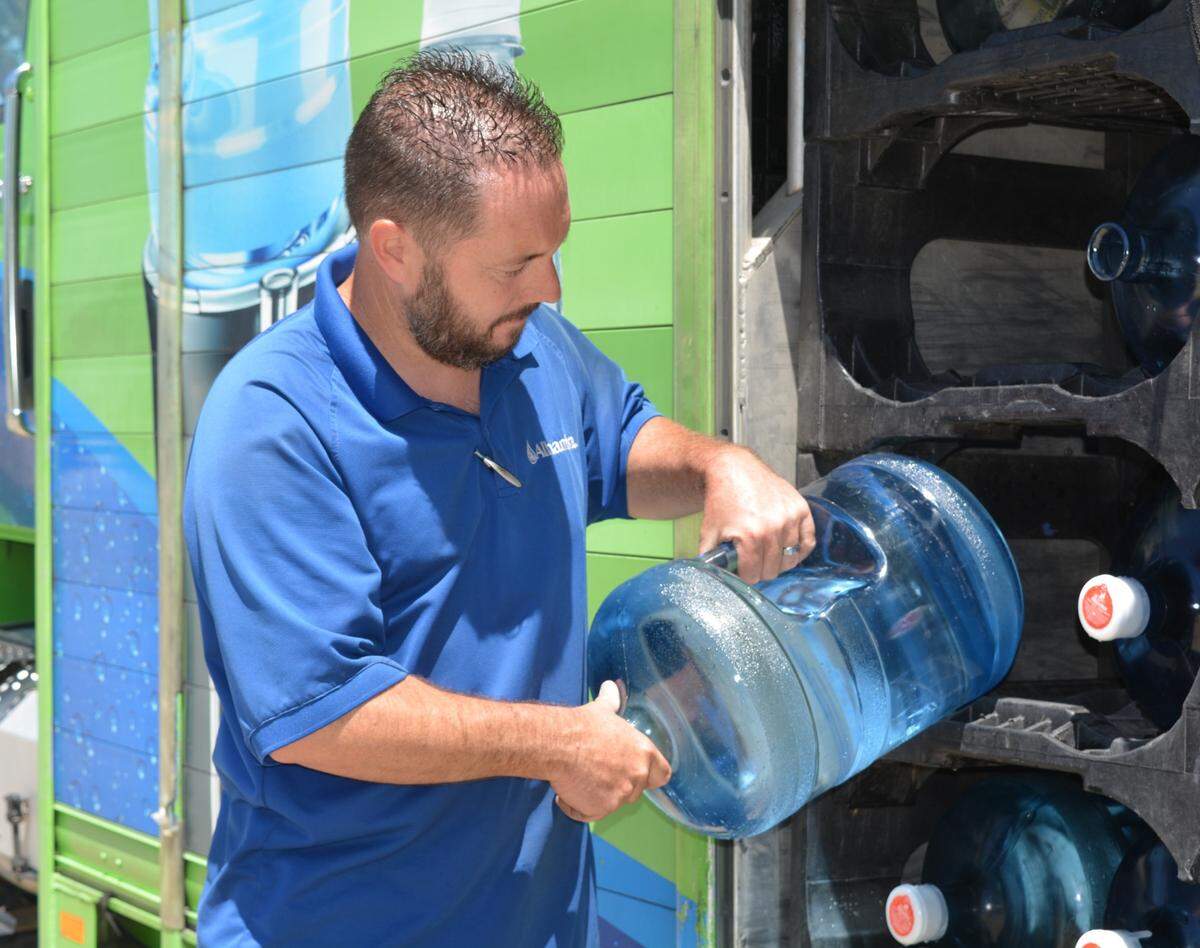
Residents can apply online for free testing of their well water. If it exceeds health standards, they can choose between regular deliveries of water jugs or installation of an in-home treatment system. The process typically takes three to four weeks.
The pollutants just added to the program include the basic elements arsenic, copper, lead, chromium and uranium. They occur naturally but can make people sick in excessive diluted concentrations.
The program also is covering two measures of microbes in water: E. coli bacteria and total coliform. And it includes four pesticide-related substances: DBCP, ethylene dibromide, percholorate and 1,2,3-TCP.
The collaborative already had planned to spend about $1 million a year on the nitrate effort and will continue to do so even with the grant. The group is funded by farmers, food processors, city wastewater systems and other parties that handle nitrate under state permits.
Nitrate has accumulated because of past handling of dairy manure, synthetic fertilizer and other material. Farmers also spray pesticides under tighter controls than decades ago.
The collaborative board includes Paul Huckaba, who oversees environmental affairs for Bronco Wine Co., a major producer near Ceres. He was present for the news conference at the Stanislaus County Agricultural Center.
“It really gives us more tools in the arsenal for making sure that folks in the area have clean, safe drinking water,” he said.
‘The human right to water’
Collaborative leaders said bottled water will be a temporary measure while they seek permanent solutions in the next few years. They could involve connecting to a nearby public system or drilling new wells away from polluted aquifers.
The group plans to look for more grants. California has put some of its huge budget surplus toward drinking water. The federal infrastructure package approved in November does the same.
The collaborative also is working to refine farming practices, such as applying pesticides and fertilizer only when and where they are needed.
The news conference also featured Laurel Firestone, part of the five-member state water board. She is an attorney who co-founded the Community Water Center, a nonprofit advocating for residents of the Central Valley and Central Coast.
“That gets us that much closer to ensuring we’re living up to the human right to water here in California,” Firestone said.
This story was originally published March 19, 2022 at 1:36 PM.