
California plans to fully reopen economy in June; Stanislaus County remains in red tier
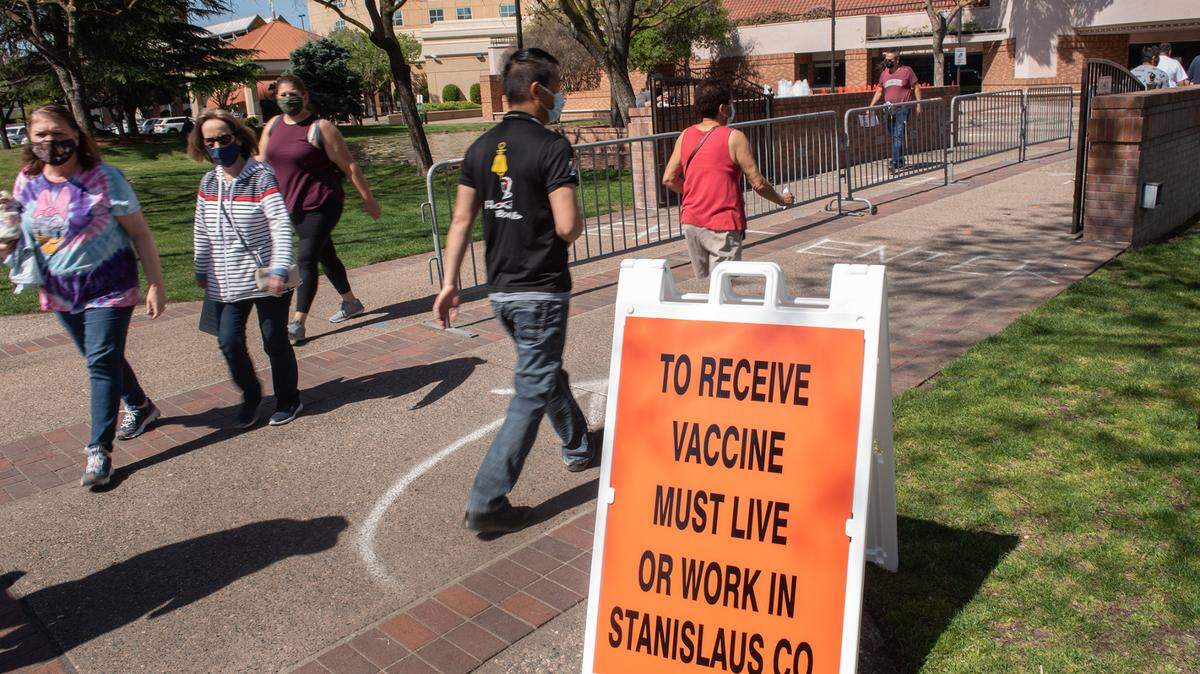
California will fully reopen its economy June 15 as long as it has a sufficient supply of vaccines and hospitalizations are low, Gov. Gavin Newsom announced Tuesday.
Californians will still need to wear masks and will still be encouraged to get vaccinated after that date, but the state plans to end its color-coded tier system that has governed county-by-county reopening for several months. Newsom says he expects all California students will be able to return to classrooms by June 15.
The news comes on the same day that Stanislaus County remained in the red tier for a third straight week, and was joined by neighboring San Joaquin County, which had been in the purple tier. Merced remained as one of only two of the state’s 58 counties to stay in purple, along with Inyo County.
In the update Tuesday, Stanislaus County’s daily case rate was above the 10 per 100,000 criteria for red tier. In addition, its test positivity rate in underserved communities rose to 5.7 percent, above the mark that qualified the county for red tier status. A county staff member explained the state does not consider the health equity test positivity in deciding whether a county backslides to a more restrictive tier.
Kamlesh Kaur, a county spokesperson, said a stable case rate and a test positivity of 4.8 percent for the entire county keeps Stanislaus in the red tier.
Merced’s case rate for the week ending March 27 was 11.7 per 100,000 residents, according to the numbers from the state health officials. The county needed to remain under 10 per 100,000 residents to move from purple to red tier.
The county’s rate actually went up from last week’s 9.2 so Merced County remains in purple.
A backlog on tests from last week caused an inaccurate swelling of the numbers in Merced County, according to Rebecca Nanyonjo-Kemp, director of public health.
Newsom made the announcement the same day California reached an immunization milestone: administering more than 20 million vaccine doses, including 4 million in the state’s most disadvantaged neighborhoods.
It comes more than a year after Newsom first ordered residents to stay at home, making California the first state to shut down its economy because of the pandemic on March 19, 2020.
“It is time to turn the page on our tier system and begin looking to fully reopen California’s economy,” Newsom said in a statement. “We can now begin planning for our lives post-pandemic. We will need to remain vigilant, and continue the practices that got us here – wearing masks and getting vaccinated – but the light at the end of this tunnel has never been brighter.”
Just last week, Newsom had warned that Californians needed to continue taking precautions to avoid spreading the coronavirus, especially as virus variants thought to be more contagious are spreading through the state. But on Tuesday, Newsom and other health officials said that the state’s vaccination progress and success in keeping case rates low indicate the state is on track to reopen.
In response to the new development, Stanislaus County advised residents to keep following the measures to prevent the spread of coronavirus, including mask-wearing, social distancing, washing hands and getting vaccinated.
Newsom said he anticipates more than 30 million people will have gotten at least one dose by the end of April.
California officials may push back the June reopening date if vaccine supply drops off and the state doesn’t have enough shots to inoculate every Californian over 16 who wants one.
Everyday activities will be allowed and businesses can open with what Newsom’s office called “common sense risk reduction measures,” including encouraging all Californians to get vaccinated and continuing to mandate masks. The state will continue contact tracing and testing to detect cases early and contain spread of the virus.
How quickly can economy recover?
Jeff Michael, an economist at the University of the Pacific, said Newsom’s announcement could serve as a “green light” to businesses that have been wary of ramping back up. “It could give them confidence,” he said.
“We’re going to see things really surge this summer,” he said. “Households are in a position to spend.”
Face coverings will remain an important prevention measure, especially indoors and in large group settings, said Dr. Mark Ghaly, California Health and Human Services secretary. Masks will still be required at schools for the foreseeable future, he said.
Despite the optimistic reopening news, Newsom said the coronavirus is “still prevalent, still deadly, still a challenge that we need to tackle.” He said Californians must not let their guard down. Meanwhile, Newsom said the state continues to detect more cases of COVID-19 variants.
“This is really a race. These vaccines against the variants,” Newsom said during an event in San Francisco.
Starting April 15, all Californians 16 and older will be eligible to receive the vaccine, though some counties have already begun offering shots to the general population. The state will have eight weeks between opening vaccines to all California adults and its target date for fully reopening the economy, which Ghaly said he anticipates will be enough time.
No vaccine passports, yet
The hope is to also give businesses time to plan, said Dee Dee Myers, director of the Governor’s Office of Business and economic Development, or GoBiz.
“This is being driven by health and science, but also with an eye to giving our communities... some visibility into what the coming months look like so they can begin to plan,” Myers said. “We’ve been in conversation with them on an ongoing basis through the past year... we’ve learned a tremendous amount about what they need, and one of the things they need is predictability. So this will certainly help to provide that across the board, from event organizers to sports teams to symphonies and arts organizations and theaters and community groups as they move forward.”
The state is not currently planning on so-called vaccine passports, Ghaly said, but business are already exploring how to ensure people who are vaccinated can participate in gatherings and events.
Officials with NFIB California, the state’s largest small-business association, applauded the governor’s announcement.
“Small-business owners need predictability and dependability from their governments to make a range of decisions from hiring to purchasing to expanding their enterprises...the governor’s establishment of a complete reopening date now gives them something solid to make plans with,” said Sunder Ramani, chairman of the NFIB California Leadership Council, and principal of Burbank-based Westwind Media.
The Sacramento Bee’s Dale Kasler and The Modesto Bee’s Ken Carlson and Brian Clark contributed to this report.
This story was originally published April 6, 2021 at 1:20 PM.