‘What are you going to do?’ Stanislaus leaders look ahead while honoring MLK’s legacy
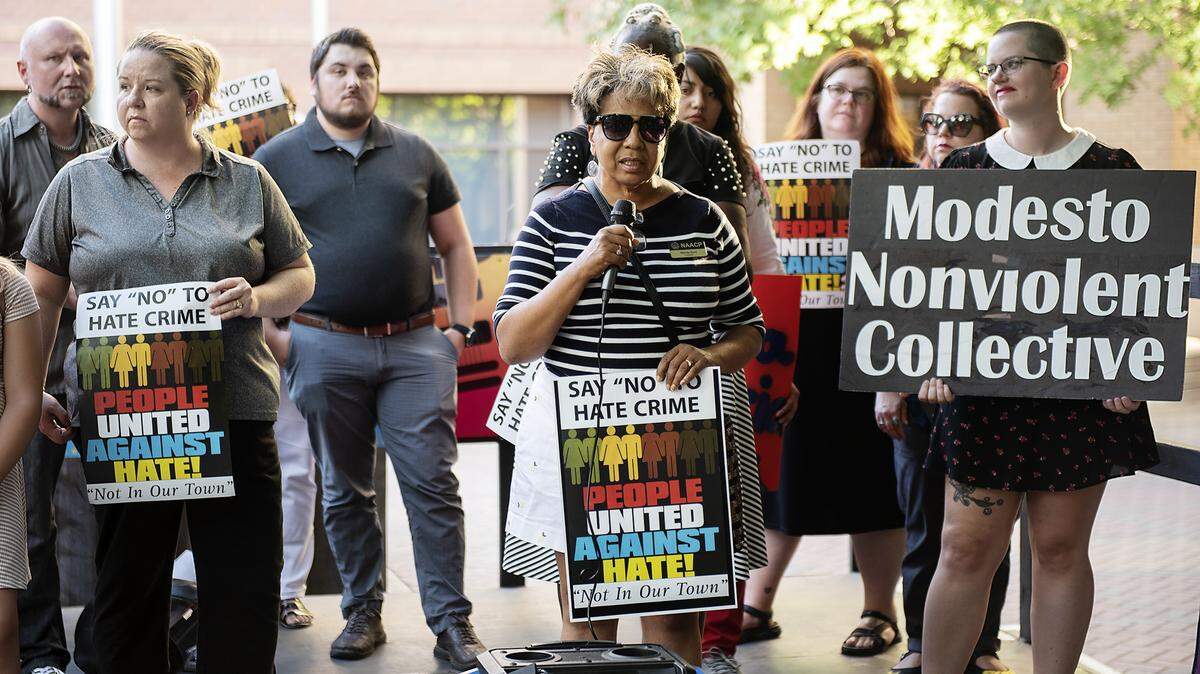
Taking ownership of the problems facing society today is crucial in honoring and building upon the late Rev. Martin Luther King Jr.’s legacy, Stanislaus County NAACP president Wendy Byrd said Monday.
Speaking at an interfaith commemoration event hosted virtually by the Revival Center in Modesto to honor the late civil rights leader, Byrd emphasized that King “did his job, and he did a good job,” but that it now falls to everyone in the community to carry on the work he set in motion. King was instrumental in the civil rights movement, gaining national and international recognition for his emphasis on nonviolence and civil disobedience.
King led the Montgomery, Alabama bus boycott and delivered his famous “I Have A Dream” speech during the 1963 March on Washington. In 1968, at the age of 39, King was assassinated in Memphis, Tennessee, where he had gone to support Black sanitation workers.
A federal holiday in his honor is observed on the third Monday in January each year.
“As we celebrate this National Day of Service and this event of honoring Dr. King,” Byrd said, “the question is not what did he do, but what are you going to do?”
This year’s holiday comes less than two weeks after pro-Trump insurrectionists stormed the U.S. Capitol in an effort to stop the certification of the November presidential election, and follows a year marked not only by the global COVID-19 pandemic — which has disproportionately affected African-American and other minority communities across the country — but widespread protests for racial equality sparked by the killing of George Floyd by a police officer in Minneapolis.
Speakers at this year’s commemoration — ranging from outgoing Modesto mayor Ted Brandvold to county supervisors Mani Grewal and Terry Withrow, as well as Stanislaus County Sheriff Jeff Dirkse — emphasized King’s calls for tolerance and nonviolence, and stressed the importance of entering into dialogue with those who have differing political opinions.
“Today’s marches, protests and division shows that while progress has been made, inequality and discrimination have not ended with the civil rights movement and the work of Dr. King,” Brandvold said. “History tends to repeat itself and time gives us perspective to look back at what has happened before. We must take a step back and look at the work of a truly remarkable man. Then we must pick up the ball and run with it.”
Byrd spoke about the need to be an agitator in order to effectively bring about change, “where you can still handle the business but then you can still leave a door open to move on.”
“When we talk about civil rights, we can’t just stay stuck in the past,” she said. “Civil rights is like a set of stairs. It’s continuous, and one step leads to the next. We can’t sit back and expect for other people to be the builders of those steps; there’s things that we can do, there’s something that we all can do.”
Byrd emphasized the importance of grassroots organizing, making an impact on the local community and “building bridges before it’s time to cross them.” She said compassion and a strategy to bring people together and focus on changing laws is “how dreams are made.”
Looking to the future, Byrd and other speakers noted the upcoming inauguration of President-elect Joe Biden and Vice President-elect Kamala Harris, who will be the first woman, as well as the first Black and South Asian person, to serve in the role. But just because there will be change in the White House doesn’t mean that everything will change, Byrd stressed.
“You can’t just think that just because you vote that your job is done,” Byrd said. “Civil rights is an ongoing thing, and as we get new members into the White House with a different vision, we have to still build upon (that) vision.”
The COVID-19 pandemic has also changed nearly every facet of people’s lives.
Byrd said that the pandemic presents an opportunity for people to reflect and see the changes they want in their own lives and in society as a whole. Moving forward, Byrd said, “there can be no business as usual because we don’t even know what usual is anymore.”
“Whenever we do get back together, there’ll be some expectations, though,” Byrd said. “(Expectations) that we won’t act the same, that we won’t think the same, that we will be different, and that we will be focusing not only on just standing on the shoulders of Dr. Martin Luther King, but we’ll focus on strengthening our shoulders, so that we can do the heavy lifting.”
This story was produced with financial support from the Stanislaus Community Foundation, along with the GroundTruth Project’s Report for America initiative. The Modesto Bee maintains full editorial control of this work.
To help fund The Bee’s economic development and children’s health reporters with Report for America, go to https://bit.ly/ModestoBeeRFA