Stanislaus County prepares for all-mail election Nov. 3. What are the chances for fraud?
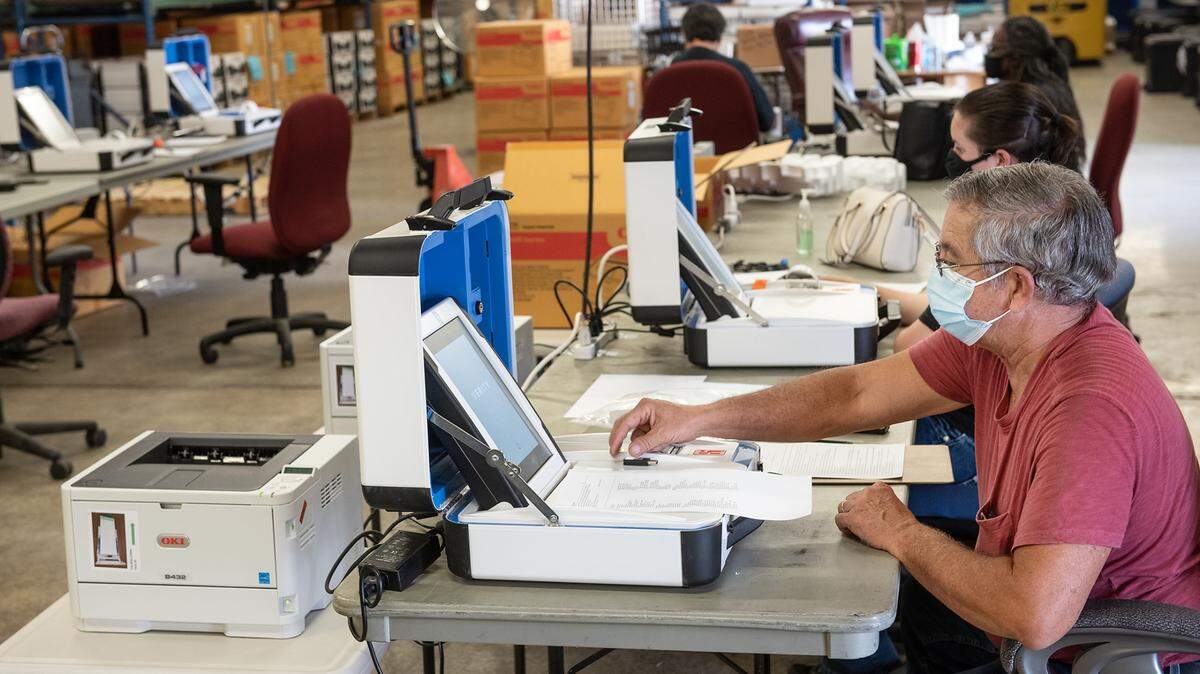
Stanislaus County is poised for its first-ever vote-by-mail general election in November brought on by a coronavirus pandemic that’s gripped the nation and even infected the top executive of the United States.
For the first time, people casting mail-in ballots will decide the outcome of federal, state and local elections.
It begins Monday as ballots are sent to the county’s 268,315 registered voters and it could end weeks after Election Day (Nov. 3) when the final tallies are completed. Voting by mail has been a widely used option in the past, but this time all registered voters are automatically given a mail ballot to avoid mixing and COVID-19 transmission at polling places.
Mail ballots are nothing new for multitudes of local voters — about 77 percent asked for them in the last statewide general election and the March primary, said Donna Linder, county registrar of voters.
While the race between President Donald Trump and former Vice President Joe Biden captures most of the attention, there is considerable energy around congressional, state and local contests in Stanislaus County.
Rep. Josh Harder, D-Turlock, is defending his congressional seat for the first time against Republican challenger Ted Howze in a much-talked-about race.
In Modesto, the mayor’s office and three council seats are contested in an election featuring no less than 18 total candidates.
Two of the three county supervisor seats on the ballot are contested. Elections will be decided in six other cities in Stanislaus County, along with school districts, irrigation districts and education boards.
The lengthy ballot also includes nine local ballot measures.
The county elections office has nixed traditional polling places for this election. People voting earlier can simply mail their completed ballots or use a drop box.
Starting Monday, the county will provide 16 indoor drop boxes at supermarkets and local government offices and two outdoor boxes at the county elections main office, at 1021 I St. in Modesto, and Burchell Nursery, 12000 Highway 120 in Oakdale. A list of drop boxes in the county and its nine cities is available at www.stanvote.com.
Voters, after marking their ballots, place them in the return envelope and then sign and write their address on the envelope.
The county is required by law to provide one satellite station for every 10,000 registered voters or 26 in all. The satellite offices will be open a few days before Election Day, from Oct. 31 through Nov. 3. The offices are for voters who need assistance because of disabilities or language barriers or their ballot is lost or damaged, Linder said.
It’s also a place for registering to vote on a conditional basis after the Oct. 19 deadline. The closest satellite near you is printed on the back of sample ballot pamphlets. Satellite offices are not a place for traditional in-person voting.
For people who do not vote early, the satellites will have boxes for dropping ballots instead of using what could be a swamped postal service near Election Day. Only ballots postmarked Nov. 3 or earlier are valid. Satellite offices are also listed at www.stanvote.com.
In addition, five curbside ballot drop locations will be available Nov. 2 and Nov. 3. County elections will have a curbside location outside the Gallo Center for the Arts, across from I Street elections office. Other drive-up locations will be John Thurman Field; California State University, Stanislaus; Turlock Silvercrest Senior Residence; and Stanislaus Culinary Arts Institute in Oakdale.
Linder said a satellite elections office in the Gallo center lobby will handle overflow Nov. 2-3.
State assists the county with extra costs
Linder said the county received $980,733 through a CARES Act agreement with the Secretary of State to offset extra costs of conducting an all-mail election during the pandemic.
Of that, $828,950 can pay for increased costs of voting by mail, equipment to process those ballots, for cleaning and disinfecting and other safety protocols. The remaining $151,783 can be spent on outreach and public communications.
Asked to compare the overall costs of the all-mail election and the 2016 presidential election, Linder said the 2020 election will potentially cost more, but it’s not a straight cost comparison between all-mail and conventional voting because of the complexities of the COVID-19 pandemic.
Linder said 900 to 1,000 poll workers are typically needed for a traditional election. Her office expects to use 150 to 200 people in staffing satellite offices. The mail election has extra costs for mailing all of the ballots and equipment and the staff time to process and count all the ballots as they come in.
To ease concerns about COVID-19, staff will practice social distancing at satellite locations and disinfect surfaces.
County supervisors raise voting fraud concerns
President Trump and some of his supporters have stoked fears about voting fraud in the upcoming election, prompting Linder to field questions about procedures and security measures that safeguard the election process.
Linder isn’t aware of any major voter fraud cases in the county’s history. “If a signature is missing from the ballot or does not match, we contact the voter,” Linder said Thursday.
She added there are measures to keep a person from voting twice.
Supervisor Jim DeMartini raised concern about “ballot harvesting” at Tuesday’s board meeting. He referred to a viral video that claims to show a political operative collecting hundreds of ballots in July for a City Council candidate in Minneapolis.
Supervisor Terry Withrow echoed another concern raised by DeMartini. With more lenient election laws, some voters are giving their ballots to strangers for delivery. DeMartini added that voter registration the same day as the election creates another opportunity for cheating.
Linder replied that voters don’t have to give their ballots to strangers. They’re encouraged to vote early by mail or take completed ballots to drop boxes or satellite offices.
For people registering to vote on Election Day, elections staff check a database to make sure they are not registered in another county, Linder said.
How long will it take to count the ballots?
The increasing popularity of mail voting tends to slow down the post-election count and delay reporting the outcome of election contests. Election workers have to process and then count thousands of ballots that come in just before Election Day or within the allowable time period.
Gov. Gavin Newsom signed a bill in June ordering counties to send a ballot to every registered voter and tabulate ballots that arrive up to 17 days after Election Day, as long as ballots are postmarked on or before Nov. 3.
Linder said the 17-day rule for this election gives the post office more time to receive and deliver ballots to county elections. She didn’t have an estimate on when the outcome of races will be known this time.
Linder said the Registrar of Voters office has always had 30 days after the election to count the ballots and certify the results. No extra time was granted for the unprecedented 2020 election.
“We have 30 days after Nov. 3 to finalize the results,” Linder stated.
This story was originally published October 4, 2020 at 6:00 AM.