A legacy of helping abused children: Stanislaus County Judge retires after 22 years
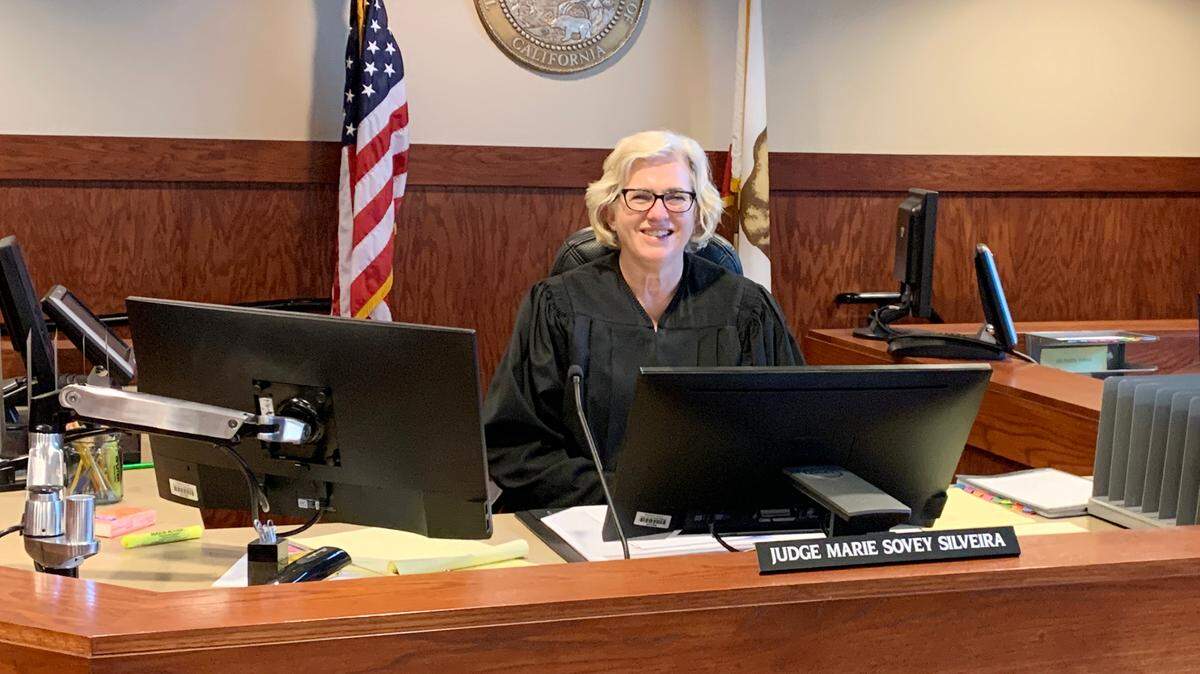
Judge Marie Silveira started her legal career as a civil attorney and has spent the last three years as a judge in the civil division, but she may be best known for presiding over some of the biggest criminal cases in the county during the last two decades.
Silveira, 65, is retiring Friday after 22 years on the bench. She has worked in nearly every division of the court, including criminal, civil, family and juvenile court. She was instrumental in establishing the Court Appointed Special Advocates program for abused and neglected children. She serves on the board of the Stanislaus County Law Library and is a member of a group that fosters professional relationships between lawyers and judges. And she twice held the position of presiding judge.
Judge Thomas Zeff, who has worked with Silveira for the past 14 years, called her “an exceptional judge and even better person. She is highly respected by our bench and the attorneys who appeared in her court. Her wisdom, integrity and acumen will be missed.”
More than half of Silveira’s judicial career was spent in the criminal division, where she heard hundreds of cases, including at least 15 murder trials with more than 20 defendants.
There was a botched home invasion robbery in which a group of Norteño gang members targeted the wrong house looking for drugs. A man was fatally shot in the back as he pleaded for mercy.
A drive-by shooting that killed a 10-year-old boy and a man at a home in the La Loma neighborhood also was gang-related. Three men who were convicted of murder and sentenced by Silveira to life in prison without the possibility of parole were targeting the boy’s father, a Norteño dropout who was selling drugs in their territory.
The cases she heard involving gang violence are some that still weigh on Silveira “partly because of the implication that gangs have on our community.”
But some of the more notorious cases stand out in her mind as well.
Dena Raley-McCluskey was missing for eight years until her killer, who was her roommate when she disappeared, confessed he buried her body near his parents’ Tuolumne County property. Silveira sentenced him to the maximum term of 11 years in prison for his conviction for voluntary manslaughter.
She presided over the trials of two teenagers who took part in the brutal killing of an 18-year-old Madera County woman.
A 19-year-old man was convicted of bludgeoning the woman to death with a dumbbell and a 16-year-old girl was convicted of orchestrating the killing out of jealousy because the victim had recently become engaged to her ex-boyfriend.
The case was moved to Stanislaus County due to pretrial publicity. It got national attention and was featured on several true crime television shows.
Appreciation for jurors
Silveira has met hundreds of jurors over the years. She said interacting with jurors and guiding them through the process is one aspect of her career she will miss most.
She said she often recognizes people who served in her trials when she runs into them outside of court.
One day at a local restaurant, she saw a group of eight woman who served on one of her murder trials and learned that they’d stayed in touch and once a month got together for a meal.
“They are strangers that come together and they are with each other every day for three or four months and they can’t talk about the case but they start talking about their families, their jobs, (and) the other things they are allowed to talk about, so they do develop a bond by doing that,” she said.
While they can’t discuss it, day after day jurors and courtroom staff are sitting together experiencing the same testimony and events.
Throughout one day of testimony, Silveira noticed jurors were noisily dropping their pencils. She never said anything about it but one of the jurors showed up a few days later with eight wooden pencil holders he’d made.
She told the man she couldn’t accept gifts but agreed to take them “On loan until we get a new courthouse … well here I am retiring and there isn’t a courthouse.”
Before her last day, she plans to disperse them to fellow judges who hopefully will still be working when the courthouse is finally built.
When Silveira was serving as presiding judge she’d attend the California Judicial Council meetings pertaining to construction of the new courthouse, which will be at Ninth and H streets.
The current Presiding Judge, Dawna Reeves, said Silveira was an “excellent leader” during her two terms as presiding judge and was always willing to be a mentor and friend to colleague.
“Judge Silveira is a person that gives endlessly of herself in all that she does,” Reeves said. “Her expressions of true care and compassion for others is routinely demonstrated both on and off the bench. All that came before her were treated with respect and dignity regardless of the circumstances of their visit to the court. Judge Silveira’s daily presence in the court will be missed but the lessons we learned from her leadership and kindness will remain with us forever.”
Silveira said she likely would have postponed her retirement if ground had been broken on the new courthouse by now.
Budget shortfalls over the years have stalled the project, which was first approved for funding in 2010. Meanwhile, the $262 million price tag increased by $17 million to adjust for inflation.
There is funding in the state’s 2020-21 budget for the project and current estimates by the Judicial Council is that construction will begin this fall.
“In this time of COVID, in terms of the economy and breaking ground and getting it finished, there are a lot of questions,” Silveira said.
Changes at the courthouse
One of the most significant changes Silveira saw during her career was an increase in diversity in court.
In 1998 when she was sworn in, Silveira was only the fifth woman to join the bench in Stanislaus County.
Now close to half of the judge and commissioner positions are held by women.
“The court has many more women judges, and more diversity, than when I started; that includes the court personnel and the attorneys appearing before the court,” Silveira said.
The most unpredictable changes have come just over the past six months with the coronavirus pandemic.
She’d hoped to see through many of the pending cases assigned to her but all civil jury trials have been vacated through November because of the pandemic.
Some of her retirement plans also have been stalled due to the coronavirus, like traveling, speaking at college criminal justices classes or joining the state program that uses retired judges to temporarily fill in when there is a conflict of interest or vacancy.
“It seems to me right now if COVID lasts, who knows how long, and the courts don’t require additional help with the current scheduling, that there will probably be some opportunity for me to work in education, maybe to get involved to help kids get through this one way or another whether that is a learning program about civics or judges,” she said. “I’d like to do something like that.”
This story was originally published July 28, 2020 at 6:00 AM.