
Enough rain? Sufficient snow? Here’s how wet California, and Modesto, got in 2019
While October marks the start of the new water year in California for state hydrology officials, the rest of us saw the calendar flip to 2020 on Wednesday.
Numbers from the National Weather Service and California Department of Water Resources tell the story of 2019 for Modesto and the Sierra Nevada: a wet start, followed by a long dry spell (minus May) and finally a few winter storms to end the year strong.
Indeed, a precipitation map by the NWS Bay Area confirms it was a wetter-than-normal December throughout most of the state, including Modesto, which had 2.37 inches, according to the Modesto Irrigation District.
Those storms brought an end to California’s 2019 wildfire season, which had roared to life in the autumn months with Sonoma County’s Kincade Fire and other significant blazes in Northern and Southern California after a relatively quiet summer.
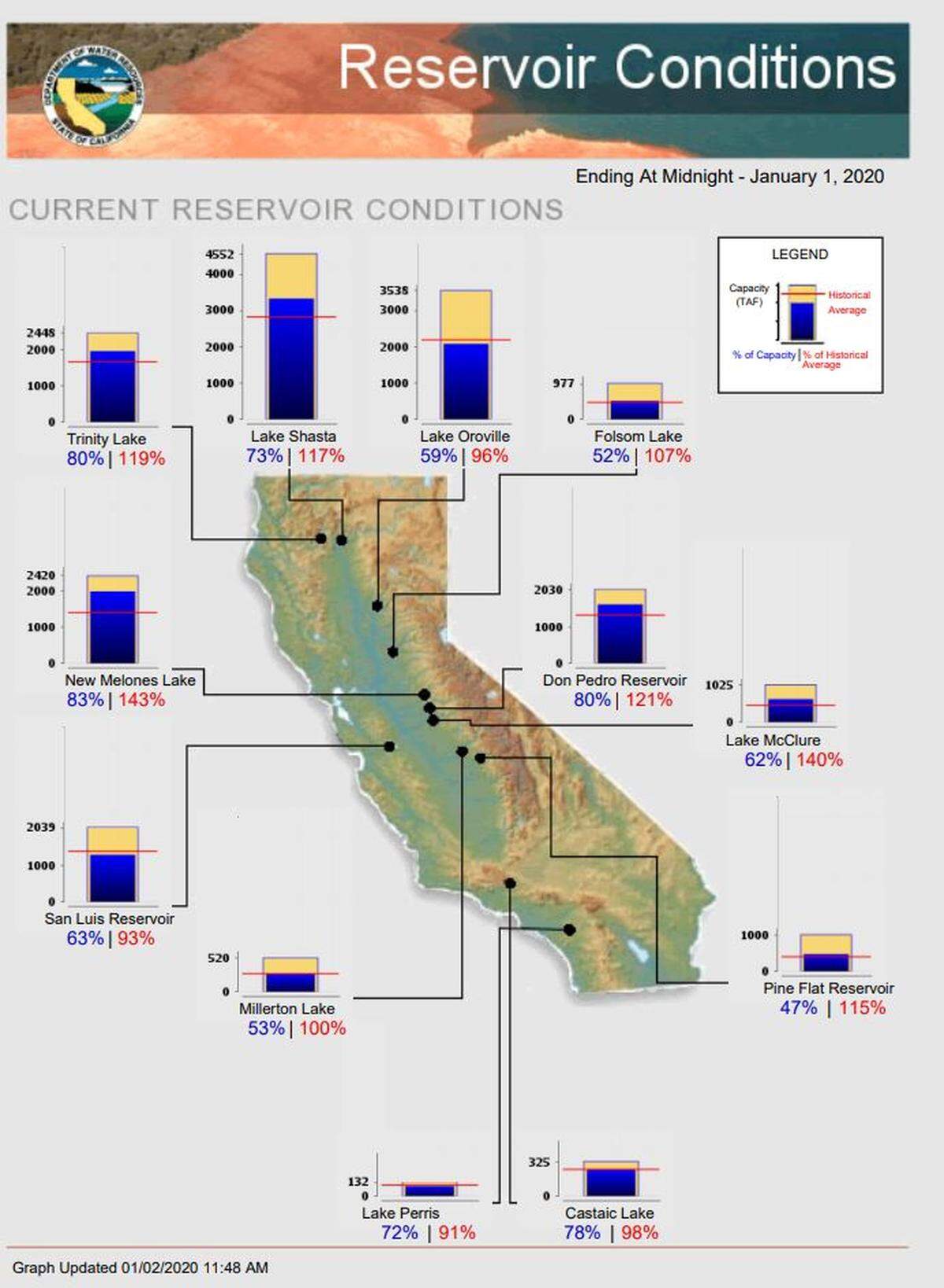
Heavy rain and snow bookending 2019 also mean reservoirs are in good shape to start 2020, DWR said.
Storage at Don Pedro Reservoir is at 121 percent of average for this time of year. MID shares it with the Turlock Irrigation District.
New Melones Reservoir is at 143 percent. It supplies the Oakdale and South San Joaquin irrigation districts and the federal Central Valley Project.
McClure Reservoir, owned by the Merced Irrigation District, is at 140 percent. The reading is 93 percent at San Luis Reservoir, shared by the CVP and the State Water Project.
How about Sierra snowpack?
The statewide average snow-water equivalent, across the Sierra Nevada range, stood at 9 inches as of the last day of 2019, according to the DWR. That represents 94 percent of normal for California, and is the best year-end figure since 2015, when it reached 106 percent.
DWR officials conducted the first manual snow survey of 2020 Thursday at Phillips Station near Echo Summit, recording a snow depth of 33.5 inches for a snow-water equivalent of 11 inches.
Sean DeGuzman, chief of snow surveys and water supply forecasting at the DWR, said those numbers are about 97 percent of average for the start of January, and 44 percent of the average snowpack for April, which is when snowpack typically peaks.
“It’s still too early to predict what the remainder of the year will bring in terms of snowpack,” he said.
DeGuzman stood atop heavy powder and wearing a beanie and thick blue jacket as he announced the results, streamed live via Facebook.
“While the series of cold weather storms in November and December has provided a good start to the 2020 snowpack, precipitation in Northern California is still below average for this time of year,” DWR Director Karla Nemeth said in a prepared statement. “We must remember how variable California’s climate is and what a profound impact climate change has on our snowpack.”
What does this mean for state’s drought status?
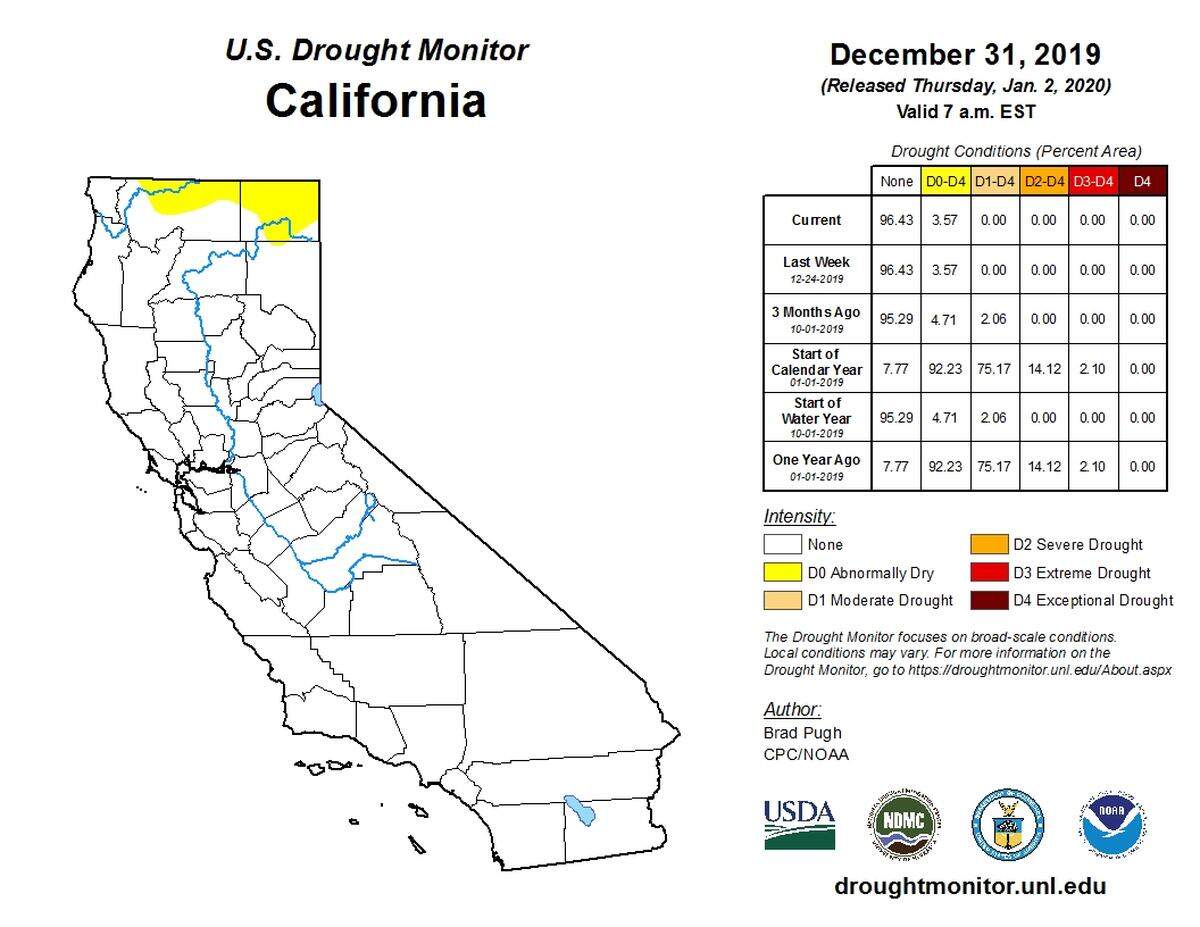
Though a “drought” technically refers to a statewide emergency being declared, as Gov. Brown did in January 2014, California is in excellent shape, according to the U.S. Drought Monitor.
According to a map released Thursday with data through the last day of 2019, more than 96 percent of the state’s land area has no measurable level of drought or “abnormal dryness.” The only dry patch is seen in the state’s northeast corner.
On Jan. 1, 2019, more than 92 percent of California had some level of drought or dryness, according to the monitor.
This story was originally published January 2, 2020 at 4:29 PM with the headline "Enough rain? Sufficient snow? Here’s how wet California, and Modesto, got in 2019."