
Abatement districts warn of early start to West Nile threat
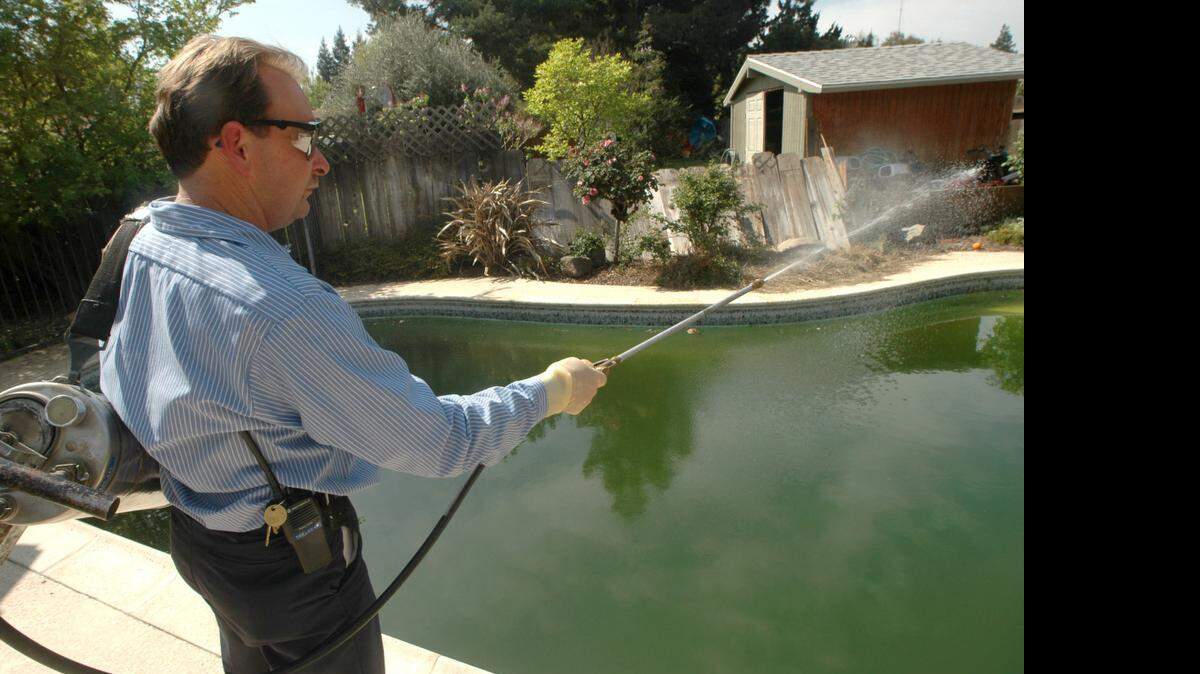
The Turlock and East Side mosquito abatement districts started surveillance and control operations this month for mosquitoes that spread West Nile disease.
Drought conditions and warmer temperatures are believed to have heightened the threat of West Nile illness in the Northern San Joaquin Valley.
The potentially deadly virus has already been detected this spring in Alameda and Santa Clara counties. Last year, the drought was blamed for an unusually high infection rate in mosquitoes and the second-highest caseload of West Nile disease in Stanislaus County since the virus first appeared in California in 2002.
A county task force will meet Friday to discuss efforts to protect the public this year.
The county had 47 cases in 2014, including two deaths and 36 other people with the debilitating neuroinvasive form of the disease, with some residents suffering for months with the illness.
David Heft, general manager of the Turlock Mosquito Abatement District, said mosquito counts last year were below the five-year average, but the proportion of mosquitoes infected with West Nile was significantly higher than normal.
Because there was less water, birds that carry the virus came into cities to forage for water. The interactions between birds and mosquitoes were more concentrated around water sources, driving up the infection rate and leading to more chance of human exposure, Heft said.
Officials also are concerned about two other factors: higher temperatures and mosquitoes showing resistance to the most common chemical sprayed to control the insects, pyrethrins.
The heat-loving virus no longer is dormant through the cooler winter months but continues to amplify. “We are seeing positive (samples) by May or early June,” Heft said.
When the state began resistance testing last year, the Turlock abatement district sent 1,000 mosquitoes to the lab and 90 percent showed resistance to pyrethrins.
To control thick concentrations of mosquitoes, the Turlock district plans to do more spraying with an organophosphate called Naled, which long has been used in agriculture, Heft said. The chemical must be applied from an airplane, raising the district’s costs.
Heft said continued spraying with pyrethrin would result in more resistance developing in mosquito populations. “We don’t want to be wasting time and money applying something that may not be effective,” Heft said.
The aerial spraying will target farmland unless there’s an infection rate that justifies spraying over urban neighborhoods, he said. The abatement district just completed a survey from the air of neglected swimming pools and other water sources where mosquitoes breed in residential areas. District personnel will inspect and treat hundreds of swimming pools that can harbor mosquito larvae.
Of the 38 cases of serious nervous system disease in 2014, seven were in the Turlock district, which includes Turlock, Ceres and other communities south of the Tuolumne River. The two deaths and 29 other cases of severe West Nile illness were within the boundaries of the East Side Mosquito Abatement District, which includes Modesto, Riverbank, Oakdale and areas north of the Tuolumne.
East Side’s general manager was away Thursday. Ron Greenwood, the only director on the six-member board who lives in Modesto, said he had not been part of any board discussion on new strategies to control mosquitoes this year.
“All we do as board members is pay the bills and approve what they do out there,” Greenwood said. “I don’t know that you can really prevent it. We have been fighting mosquitoes forever and they are winning.”
In a news release, the county Health Services Agency urged the public to report dead birds to the state’s hotline: (877) 968-2473. People can take precautions by draining standing water around their homes, using insect repellents with DEET and not being outdoors at dawn and dusk when mosquitoes are active.
Bee staff writer Ken Carlson can be reached at kcarlson@modbee.com or (209) 578-2321.
This story was originally published April 23, 2015 at 7:55 PM with the headline "Abatement districts warn of early start to West Nile threat."