
Modesto Bee reporter walks a mile in firefighter’s boots
Today I watched flames lick the air over me, smoke so thick it could only be seen in the beam of a flashlight. I opened a hose nozzle and realized the force could have flicked me around like a bug. I did CPR until my shoulders ached – 30 seconds, out of 30 to 40 minutes given most patients.
Safe to say, the city of Modesto will not be hiring me as a firefighter.
But I was a trainee for a day. The Modesto Fire Fighters Local 1289 and Modesto Fire Department jointly put on Fire Ops 101 Saturday for city leaders, legislators and one 5-foot-2 reporter.
“The goal is to get an inside look at what we do on a daily basis,” explained union President Jair Juarez in welcoming remarks.
“It’s for us to build better relationships,” said Fire Chief Sean Slamon. “In the fire department, we’re a very unique department with a different role, different schedules. We don’t bring a lot of revenue into the city.”
To say fire departments are not profitable is an understatement. They require expensive gear, drive expensive rigs – and qualified personnel do not come cheap. Taxpayers outfit the force that walks into burning buildings, ratchets open wrecked cars and rescues the injured wherever they lie.
The Modesto department answers roughly 30,000 calls a year. That’s just over 82 calls a day, handled by 10 fire engine crews, two ladder trucks and a one-man apparatus designed for airport emergencies.
“Modesto answers more calls per firefighter than anywhere in the country,” said Mayor Garrad Marsh. “That doesn’t mean we have more calls than everywhere else, but we have less staff.”
Marsh was standing in turnouts and helmet on the tarmac at the Regional Fire Training Center, having just wrestled a charged hose line to battle an imaginary fire in the training tower basement. Fire attack was the fourth and final station of Ops 101 for my group.
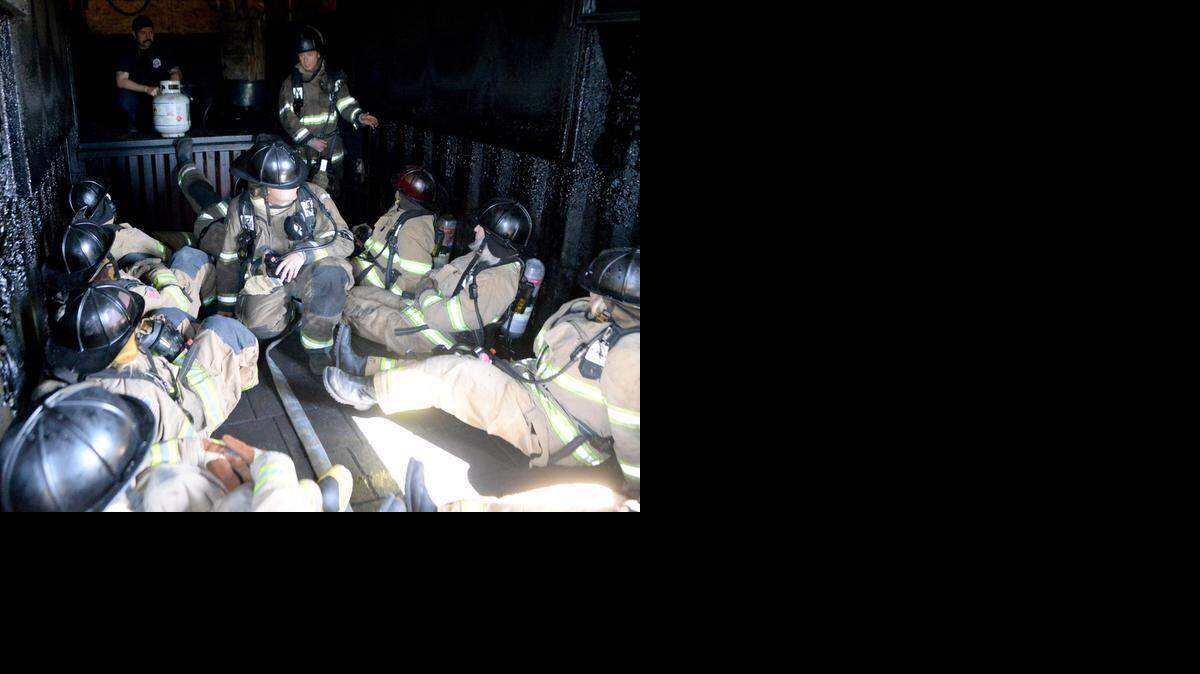
The first was taking part in a live fire training. We donned 40-plus pounds of standard fire gear after a half-hour of fire science basics. What sunk in were details like the temperature that sweat boils, skin peels, turnouts dissolve. All of which, by the way, would be exceeded in the fire rolling above us.
“The room reaches a point where everything in that room is going to become a vapor and turn into fuel,” firefighter Todd Stasiowski explained.
For 15 to 20 minutes the men helped us balance, pulled leggings over boots, zipped jackets, tucked in hoods, held up tanks while we tugged the straps and cinched on masks. Picture a little kid being stuffed into a snowsuit and boots, then add a scuba tank, to get the essence. Then our helpers leaped into their gear in 30 seconds as we trainees trundled, zombie-like, toward the split-level rail car housing the burn.
A few cut-up pallets, stuffed in a barrel on the high section, furnish the fuel that flashes over those sitting 36 inches below in the longer section. Stasiowski narrated as the smoke thickened and elegant rivulets of flame licked just over our heads – surreal, mesmerizing, deadly.
The oily campfire smell I acquired lasts a good two days, even with showers, firefighters said. Had our fire burned plastics and modern building compounds like those in a standard house fire, it would have stayed with us three or more days, oozing out even in sweat.
We crawled out of the car, sweaty and tired after our 20-minute sit. Back to the training center to see what ladder trucks do.
Ladder trucks carry no water and have no pump engine. But what they do have speaks volumes about the step-in-anywhere, figure-it-out, solve-the-problem role of the fire department.
“This is just a big, giant toolbox,” firefighter Jesse Miguel said, by way of introduction. It holds a stokes basket for hauling injured people up cliffs and all the ropes, pulleys and carabiners to manage the terrain. It has an inflatable boat, piles of tarps and telescoping pylons to secure cars in unstable places. Then crews can use the Jaws of Life spreader, with a metal cutter and a ram that extends, pushing apart crunched car parts to free trapped limbs.
There are a selection of power saws, lights, power outlets with 100-foot cords, and fans. Bags of 4-by-4 lumber called cribbing are for stacking, Lincoln Log-like, to brace a side being raised. They have long hooks, axes, metal claws and pry bars to force doors. Straps, water vacuums and squeegees, sledgehammers, screwdrivers and paramedic gear.
Firefighters work 48 hours straight, then have four days off, which averages out to be a 56-hour week. I lasted eight hours, with help.
Bee education reporter Nan Austin can be reached at naustin@modbee.com or (209) 578-2339. Follow her on Twitter @NanAustin.
This story was originally published March 28, 2015 at 10:39 PM with the headline "Modesto Bee reporter walks a mile in firefighter’s boots."