
Longtime Stanislaus bailiff, the last from former Marshal’s Office, retires
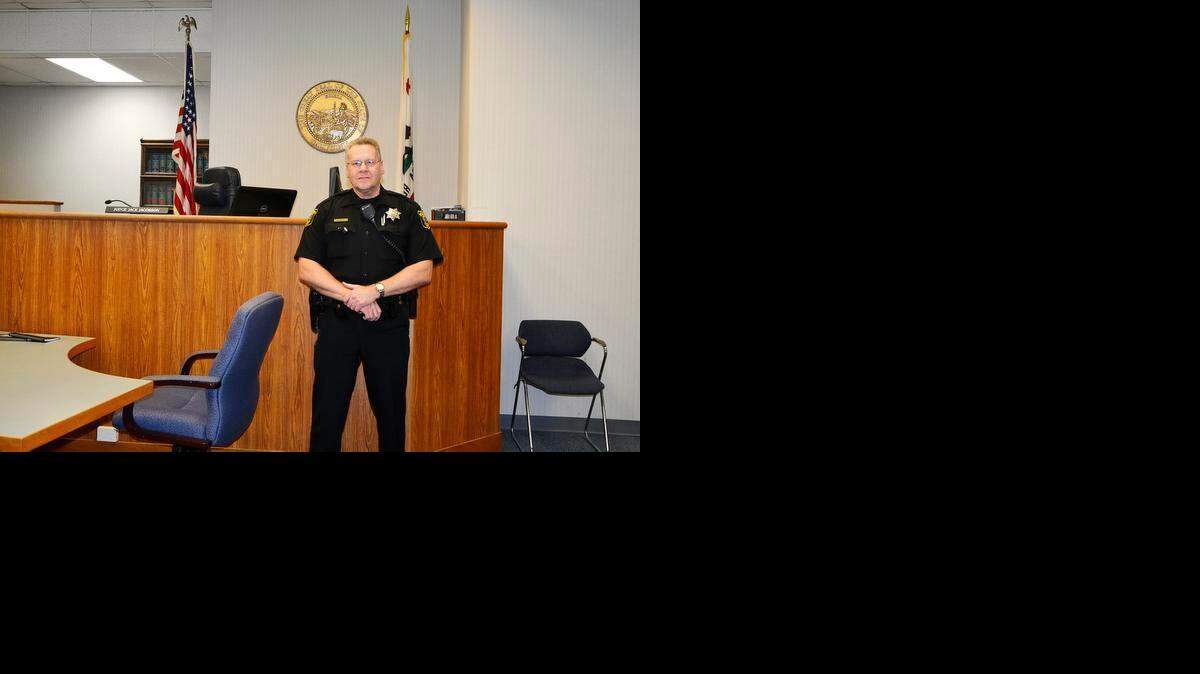
When Stanislaus County sheriff’s Deputy Richard Smith, a bailiff in Department 9, retired on Friday, he took a piece of history home from the courts – himself.
Smith, 59, was the department’s last remaining deputy marshal from before the Marshal’s Office and Sheriff’s Department merged in 1992.
The Marshal’s Office used to provide court security and serve papers for Municipal Court, also a thing of the past. Six years after the Marshal’s Office disbanded and deputy marshals became deputy sheriffs, the courts followed suit by eliminating Municipal Court and swearing in all its judges to serve in Superior Court.
All municipal courts were absorbed by superior courts by the early 2000s following a statewide vote. Only three of California’s 58 counties retained marshal’s offices for security, according to the court website for one of them, Shasta County.
The first presiding judge for the newly unified courts in Stanislaus County was John Whiteside, to whom Smith was assigned for the majority of his 29-year career in law enforcement.
Whiteside was appointed to the Municipal Court bench in 1989, the same year Smith started as a deputy marshal after working in the jail for a few years.
Municipal Court judges handled all misdemeanor criminal cases to completion and felony arraignments and preliminary hearings, Smith said. The felony cases went to Superior Court after the preliminary hearing.
Traffic Court was also heard in Municipal Court, as well as civil lawsuits for amounts up to $25,000.
The Municipal Court judges rotated through the four courtrooms in the basement of the courthouse on I Street as well as a few other permanent courtrooms in Modesto, Ceres and Turlock, and one judge was assigned to the “the circuit,” Smith said.
Back then, there was no commuting to court for defendants who lived in outlying cities; the court came to them.
The circuit judge and his deputy marshal traveled to each city for a day or more, or just part of a day, depending on the size of the city and the number of cases there, Smith said. In the smaller cities like Riverbank, Waterford and Oakdale, city council chambers and community centers were used as temporary courtrooms.
Smith chuckled as he recalled the complications that sometimes came with sharing the space.
He and Whiteside arrived at the community center in Waterford at about 10:30 or 11 a.m. on Thursdays, around the same time a lunch was being held for senior citizens.
All that separated the courtroom in which serious matters were up for discussion from dozens of snacking seniors was a flimsy accordion door, Smith said.
The seniors were getting particularly loud one day, so much so that Whiteside couldn’t hear the defendants and they couldn’t hear him. He had Smith ask them to pipe down.
“I open the door and there is about 100 of these old people in there. … They are all eating and talking to each other and holding their hands to their ear because they can’t hear very well,” he said.
It took a while to get their attention, but when he eventually did, Smith explained the dilemma they were having next door.
“This little old guy says, ‘Deputy, you go tell that judge that we are old people and we can’t hear and that’s why we have to yell at each other, and if it bothers him … he needs to pick a different time to hold court,’” Smith said.
Smith reported back to Whiteside, and after joking that he could arrest them all for contempt of court, “Judge Whiteside looked at me and says, ‘No, I’ll just talk a little louder.’”
In the afternoons after court or if their judge was on vacation, the marshals would do much of what the sheriff’s civil unit does today, such as serve subpoenas and restraining orders, carry out evictions and conduct till taps, in which they collect every sale from a business that has a judgment against it until that judgment is paid in full.
The marshals also would arrest people with misdemeanor warrants.
“Back then if they had cash … they could give us the cash bail; we’d give them a receipt and a summons for their new court date,” Smith said. “They bonded out with us right there.”
Bails are higher now and usually require a bondsman. Even so, at-your-door bail service is a thing of the past.
The end of the Marshal’s Office didn’t come without a fight and took decades of encouragement by grand juries that pushed for a merger to save money by eliminating duplicate responsibilities of the two county departments.
In 1991, then Marshal Don Olson and Sheriff Les Weidman fought for total control of the courts, both submitting proposals to the county. The sheriff prevailed, but only when an agreement was made that ensured no one would be laid off, including Olson, who was appointed as the new lieutenant in the charge of the courts.
Smith said all of the former deputy marshals became sheriff’s deputies in the courts. Some eventually transferred to patrol for the Sheriff’s Department, and some went to other agencies.
Smith said two of his former marshal colleagues are still working, one for Modesto police and the other for Oakdale police, but he was the last remaining at the Sheriff’s Department.
“We’ve had days where it’s really quiet in the court; like most jobs, it’s mundane day-to-day stuff, then all of a sudden one day it just goes crazy,” he said.
During his career, he’s had to act when a murderer tried to run out of the courtroom upon being sentenced to death, when a drug offender flipped over the large wooden defense table and, on too many occasions, when a defendant punched or lunged at his attorney when he was unhappy with a judge’s ruling.
Up until last week, Smith wondered whether he should have held off on retirement.
“I wouldn’t have realized it until I got into this work that it really is a great job,” he said. “Even with all of its pitfalls, especially the way it’s been portrayed here lately, it is a good career. You just have to watch what you do and use your good common sense. I have met a lot of really good people in this job throughout the years.”
While Smith got his share of congratulatory hugs and slaps on the back last week, he hasn’t left law enforcement entirely. He’s returning to court Monday as a reserve deputy to train his replacement.
Bee staff writer Erin Tracy can be reached at etracy@modbee.com or (209) 578-2366. Follow her on Twitter @ModestoBeeCrime.
This story was originally published March 22, 2015 at 7:28 PM with the headline "Longtime Stanislaus bailiff, the last from former Marshal’s Office, retires."