Central Valley native launches scholarship program for overlooked, struggling students
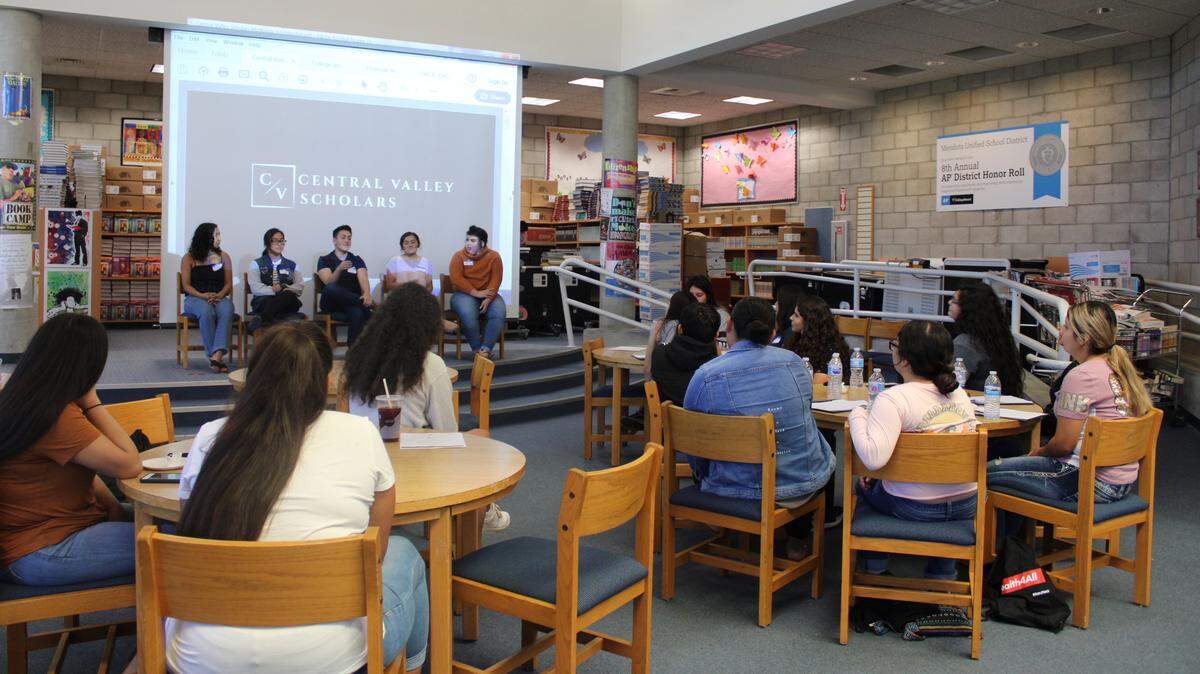
A shortage of scholarship and resource opportunities for people of color, the LGBTQIA and other marginalized populations is motivating a Fresno County native to help those in the Central Valley pursue higher education.
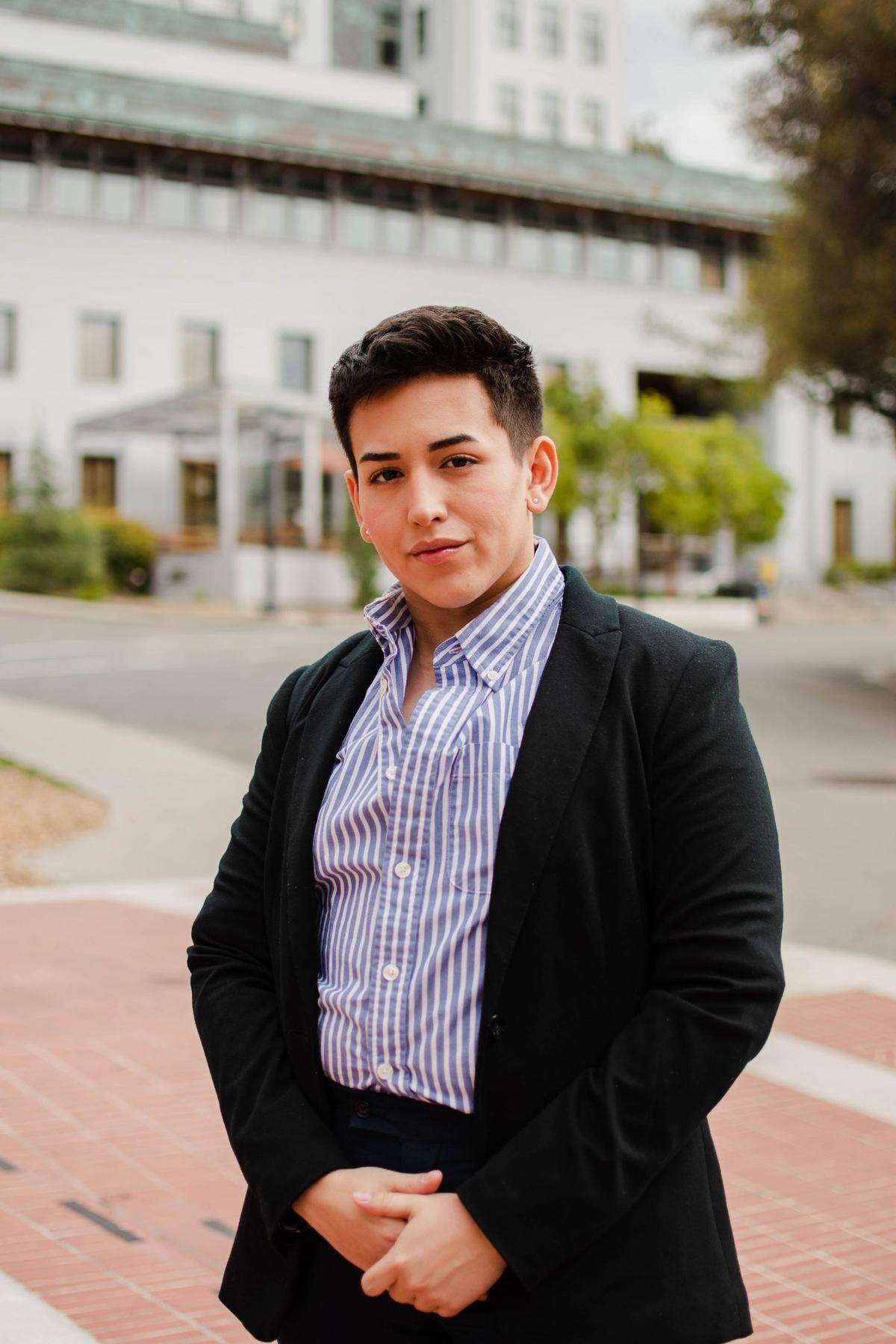
Typically, scholarships are based on students’ academic achievement and involvement in extracurricular activities. Michael Piña, who uses both he and she pronouns, said institutions should rethink their approach to be more inclusive. That’s why Piña launched his nonprofit organization, Central Valley Scholars, to give a chance to those who normally may be overlooked for scholarships.
Piña’s efforts are rooted in his upbringing in Kerman, where he lived in a poor immigrant household, sleeping in the living room with his family to escape drive-by shootings. Terrible comments at different times in high school by a counselor and a scholarship interviewer made him doubt who he was and his potential.
But when the straight-A student was accepted into the University of California, Berkeley, Piña realized how hard his journey was compared to his other more privileged peers and how much he desired inclusivity in higher education.
So in 2019, as a college sophomore, Piña launched a pilot program with a mission to do just that.
“My goal is to get students where they want to be,” said the now 22-year-old.
One of this year’s Central Valley Scholars award recipients, Juan Carlos Mosqueda Rosales, shared with The Bee his college journey as a first-generation, undocumented student. More on his and Piña’s stories later.
Organization offers more than scholarships
Central Valley Scholars offers various workshops and training throughout the year, focused on applying for college, financial aid, transferring schools, mental health and advocating for the queer and transgender. At this time, those services are being offered only over Zoom, but the organization will eventually hold in-person sessions across the Valley.
The organization also offers three programs, one being the Themtorship program, which provides first-generation, undocumented and Black students with one-on-one college preparatory guidance and mentoring by a current or former college student for 10 months. Black students can also apply for the Black Empowerment Program, a space where they can learn about themselves, network and express who they are through art and culture.
Those interested in learning more about health, research and engagement can apply to be a Community Health Scholar, a six-week summer program where participants, guided by an educator, can conduct local research to better understand the health issue they’re interested in and propose an outreach project.
Community Health Scholar recipients and those in the Black Empowerment Program will be awarded $100 for participating, and the finalist of the latter program will receive $1,000.
Central Valley Scholars also offers six types of awards based on identity and totaling $12,000. There are awards for students who are undocumented, in the LGBTQIA (lesbian, gay, bisexual, transgender, queer, intersex and asexual) community, first generation, or mentally and/or physically disabled. There are two awards for Black students.
One of the recipients also will be entered to receive the Inspire Award, providing the applicant with an additional $3,000.
Upbringing provides motivation
Piña said he wanted to escape the reality that surrounded him, especially the mistreatment he faced growing up as a queer individual in the Valley.
He knew college would be the way. But he said when he reached out to his counselor at Kerman High School for guidance, the man made it clear he didn’t believe in Piña.
“In my face, he looked at me and said, ‘You’re never going to college, so save yourself both the time and money,’” he said his counselor told Piña, who was a straight-A student and a sophomore at the time.
For a while, Piña doubted himself. He said the experience taught him to develop a thick skin and not always accept people’s words as truth.
His economic background was another barrier to getting to college. Piña said when he tried applying for scholarships, he wanted to be authentic and talk about the challenges of being queer in the Valley.
But he said one scholarship interviewer told him that his circumstances, like his environment, family’s immigration status and finances, weren’t the issue. Being queer was the root of all his problems, Piña was told.
Nonetheless, Piña, who graduated high school as a valedictorian of his class of about 300 students in 2017, was accepted into UC Berkeley. There, he was awarded the blue and gold opportunity plan, a grant of at least $12,570 given to students whose family income is less than $80,000 annually. He also was able to receive financial aid and qualify for other scholarships and graduated debt free in May.
Letters of recommendation and a track record of academic excellence may be a challenge for marginalized individuals applying for college, who may not have the connections or are dealing with underlying issues that make it much harder to succeed, Piña said. But those with the will to keep moving forward in the face of obstacles deserve a helping hand, he said.
“We never reward or support students … when they most need it, when they’re still struggling through that journey,” Piña said.
Nontraditional student awarded
Mosqueda Rosales, this year’s Inspire Award recipient, said he never thought someone like him would be selected. The big scholarships typically are awarded to students, particularly those in bigger cities, who have access to opportunities to showcase their talents, strengths and leadership skills, the 26-year-old said.
But living in the small town of Orosi, in Tulare County, Mosqueda Rosales said opportunities like that are limited, and in some cases nonexistent.
“I have very little to sort of promote myself,” he said.
As a first-generation student, college is challenging because there’s not much guidance on how to get there and what to do next, Mosqueda Rosales said. Though he’s earned three associate’s degrees, he said he feels frustrated and behind in life because high school peers have completed their bachelor’s degrees and some have gone on to graduate school.
“I do need guidance … I need someplace to look, to understand what can be done with an education,” he said. “That’s really been the struggle.”
Though Mosqueda Rosales tries his best to find his way, the undocumented individual said he feels a heaviness in his heart and struggles with his identity as imported books, food and art no longer fill the void of missing Mexico and his culture. And while life keeps happening and society says to keep up with the pace, he said he feels ungrounded, like he’s free falling.
“(Undocumented students) don’t really have any backup options, so it’s really just kind of keep pushing forward,” he said.
With the scholarship, Mosqueda Rosales said, he was able to pay his tuition at Fresno State, where he’s studying city and regional planning and is one of the few Latinos in classes for his major. He adds that he was also able to buy his first laptop, so he no longer has to share with his two siblings.
In spite of the obstacles he’s faced and those he expects to encounter in the future, he said he feels education may be the only way he can one day fly back to his country.
%20(1).jpg "IMG_9058 (1) (1).jpg")
This story was originally published January 3, 2022 at 7:30 AM.