Stanislaus resident to march for women’s rights as abortion access in U.S. is threatened
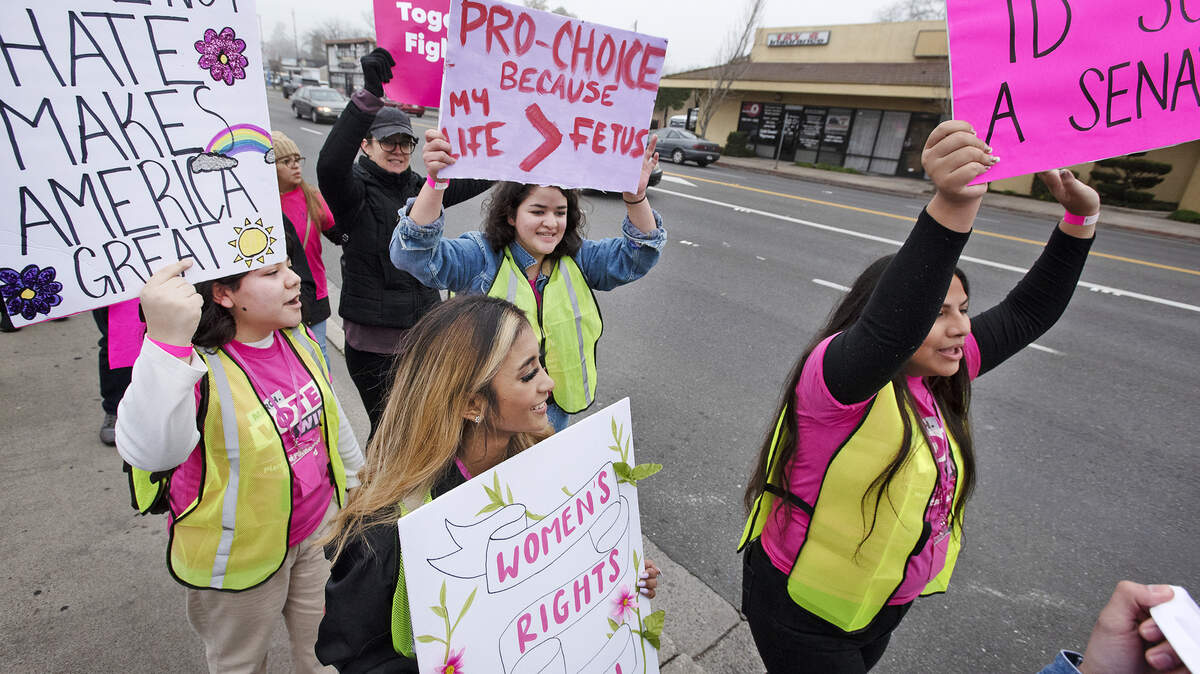
Stanislaus County residents are set to march and rally for reproductive rights this weekend as an almost 50-year-old constitutional law allowing abortion in the nation faces possible overturn.
The effort comes on the heels of two court cases that challenge Roe. v. Wade, a landmark decision made in 1973 protecting women’s choice on abortion. Texan women are traveling hundreds of miles for abortions after the U.S. Supreme Court declined to block a state law in early September that bans nearly all abortions after six weeks, well before many even know they’re pregnant.
Mississippi is also asking justices to overturn Roe v. Wade by banning abortions after 15 weeks of pregnancy.
Since 2017, the Women’s March has been held every January, but with the high court set to hear Mississippi’s arguments in December, organizers decided an impromptu march is needed, said Jessica Self, chair of the Stanislaus County Democratic Party.
“There were a lot of people who reached out who were going to march with or without us,” she said. “And so we sort of stepped up in that role.”
A car rally and march will take place at Graceada Park on Saturday at 10 a.m., followed by speakers at 11:30 a.m. Those participating in the car rally should meet at Enslen Park, where they will join marchers in about a mile march around the adjacent parks.
Voices from across the county
Participants are asked to wear masks and practice social distancing. City council members from Modesto, Riverbank, Oakdale, Waterford and Patterson are expected to speak, Self said.
More than half (59%) of the adults in the country believe abortion should be legal in all or most cases, according to a recent survey by the Pew Research Center. But Republicans and Democrats are more divided on this issue than ever, with 80% of Democrats, or Democratic-leaning independents, agreeing that abortion should be legal and only 35% of Republicans, or those leaning more right, believing the same.
With the Texas ban still standing and Republicans leaders in Arkansas, Florida, South Carolina and South Dakota looking to follow suit, Shannon Olivieri Hovis, director of National Abortion Rights Action League (NARAL) Pro-Choice California, said women’s right to abortion has never been in greater peril than it has in the last half century.
Strong abortion protections in California likely would withstand Roe v. Wade being overturned during the Mississippi case hearing, but the decision would cause a massive influx of out-of-state residents seeking abortions in California, she said.
“In a post-Roe world, California will have an outsize role to play in helping people all across the country access the care they need,” Hovis said.
Access is an issue nationwide
Even without the threat to women’s rights, seeking access is a problem across the country, with an estimated 89% of U.S. counties lacking clinics that perform abortion services, according to the Guttmacher Institute, a research group supporting abortion rights.
Of the estimated 1,587 abortion facilities in the U.S., more than a quarter of them are in California.
That doesn’t mean women in the Golden State don’t struggle with abortion access. In fact, 40% of counties here don’t have a facility that provides abortions and 3% of women in the state live in those regions. “It is true that those counties are sparsely populated, but we’re still talking about hundreds of thousands of women who live within those counties that have to travel,” Hovis said.
In Stanislaus County, Family Planning Associates (FPA) Women’s Health is the sole abortion provider, according to AbortionFinder.org. Besides that, the closest other options are in Tracy, Stockton and Merced.
“We are not a place where resources are made available to our working families as easily, or to our non-English speaking community members,” Self said.
Many women in the county are low-income, lack healthcare, don’t speak English and struggle to secure basic needs like water and therefore face greater barriers to abortion access.
Money a problem for many
Cost is also a huge barrier for women. Despite two-thirds of women receiving financial support for an abortion, many pay an average of $474 out of pocket, and some have paid up to $3,700, a University of California, San Francisco, study found.
Of the participants in the study, more than half used one-third of their income toward the cost. The cost of abortion also increases as the pregnancy progresses, with more than half of women in the study reporting a delay in abortion care because they needed to gather funds.
With income inequality rampant among Black women and Latinas, access to affordable abortion care is already a struggle. Black women (30%) and Latinas (24%) make up the majority of Medicaid enrollees, leading them to disproportionately suffer from the Hyde Amendment, which bans federal funds from being used toward abortion in Medicaid.
“Another part of the solution is really addressing our provider shortage,” Hovis said.
Training in Early Abortion for Comprehensive Health Care (TEACH) is one solution that could help. The program teaches family physicians how to provide abortion care and miscarriage mismanagement so that women don’t have to go through the added step of booking another appointment at a women’s health center.
Although Self said California isn’t looming with anti-choice legislation, it’s important for people to march for those that cannot.
“We want to tell women across the country that … wherever they are, that we’re not going to leave them behind. We’re going to do whatever we have to do,” she said.