Update: New coronavirus restrictions go into effect in Stanislaus County on Tuesday
Stanislaus County reverted to the most restrictive coronavirus status Monday as the state placed tighter restrictions on numerous counties to contain a resurgence of COVID-19 illness.
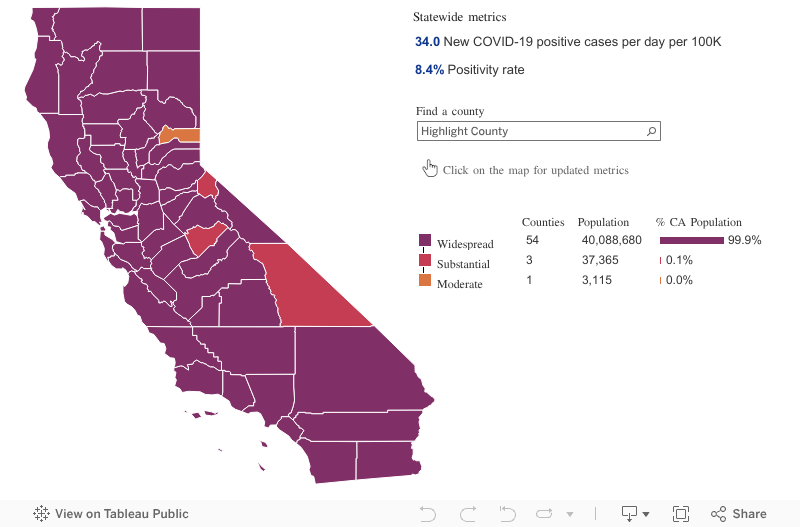
The sweeping move assigned 41 counties to the most restrictive purple tier of California’s strategy for battling coronavirus as more people stay indoors and prepare for traditional holiday activities. Only three weeks ago, nine counties remained in purple after economic sectors had been reopened because of much lower case data.
Stanislaus, Merced, San Joaquin and Tuolumne were redesignated as purple counties Monday, placing restrictions on many non-essential businesses.
Stanislaus had argued in an adjudication claim that restaurants and fitness centers were not the cause of new outbreaks and there was no reason to penalize those businesses, but the state did not agree.
Gov. Gavin Newsom said at a noon press conference that COVID-19 cases statewide have doubled in the last 10 days, the fastest increase since the beginning of the pandemic. Newsom said the state will act quickly to impose more restrictions in local communities and could reassign counties to more restrictive tier status based on one week’s data, not two weeks.
Counties will be expected to implement changes in 24 hours instead of three days. Following the announcement Monday, a Stanislaus County spokesperson referred to information on a state website saying that, “in light of the extreme circumstances requiring immediate action”, counties are required to implement sector changes the day after tier reassignment.
That means the purple tier restrictions go into effect Tuesday.
Newsom said his administration also is considering the use of curfews to keep the virus from spreading.
According to the state, Stanislaus County has a daily rate of 14.4 per 100,000 population, which was adjusted to 15.9 per 100,000, more than two times the criteria for staying in the less restrictive red zone. The county’s case rate is often adjusted upward because the state determines the county’s testing volume is below the state median, something that’s disputed by the county.
The county’s testing positivity rate is 7.4 percent. It was 4.4 percent a week ago.
Dr. Julie Vaishampayan, county health official, issued a statement Monday that echoed the opinion that social gatherings are a primary source of coronavirus transmission.
“As the weather gets cooler, flu season imminent, and the holidays just around the corner, we are not moving in the right direction,” Vaishampayan stated. “Our communities worked extremely hard to lower our numbers and move into the less restrictive red tier four weeks ago. Our numbers began to steadily increase as folks began to return to regular activities, like attending small and large gatherings without wearing a face covering and maintaining a 6-foot distance at all times.”
Vaishampayan expressed optimism that county residents can bring down the case numbers by wearing masks and through social distancing. “I know we can decrease the spread; we’ve done it before and can do it again. It is critical that we turn this trend quickly to avoid overwhelming our healthcare system,” the health officer said.
The rise in new COVID-19 cases is concerning for health experts as the regular flu season approaches. Hospitals could soon be caring for large numbers of patients stricken by flu along with COVID-19 sufferers.
Citing a 43 percent increase in COVID-related hospitalizations, top state officials resumed talk of protecting the health care system from a late fall and winter surge in coronavirus patients, combined with people ailing from seasonal flu. The state’s new measures are viewed as a bridge to the availability of coronavirus vaccines at some point in 2021, now that drug makers Pfizer and Moderna claim to have effective vaccines.
Newsom also talked about state assistance and a new federal economic relief package to support small businesses and laid-off employees during the prolonged health emergency.
Hospitals in the state have plenty of capacity now — about 5 percent of the 43,448 hospitalized patients have COVID-19. But the state has the ability to activate 1,872 beds in 11 surge facilities in case the worst happens.
About 21,000 ventilators are available and California has a stockpile of 180 million N95 masks and 342 million surgical masks for protecting health workers.
Stanislaus County reported 132 new cases of coronavirus on Sunday. COVID-related hospitalizations grew to 89, climbing from 54 only 10 days ago. The county’s five hospitals were often caring for 250 COVID-stricken patients during a previous surge in July and August.
The tracking of cases over months has shown that new cases result in hospital admissions in two or three weeks at a 12 percent rate.
Because of a downturn in cases, Stanislaus was placed in the state’s red tier Oct. 12, allowing indoor restaurant dining, opening of gyms and church services within capacity limits. In addition, some schools returned to in-class learning on campuses.
The change to purple tier does not require schools that are open to close. They may continue under the state guidelines. Only elementary schools can open classrooms in the purple tier after getting county and state approval of a waiver.
Restaurants and fitness centers must shut down indoor operations and revert to only outdoor services and takeout. Retailers may operate with capacity topped at 25 percent.
In order to return to the red tier, Stanislaus County needs a daily case rate of less than 7 per 100,000 and test positivity of less than 8 percent.
This story was originally published November 16, 2020 at 12:04 PM.