In Stanislaus County, how coronavirus is affecting the way mortuaries do their work
Next to health care, perhaps no occupation more than the funeral business calls for compassion in the time of coronavirus, for balancing safety with sensitivity.
Grieving families don’t need to be given more grief, and local mortuary operators say they are working to ensure that while also ensuring employees’ safety.
The California Department of Public Health issued, and the California Funeral Directors Association shared, guidance for facilities on the handling of the dead with confirmed or suspected COVID-19. Those include the use of personal protective equipment and body bags.
Like the rest of us, funeral homes also are practicing social distancing among employees and among visitors — if allowing visitors at all.
By phone from Turlock Memorial Park & Funeral Home on Tuesday, President and CEO Lonnie Alvares said that pre-coronavirus, it was common for eight to 10 family members to come in to discuss plans for their loved one’s services.
“Now, we’re allowing only one or two,” he said. Services at the funeral home are limited to 10 people, “but we’re telling them they have to spread out,” he added.
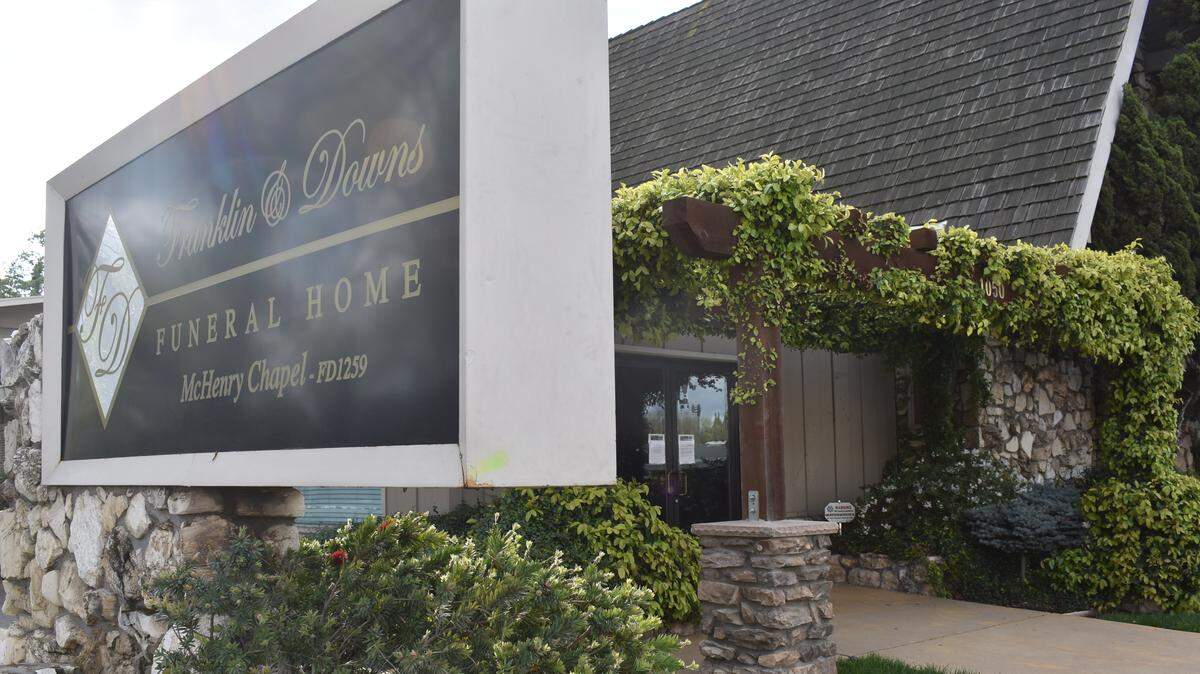
Franklin & Downs Funeral Homes, which operates in Modesto and Ceres, allows no more than 10 people in its chapels, said Managing Partner Kristi Ah You. “But at any moment, it could potentially be that our front door is locked and we would only be doing arrangements remotely.”
That’s already the case at Salas Brothers Funeral Chapel in Modesto. Owner Jon Salas said he’s communicating with families only by phone, email or fax. They stopped doing services about two weeks ago and now are just handling direct cremains or burials and the permitting process required before a body is buried or cremated.
Work at Franklin & Downs, Salas Brothers
Body preparation for burial also has stopped, he said. “Embalming someone — there is not really a function to it when we can’t have people coming in to view.”
Families are saddened but understanding of the restrictions during the pandemic, the funeral home operators said.
Alvares said families have been very respectful of the fact that mortuary employees have their own loved ones they go home to and want to keep safe.
“People are disappointed already because they have lost their loved ones and now they are being told they can’t do certain things” like Masses and other religious rituals, Ah You said. It’s not like they’re being told they can’t run to the store for milk, she said.
“They are dealing with the fact that their child just died, or their husband, (and) they can’t do what they are expected to do for their loved ones.”
Of her colleagues in the funeral industry, she added, “We are a breed of people who want to be kind and compassionate and empathetic.” That’s hard to convey when you have to say, “Sorry, no more than 10 people can enter the building.”
Said Salas, “It is tough to go against the huge religious traditions. I have had to have some tough conversations with people … and to try to do something online is just not a thing that people connect with.” It’s one thing to take part in an online church service — it can be affirming and calming — “but it’s not the same for funeral services,” he said.
Recent obituaries show how some families are rolling with the social distancing required by the coronavirus outbreak. One notes that in a private ceremony, a veteran will be interred with military honors at San Joaquin Valley National Cemetery, but “due to concerns about travel and social gatherings,” a celebration of life for family and friends will be held later.
Another reads: “Burial will be private due to the current state restrictions on gatherings. A memorial will be announced at a later date.”
And a third: “Due to the coronavirus pandemic, a celebration of life is postponed until further notice.”
In this trying time, the mortuaries say they’re doing all they can to keep employees healthy, both physically and emotionally.
“It is mentally hard on our staff and every other funeral home,” Salas said. “It takes an awful lot of just hanging on to every quiet moment we can, because this is so different and challenging.” On restrictions to services, he added, “It is not what we want to be forcing families to do.”
But safety measures far outweigh everything else, he said. “Even dressing people is difficult because you have a high level of contact.”
Every deceased person brought through his doors is treated with the assumption they may have had the virus, Alvares said. The same goes for every living person who comes in, for their safety and that of his staff.
Impact from COVID-19
Whether a body is coming from the county Coroner’s Office or a hospital, “we’re making sure we call them and speak to whoever is releasing the body to get documentation on what the causes are,” he said.
Employees don personal protective equipment — goggles, masks and gloves — before even entering a prep room at Turlock Funeral Home.
An in-house cleaner works six days a week, wiping down all surfaces, Alvares said, and every time a family comes and goes, the meeting table again is sanitized.
Noting that the virus that causes COVID-19 can live on their clothing for days and that the deceased expel air when moved, Ah You said Franklin & Downs also is having hospitals put identifying information on the outside of body bags. Then her staff puts an additional bag on each body, and limits the handling as much as possible.
Her business has a staff of just 10, Ah You said, and that includes her husband and another couple. If one half of a couple were to fall ill, the other almost certainly would, too. “If we wiped out half our staff, we couldn’t be able to carry on.”
At a time when anyone dealing with the ill or deceased needs to be taking the highest precautions, Salas said, he had run out of N95 masks and disinfectant spray and was having a hard time finding bleach. He’s used swimming pool tablets to make disinfectant.
During one of their last services a few weeks ago, someone stole all their toilet paper and cleaning supplies, Salas said.
Given there’s no absolute understanding of how long the virus can survive on a body bag and other surfaces, Salas said, “I don’t think anyone can fault us for taking the most extreme precautions.”
Ah You noted that Franklin & Downs has plenty of bleach, gloves, masks — “everything we need to do our jobs. We always have enough for an emergency.”
Looking ahead in Modesto area
As of Thursday, there were 17 confirmed cases in Stanislaus County of people with COVID-19, and no known coronavirus-related deaths.
Though it’s a grim topic, Alvares said Turlock Funeral Home has the capacity “if there was to be a mass of deaths coming our way.” He has one of the larger prep rooms in the county, he said, able to accommodate up to 35 bodies. And his Turlock Memorial Park about three years ago developed a new area with “a lot of availability.”
Ah You said she is “developing protocols” in the event of an influx. She anticipates Franklin & Downs likely would stop prepping bodies altogether, as Salas said he’s done. “I am considering not doing that at all” and simply receiving bodies and going through the death certificate and permitting process for burial or cremation.
Preparing for her mortuary to at some point handle a COVID-19 case, Ah You said she’s trying to get the death certificate process expedited to more quickly be able to bury or cremate bodies.
“The issue with our local funeral homes is no one has massive storage available,” she said. “I can typically hold about 25 at our facility.”
Stanislaus County Coroner’s Office
Capacity at the Stanislaus County Coroner’s Office is 75, plus an overflow for 25, said Sheriff’s Department spokesman Lt. Joshua Clayton. “Additionally, there are plans in place to add storage for more in times of emergency.”
Citing the state health and safety code, Salas said doctors are required to complete paperwork and have it to a funeral home within 15 hours of a death. But it never happens that quickly, and always takes days, he said. Now more than ever, the process needs to be expedited.
The urgency and uncertainty during this pandemic “takes some of the humanness out of taking care of the dead,” Salas said. But looking at what’s happened elsewhere in the world makes clear the importance of taking any and every safety measure, he said.
“At least we are not having tons of caskets piling up and people are just being cremated as fast as they can. I can’t even imagine how they are keeping track of all that.”
Bee staff writer Deke Farrow contributed to this report.
This story was originally published March 27, 2020 at 5:47 AM.