Modesto-area residents most impacted by contamination get free well testing, bottled water
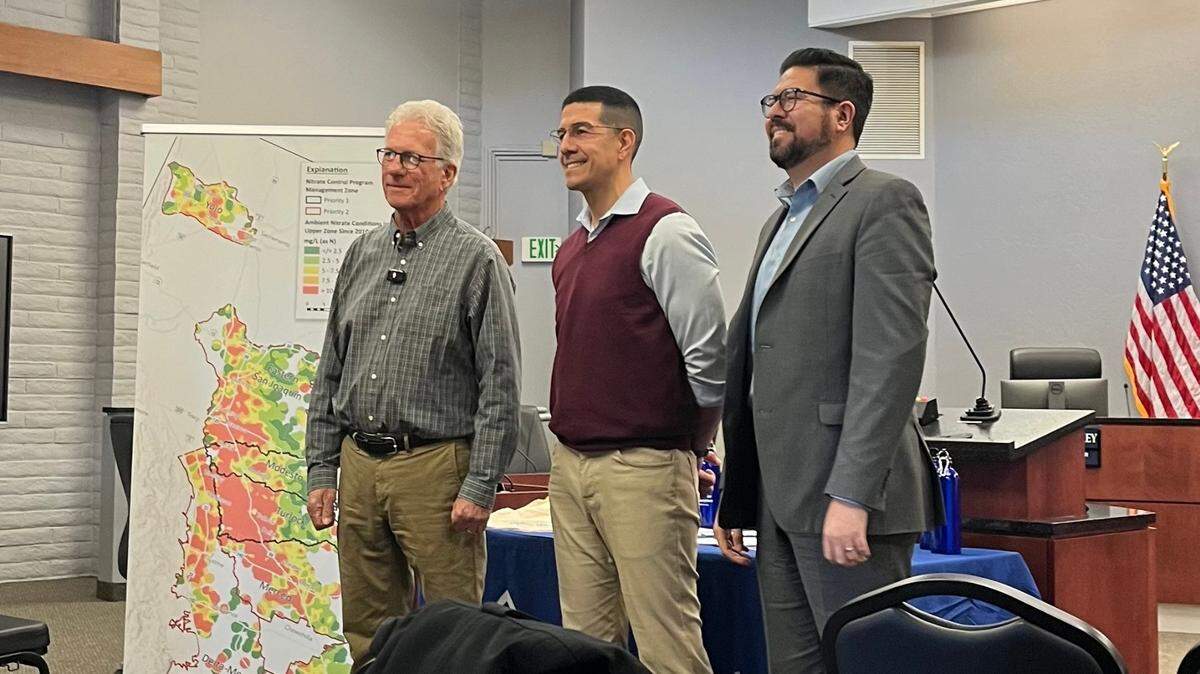
Over the last four years, the Valley Water Collaborative has focused its efforts on testing nitrate levels in private wells in the Turlock and Modesto subbasins. The findings are not good and not surprising: Contamination at unhealthy levels was found in 75% of the wells tested.
The collaborative offers free water replacement to those who need it. Now, the nonprofit organization is expanding to five more subbasins throughout the Central Valley.
People most impacted live in rural, underserved communities not hooked up to a municipal water source.
“It is those households that are relatively isolated, that were built maybe 40, 50, 60 years ago, that have a relatively shallow well that are most vulnerable to this contamination,” said Patrick Pulupa, executive officer of the Central Valley Regional Water Quality Control Board..
Joaquin Esquivel, chair of the State Water Resources Control Board, said free well testing for nitrate started four years ago as a collaborative effort between regulators and agriculture to address contamination in the Central Valley.
As of Feb. 26, the Nitrate Control Program has expanded to the Eastern San Joaquin, Merced, Madera, Delta-Mendota and Yolo subbasins, known as priority-two basins where there are concerns about nitrate contamination, but not as urgent.
Nitrate concerns within the Modesto, Turlock subbasins
Since the beginning of the program, around 75% of the private wells tested in the Modesto-Turlock area, have tested positive for unhealthy levels of nitrate. Nitrate enters groundwater largely through agricultural activities with fertilizers and manure and secondarily through septic systems and sewage.
“When the program was first established, those areas where nitrate contamination was found to be particularly troublesome were known as priority-one subbasins,” Esquivel said of the Modesto and Turlock subbasins. “They had the highest priority.”
Nitrate is known to be especially harmful for pregnant women and small children. It can cause so-called blue baby syndrome, a condition caused by the restriction of oxygen in the bloodstream. Nitrate can cause methemoglobin to replace hemoglobin in the blood.
“It reduces the amount of oxygen that your blood is able to move about, so it’s a real concern,” Esquivel said.
Origin of the Valley Water Collaborative’s initiative
The Nitrate Control Program began as part of a compromise with the agricultural, dairy and treatment plant industries that contributed to the increase in nitrate but did not have a comprehensive way to address the contamination of groundwater. The Central Valley Water Control board gave these industries a 35-year window to address the issue, with the understanding that they would fund water replacement programs to address their impact.
“We’re going to give you a long compliance time frame, but you have to make sure that the most vulnerable populations within these areas affected by your pollution are provided safe drinking water,” said Pulupa.
Expansion of testing through state funding
The Valley Water Collaborative was originally established to test solely for nitrate but began testing for other legacy pesticides and contaminants with a grant awarded by the state to the Central Valley Water Control Board through a program known as the Safe and Affordable Funding for Equity and Resilience (SAFER).
“It was a happy coincidence that the Legislature apportioned dollars to the SAFER program right about the same time that [Valley Water Collaborative]’s nitrate efforts were underway, so the management zones saw an opportunity and the state saw an opportunity,” Pulupa said.
So far, about half of the 826 private wells tested in the Modesto and Turlock subbasins exceeded acceptable levels for uranium, a naturally occurring contaminant found in soil that can weaken kidney function over time. Around 15% tested positive for arsenic.
The wells are also tested for industrial waste including TCP 1, 2 and 3, which are used as industrial solvents, and PFAS, also known as “forever chemicals” which are man-made and known to cause cancer, liver damage and fetal development problems.
“If we’re going to go to a household and we’re going to disrupt … their time, we may as well be comprehensive in the approach,” Esquivel said.
Challenges to getting people signed up
People who have their private wells tested and need a replacement water source are given free access to bottled water or a water kiosk immediately. However, there have been issues getting people to accept the free assistance.
“There is often a mistrust of government, there is kind of concern of what is done with the data, and so there are definitely hurdles when it comes to really ensuring that those in our community that need this replacement water most, are being served by it,” Esquivel said.
Also, some private companies will offer free testing with the intent to sell filtration systems, or water softeners, which can cause confusion for people trying to get free access. People can get correct information and resources at the Valley Water Collaborative website or scan QR codes on postcards sent by VWC.
“But I’ll tell you the one thing that works better than all of that is word of mouth,” said Pulupa. “Once your neighbor finds out that they actually did come into my house, sample my well, it tested above the standard and now I get free bottles of water delivered to my doorstep twice a week? It sells like nothing else.”
When a water well is tested, the results are posted on GeoTracker without the addresses or names and are combined with other water monitoring information provided to the state. This helps the program create heat maps of areas most impacted by contaminated well water.
Parry Klassen, executive director of WVC, said this has been a challenge when trying to sign people up. “They think it’s going to affect their land value. It’s really kind of a myth-type thing,” he said.
Some want to avoid bad-tasting city water, which is chlorinated. “They think, ‘I’m in the country, I’ve got my water, it tastes good’ —but nitrate, you can’t taste.” Klassen said. “A lot of these things have no taste or odor.”
Esquivel said he’s really proud and he feels an incredible sense of urgency about the work being done around private well testing in the Central Valley and hopes that they can continue to do better.
“This is really an example of the agricultural community, the regulated community, regulators in government, coming together to figure out how we can ensure we’re protecting public health at scale,” Esquivel said.
Anyone in the areas listed can get their private domestic wells checked for free by going to valleywaterc.org
This story was originally published February 25, 2025 at 5:20 PM.