A ‘hurricane of fire’ leaves Chinese Camp in ash but not defeat
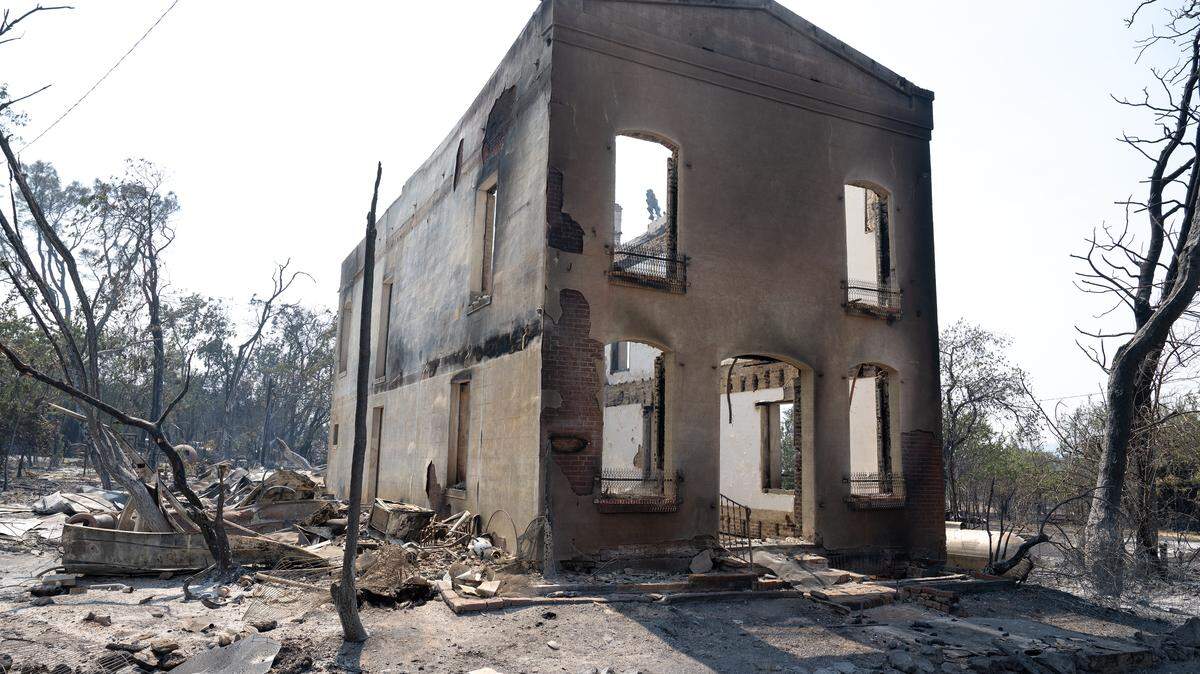
The wind arrived first — hot, sudden and furious. Leonard Martin was sprinting across his yard, a chicken tucked under each arm, when a roar like a freight train swallowed the night.
“It went from calm to a 35-mile-an-hour hurricane of fire,” Martin recalled. “The sky turned orange and we couldn’t breathe. I thought we were dead.”
Martin, a 17-year resident of Chinese Camp, a Gold Rush-era settlement in Tuolumne County, had spent the evening loading three Great Danes, a little dog, six cats, ducks and chickens into a Cadillac and an RV as ash began to “snow” from the sky. Power failed. Both vehicles were idling on the road when a wall of flame reached his driveway.
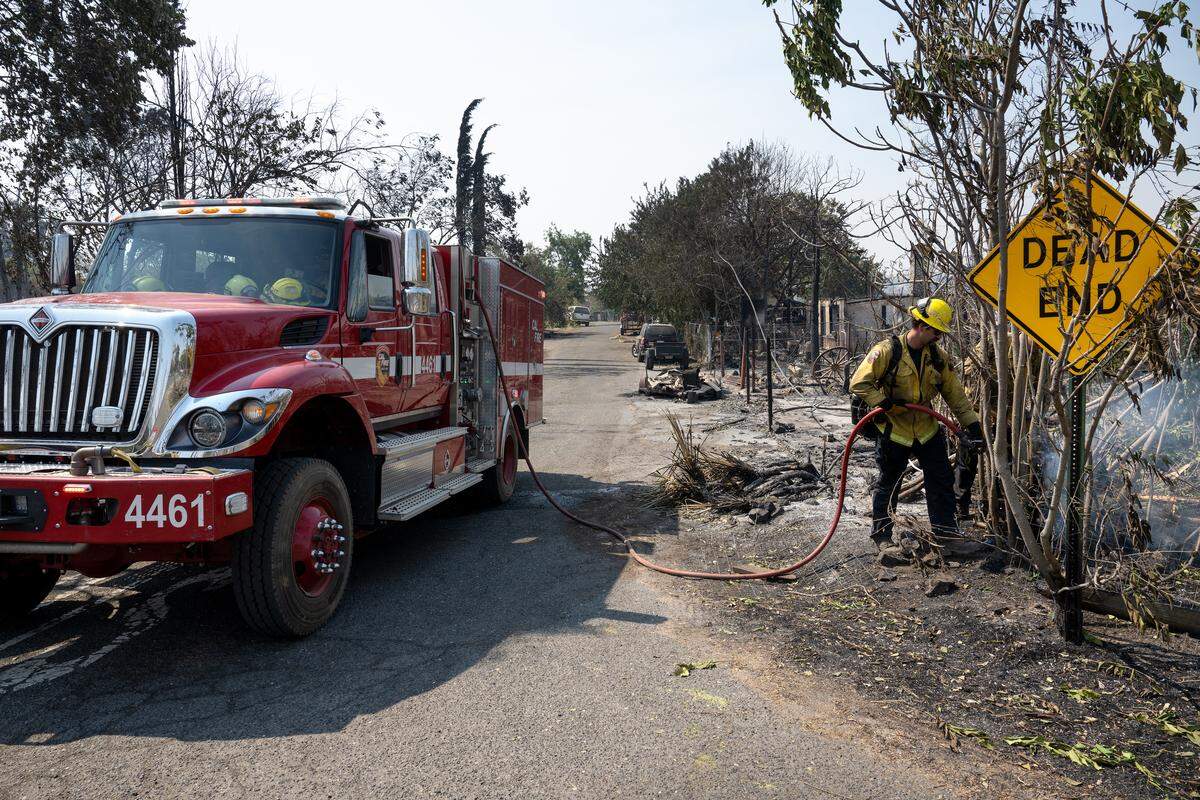
Through the smoke, he glimpsed salvation: two red fire engines, “butt-to-butt,” hoses blasting water into the onrushing inferno as firefighters shouted for him to get inside. “They weren’t even assigned here,” Martin said, still shaken a week later. “They just saw my dumb self in the yard and stopped. Those guys saved our lives.”
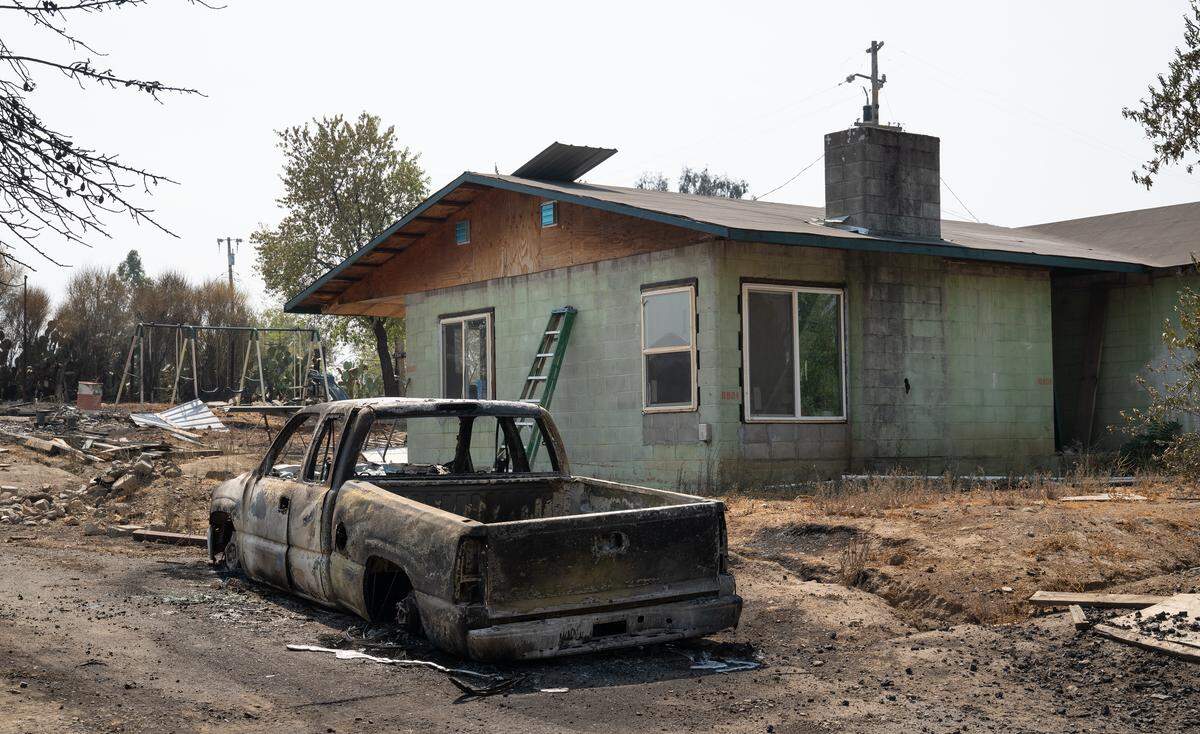
Rather than go inside, Martin and his neighbors fought the fire with garden hoses and five-gallon buckets for hours, saving four homes — including his own — even as most of Chinese Camp burned around them.
A COMPLEX FIRE, A HISTORIC LOSS
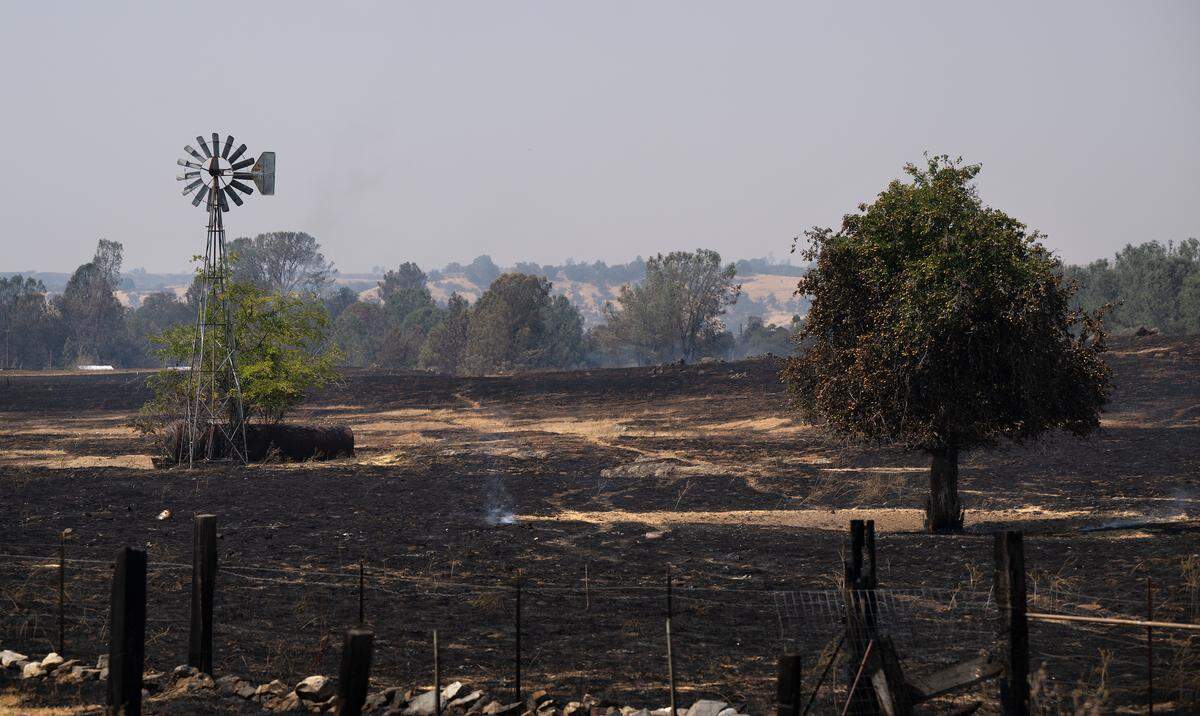
Cal Fire investigators say the 6-5 Fire, sparked by lightning the morning of Sept. 2, became the largest and most destructive of the 21 blazes in the TCU September Lightning Fire Complex, which swept across parts of Calaveras, Tuolumne, San Joaquin and Stanislaus counties.
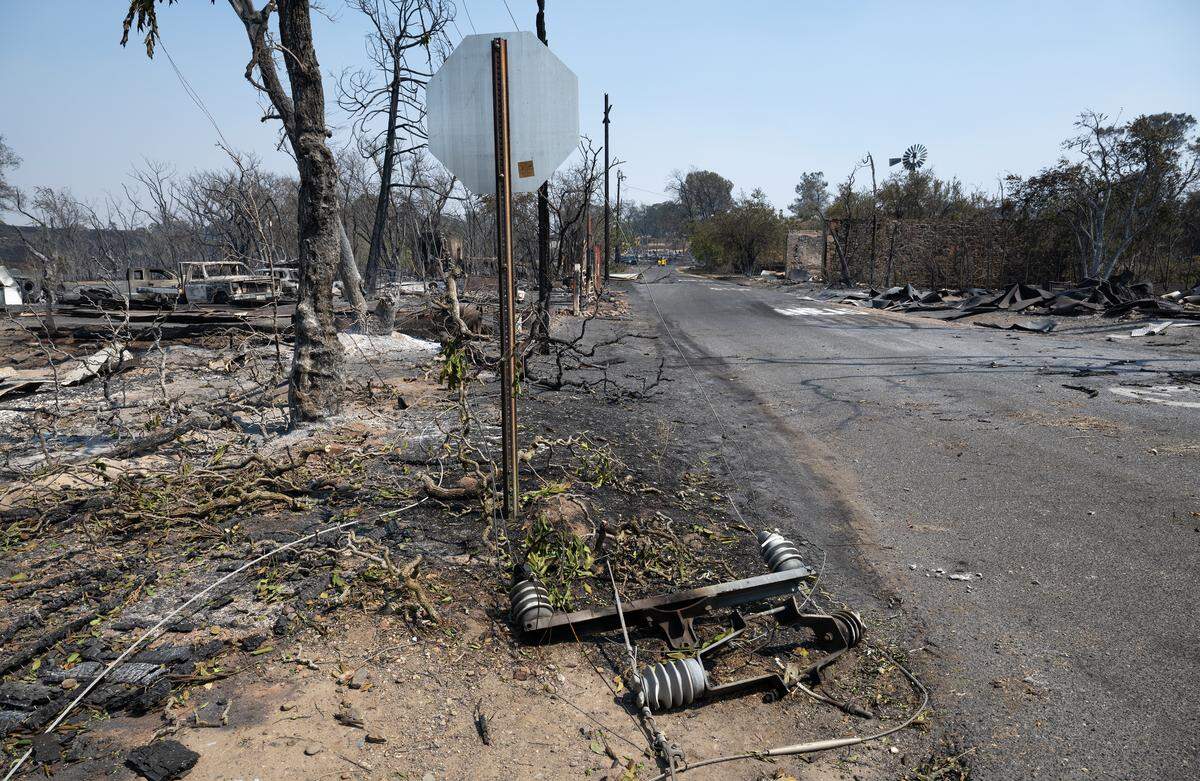
Cal Fire reported Thursday morning, over a week later, that the 6-5 Fire has burned 7,037 acres and was 94% contained. In Chinese Camp alone, officials estimate roughly 90 structures were destroyed, including at least 45 single-family homes, five commercial or mixed-use buildings and about 40 smaller outbuildings, according to the Tuolumne County Sheriff’s Office.
All evacuation warnings and road closures have now been lifted, though Highway 120 through town remains limited to 25 mph while crews replace power lines and clear hazards. Cal Fire said fire-suppression repair continues across the burn area, and the Red Cross is distributing food, water and essential toiletries to displaced residents. The wider TCU September Lightning Fire Complex, of which the 6-5 Fire is the largest blaze, has scorched 13,869 acres and was 97% contained by Thursday.
NEIGHBORS HELPING NEIGHBORS
Just down the hill from Martin, Stacy Carter returned to find generations of family memories reduced to ash.
“My family’s been here since 1929,” he said after the loss of his family’s two houses, cabin and a workshop. “All the model trains, bottles, my huge beer-can collection — gone. You can’t bring that back.”
Carter’s loss is repeated across the townsite, where block after block is little more than blackened chimneys and twisted metal.
At the center of what remains, the Chinese Camp Store & Tavern has become a lifeline. Owner Richard Beale, who bought the rundown property eight years ago with his wife after selling their home and coin collection, said the fire scorched bathrooms and a rental cabin but spared the store itself.
“We’re open late every night because people need a place to gather,” Beale said. “Folks here are independent. They’d rather pitch a tent on their own land than go to a shelter. What they need are campers, tents — anything to stay on their property while they rebuild.”
In the week since the blaze, neighbors have been filling the store’s garden, swapping stories, sharing donated meals and checking on one another. “There’s a shocking amount of kindness,” Beale said. “People want to help.”
A GOLD RUSH TREASURE, NEARLY ERASED
Before the flames, Chinese Camp was a rare survivor of California’s Gold Rush era — a place where the 19th century still whispered through weathered brick and sagging wood.
“Chinese Camp was the crossroads of the Mother Lode,” said Stephen Provost, author of “Chinese Camp: The Haunting History of California’s Forgotten Boomtown.” “Stagecoaches from Stockton to Yosemite stopped here. Black Bart is said to have bought candy at the old post office. Joaquin Murrieta stabled his horses here. Five thousand people once crowded its saloons and hotels.”
Provost visited often while researching his book, drawn to what he called “a town that still felt alive even in decay.” He and his wife arrived one dusky spring evening to find Main Street deserted, “the spookiest place I’d ever seen,” he said. “It was as if the ghosts of the past were waiting to tell their stories.”
Those stories, he fears, may now be lost. “It breaks my heart,” Provost said. “You can read about history, but nothing compares to standing where it happened. Now people can only read about it.”
Rob Gordon of the Tuolumne County Historical Society agreed. He said the town “remained much the same as it was at least one hundred years ago,” making it one of the county’s last truly untouched Gold Rush sites. Gordon believes “almost all of the historical buildings have been destroyed,” though the front façade of the Odd Fellows Hall still stands and the Catholic church outside the town proper survived.
PICKING UP THE PIECES
Today, St. Francis Xavier Catholic Church still casts its shadow over a landscape of ash. Residents sift through debris for keepsakes. Power crews restring lines along Highway 120. Cal Fire crews cut hazard trees and mend control lines.
Tuolumne County District 4 Supervisor Stephen Griefer praised the coordinated emergency response, noting that “without doubt, the evacuations saved lives. We had zero fatalities — and in a firestorm like this, that’s extraordinary.”
He said the county is “looking at every option to streamline or fast-track permits,” while weighing whether to manage rebuilding locally or through the state. “Our goal is to get people back into their homes as quickly and safely as possible,” Griefer said, adding that the Historical Society is already assessing what can be salvaged of the town’s Gold Rush-era structures.
In recounting the fire, Martin emphasized how fortunate he feels that his house survived when so many others did not. “We actually saved houses with garden hoses,” he said. “But those firefighters — wherever they came from — they saved us.”
Beale keeps his store open as a gathering place and donation hub. Carter weighs whether to rebuild or relocate. The Red Cross continues to distribute food, water and toiletries as residents camp on their properties in borrowed trailers and tents.
Community members across the region have rallied with donations and online fundraisers. Last week, The Bee reported on several GoFundMe campaigns helping families who lost everything, including longtime resident Polina Ken, who fled war in Cambodia decades ago only to see her home destroyed in the 6-5 Fire.
Provost said he hopes the story of Chinese Camp endures. “Go see historic places while you can,” he said. “You never know when a fire — or time — will take them away.”
For residents who lived through the blaze, that warning already has come true.
“I love this town,” Martin said. “We almost lost everything — our homes, our history. But we’re still here. That has to count for something.”
This story was originally published September 12, 2025 at 10:52 AM.