More snow on the way to California. When are tire chains required in mountains?
A major storm is forecast to arrive in California over the weekend, bringing widespread rain, gusty winds and significant snowfall to the mountains, according to the National Weather Service.
The system is expected to add even more snow to the Sierra Nevada while delivering additional rainfall to parts of the Golden State, including Sacramento, Modesto, Merced, Fresno and San Luis Obispo, the weather agency said Thursday, Feb. 12, on X.
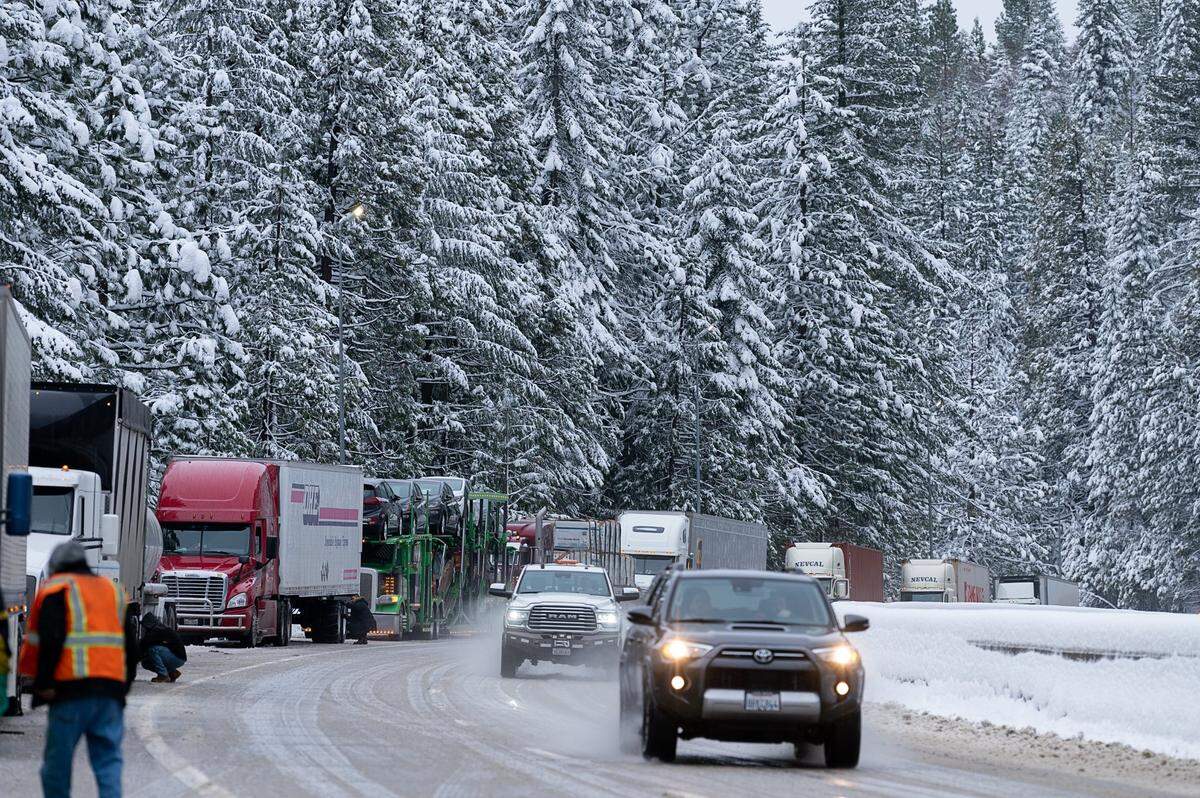
Forecasters with the National Weather Service warned the snow impact could be “major,” leading to chain controls and hazardous travel conditions across California, including the Lake Tahoe region.
Snow levels are expected to begin around 5,500 feet starting Sunday, Feb. 15, and continue through Tuesday, Feb. 17.
By Tuesday, snow levels could drop as low as 3,000 feet, increasing the risk of travel disruptions in mountain areas, the National Weather Service said in an area forecast discussion on Thursday, Feb. 12.
When are snow chains required while traveling in California?
Here’s what you need to know about the state’s tire chain requirements during winter weather:
When do I need chains on my tires for snow in California?
During the winter, drivers can be required to have tire chains in some mountain areas, according to the California Department of Transportation.
You are required to have chains when there are signs posted along the road, the state roads agency said on its website.
The signs will also indicate the type of chain requirement.
There are three levels of chain requirements in California, according to Caltrans:
- Requirement 1: You must carry chains with you, but you do not have to have chains installed if your vehicle is equipped with snow tires. If you’re towing a trailer, you are required to have chains on one axle.
- Requirement 2: You must carry chains with you. If you have snow tires and four-wheel drive, you do not have to have them installed.
- Requirement 3: Every vehicle must have chains installed.
“R-1 and R-2 are the most common conditions,” Caltrans said. “A highway will often be closed before an R-3 condition is imposed.”
Where are snow chains required in California?
Caltrans previously told The Sacramento Bee that all highways in the Sierra Nevada region that experience winter snow can have chain restrictions during storms.
“The areas that are most common are highway passes at the highest elevation,” the state department said.
These areas include Donner Summit along Interstate 80 and Echo Summit along Highway 50. They are the busiest areas in the Lake Tahoe region that experience snowfall.
If you plan to head into the Sierra Nevada during the winter, Caltrans officials said, you should check the forecast and be prepared. That includes packing chains and other approved traction control devices, as well as necessary supplies in the event of an emergency.
Off-highway roads that are not maintained by Caltrans fall under the jurisdiction of local cities and counties. Check with local officials for road closures due to snow.
“Motorists should never seek an alternate route to avoid chain restrictions,” the state department said. “If exiting the highway during chain restrictions, leave your chains on and remove them only when conditions improve.”
If chains are required on the highway, they will likely be needed on local streets as well.
How do I install snow chains on my tires?
If signs indicate that tire chains are required, Caltrans said, you must stop and put on chains as soon as it is safe to do so.
You will typically have about a mile between the signs and the checkpoint to install them, the department said on its website.
Caltrans does not sell or recommend specific tire chains.
“It is best to check your vehicle manufacturer’s specifications for use of tire chains/traction devices,” Caltrans said.
To install tire chains, wait until you can pull off to the right side of the road and not block traffic.
Check out Caltrans’ chain installation chart to see the proper placement of chains on your vehicle.
“When removing chains, drive beyond the signs reading ‘End of Chain Control’ to a pull-off area where you can safely remove them,” the state department said.
Can I be fined for not having snow chains?
You can be cited by the California Highway Patrol and fined if you do not have tire chains installed on your vehicle when they are required, the Caltrans website states.
If you fail to put on chains, the National Park Service said, you can face a fine of up to $5,000.
In areas where snow chains are required, the speed limit is 25 or 30 miles an hour, according to the Caltrans website.
If you do not abide by that speed limit, you can also be cited for speeding regardless of the posted speed limit.
Drivers should adjust their speed depending on surrounding driving factors, according to the California Driver Handbook.
This story was originally published February 13, 2026 at 5:00 AM with the headline "More snow on the way to California. When are tire chains required in mountains?."