Judge to rule on the legality of Trump sending troops to Los Angeles amid protests
AI-generated summary reviewed by our newsroom.
- Judge Charles Breyer will soon rule on legality of Trump's troop deployment.
- Newsom argues Trump violated law by bypassing state in federalizing Guard.
- Trump lawyers claim deployment legal under conditions of unrest and rebellion.
Lawyers for Gov. Gavin Newsom argued in federal court Thursday that the Trump administration’s deployment of the National Guard and Marines to Los Angeles during protests over immigration raids was unlawful — a claim strongly disputed by White House attorneys.
The hearing before Senior District Court Judge Charles R. Breyer was part of a lawsuit filed by Newsom in San Francisco federal court on Monday against Trump’s move to deploy the guard and marines to the nation’s second-largest city without the governor’s approval.
Breyer said he would issue an order as soon as Thursday afternoon on Newsom’s request that he prohibit the Trump administration from using the military to make arrests or actively quell protests. But he also indicated he might rule on the larger issues at play as well in a situation that has riveted the nation.
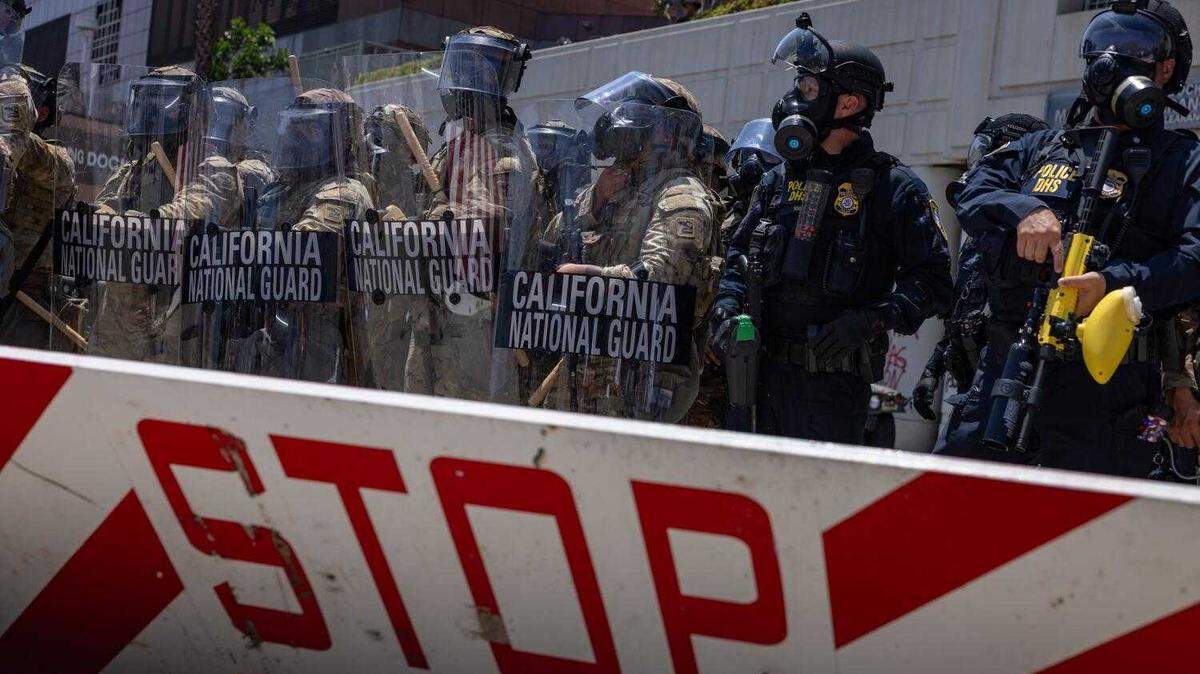
The hearing took place against a backdrop of ongoing tensions in Los Angeles, where Trump has deployed 4,000 National Guard troops and 700 U.S. Marines, a move that legal experts said was highly unusual and based on laws that could be interpreted in different ways.
Protests began on Friday, after Immigration and Customs Enforcement agents swarmed a local Home Depot store arresting day laborers, and raided businesses in the city’s largely immigrant garment district.
The city has been under a nightly curfew since Tuesday night, when Mayor Karen Bass said it was necessary to stop vandalism and looting.
On Thursday, Alex Padilla, one of California’s two U.S. Senators, was forcibly removed from a press conference given by Homeland Security Secretary Kristi Noem, forced to kneel and then lie on the ground before being handcuffed.
Newsom has blamed Trump for fanning the protests and violence, saying both the immigration raids and the activation of troops were deliberately provocative in a city where a third of the residents are immigrants.
On Tuesday, he filed the request for a temporary restraining order, asking the judge to immediately limit the military’s activities to support roles, protecting federal property and personnel. Newsom said in a court filing on Thursday that troops had moved beyond those allowable duties to actively assist ICE agents in making arrests, in violation of a federal law known as the Posse Comitatus Act, which is designed to prevent the military from being used as a domestic police force.
At the hearing on Thursday Breyer questioned the Trump Administration’s lawyers sharply on whether the president had followed the law when taking over control of the guard over Newsom’s objections. In particular, he asked Assistant Attorney General Brett Shumate about a clause in the law that says that orders to federalize the national guard “shall” come through the governors of the states.
He also pressed the administration on its claim that even if Trump had not adhered to conditions laid out in the law for federalizing the National Guard, the courts don’t have the jurisdiction to overturn his decision because the president has the discretion to interpret those conditions in his own way.
He appeared to show some sympathy to Newsom’s point of view when he asked California Deputy Attorney General Nicholas Green to address the question of Trump’s discretion.
“That’s the difference between a constitutional government and King George,” Breyer said, referring to the British Monarch against whom the American Revolution was fought. “It’s not that a leader can simply say something and it becomes” the truth.
But he questioned Green about Newsom’s argument that the court had jurisdiction over what he called speculative concerns about how Trump might use the Marines, which are already under federal control.
Much of the discussion at the hearing revolved around the law invoked by Trump when he activated the military in Los Angeles, which limits his power to do so unless there is an invasion, a rebellion, or the president is unable to enforce the laws of the United States.
In documents submitted to the court this week, the president’s lawyers argued that such conditions did exist in Los Angeles, making the deployments legal. Moreover, they argued that the federal government was following the law by limiting such military intervention to protection of federal property and personnel.
But in his claim Newsom alleges that Trump broke laws against the domestic deployment of military troops without consent from the state’s governor. Newsom said he did not approve of the deployment and did not request it. He pointed to a clause in the law that says that orders to deploy the National Guard by the federal government must be made through the governors of the states.
Trump’s lawyers argued for a different interpretation of the statute, saying it required the order to go through the governor or a representative, but not be made by the governor, court documents show. In this case, they argued, the order went through a top commander at the California National Guard, who responded to the president’s directive.
This story was originally published June 12, 2025 at 4:39 PM with the headline "Judge to rule on the legality of Trump sending troops to Los Angeles amid protests."